In this article (16)
- What applies for CS Executive Tax Laws Dec 2026
- How the 100 marks really work
- The common mistake
- A 36-day plan for Tax Laws and Practice
- How to practise computations so they stick
- Writing GST and customs answers that score
- Amendments and notifications
- Mock tests in the last two weeks
- Exam day plan for 27 December
- Frequently asked questions
- Which Finance Act is applicable for CS Executive Dec 2026 Tax Laws?
- Is the Income-tax Act 2025 applicable for CS Executive Dec 2026?
- When is the CS Executive Tax Laws paper in December 2026?
- How are marks split between income tax and GST in CS Executive Tax Laws?
- Can I clear CS Executive Tax Laws in one month?
- Is customs law part of CS Executive Tax Laws?
CS Executive Tax Laws Dec 2026 is on Sunday, 27 December 2026, and the law you should study is fixed. ICSI has confirmed that the Finance Act, 2025 applies, that is Assessment Year 2026-27, and that the new Income-tax Act, 2025 is not applicable for this session. So if you have been watching videos about the new Act and feeling lost, stop. Your paper is on the old Act as amended up to the Finance Act, 2025.
Latest update (18 Nov 2026): the CS Executive December 2026 exams run from 21 to 28 December 2026 (2:00 PM to 5:15 PM, no paper on 25 December). The next attempt after that is June 2027; ICSI announces its dates closer to the time.
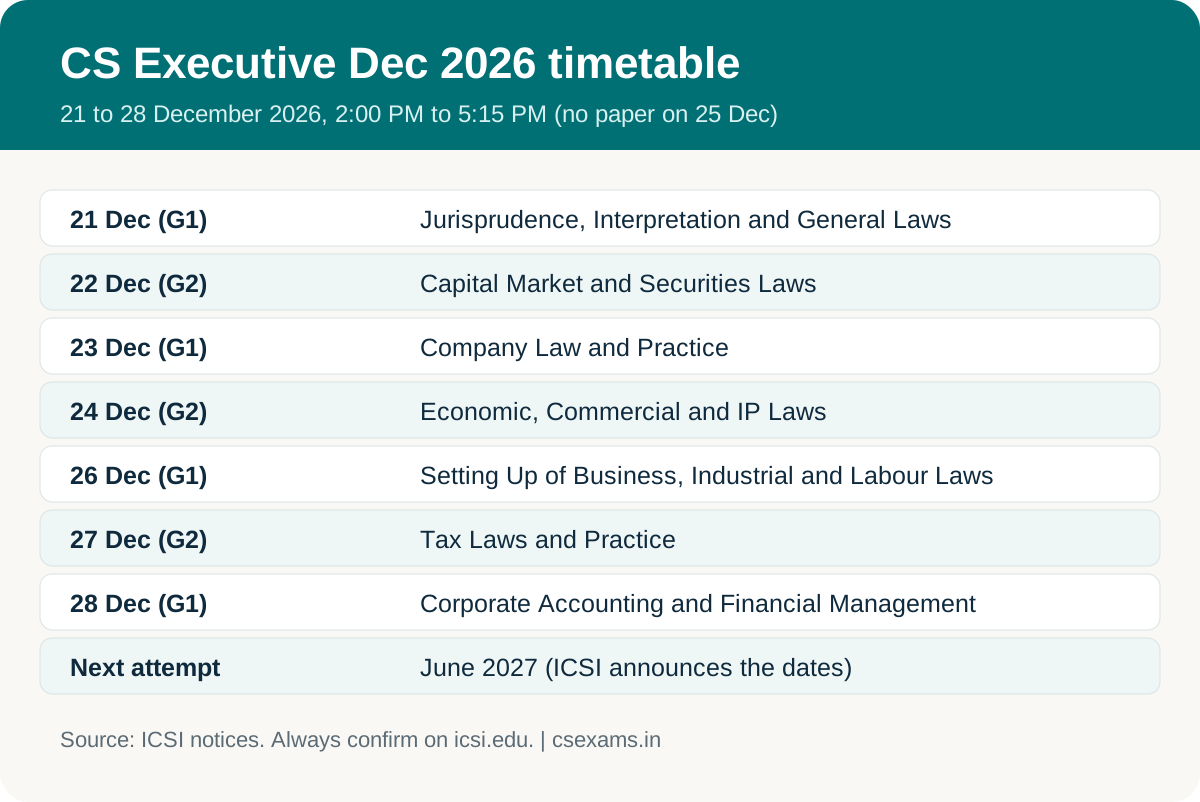
| What | Date |
|---|---|
| CS Executive Dec 2026 exams | 21 to 28 December 2026 |
| Admit card | Expected in the second week of December 2026 on icsi.edu, based on past years (the Dec 2025 cards came on 12 December 2025) |
| Dec 2026 result | Expected around 25 February 2027, based on past years (the Dec 2025 result came on 25 February 2026) |
| Next attempt | June 2027 |
Write full papers under time before the exam: our CS Executive test series has papers on the ICSI pattern, checked by Company Secretaries. See plans and prices.
Always confirm dates on the official ICSI website, icsi.edu.
From 21 November you have about 36 days for this paper. That is enough to revise it properly if you spend the time on computations and GST provisions instead of rereading theory. Below is how the paper is built, what applies, and a plan we give our own students.
What applies for CS Executive Tax Laws Dec 2026
ICSI publishes a short notice on applicability of the Finance Act before every session. For December 2026 it covers three papers, and Tax Laws and Practice is the big one for Executive students. Everything in the table comes straight from that notice and the official time table.
| Point | What ICSI has said for Dec 2026 |
|---|---|
| Paper | Tax Laws and Practice, Group 2, Paper 7 (Syllabus 2022) |
| Exam date and time | Sunday, 27 December 2026, 2:00 PM to 5:15 PM (first 15 minutes for reading) |
| Finance Act applicable | Finance Act, 2025 (AY 2026-27, PY 2025-26) |
| Income-tax Act, 2025 | Not applicable for the December 2026 session |
| Notifications and circulars | Those issued by CBDT, CBIC and the Central Government on or before 31 May 2026 |
| Marks split | Part I Direct Tax 60 marks, Part II Indirect Tax (GST and Customs) 40 marks |
You can read the notice yourself on the ICSI examination page. Keep a printout of the applicability notice in your tax file. Students lose easy marks every attempt because they use rates or limits from a later Budget video.
How the 100 marks really work
The 60:40 split tells you where your hours go. Direct tax is the larger part, and inside it the heads of income, set off and carry forward, deductions and computation of total income for an individual carry the weight. Practical questions here are long, but they follow patterns you can practise.
The 40 marks of indirect tax are where many students either score well or lose the paper. GST questions are mostly provision based: supply, time and place of supply, input tax credit, registration, returns and payment. Customs is smaller but still asked, so do not drop it. A student who writes clear section-based answers in GST can often pick up more marks per hour than in a long income tax computation.
The common mistake
Most students spend four of their five weeks on income tax and leave GST and customs for the last two days. Then the GST answers come out vague, with no section numbers and no conditions. We would rather you reach the exam with income tax at 80 percent and GST at 80 percent than income tax at 95 and GST at 50.
A 36-day plan for Tax Laws and Practice
Your Group 1 and Group 2 papers sit close together in the schedule, so tax cannot get all your time. The plan below assumes about two to three hours a day for Tax Laws until mid December, and more once your earlier papers are close. Adjust the hours, but keep the order.
- Days 1 to 8: Residential status, salaries, house property and capital gains. Do one full computation question from each head every day, without looking at the solution first.
- Days 9 to 14: Business and profession, other sources, clubbing, set off and carry forward, and deductions. End with two complete total income computations.
- Days 15 to 18: TDS, TCS, advance tax, return filing and assessment basics. These are theory heavy, so make a one-page chart of due dates and sections.
- Days 19 to 26: GST in full. Supply and levy, composition, time and value of supply, place of supply, input tax credit, registration, invoices, returns, payment and refunds.
- Days 27 to 29: Customs. Types of duty, valuation, import and export procedure basics.
- Days 30 to 34: Two full timed papers, one direct tax revision round and one GST round, with checking.
- Days 35 and 36: Only your own notes, rates and limits chart, and the questions you got wrong.
If you are writing both groups, slot the GST days so that they do not clash with your Group 1 papers in the week of 21 to 26 December. Our last month revision plan for CS Executive shows how to fit all papers together.
How to practise computations so they stick
Reading a solved computation feels like learning. It is not. Pick a question, close the book and solve it on paper with a timer. Then match line by line and mark every error in red. The second time you see the same type, you will remember the red mark, not the page.
Present your computation in the format the examiner expects. Start with the heading, show each head of income separately, write the section number next to each exemption or deduction, and give a short working note below. Even if your final figure is wrong, a well laid out answer earns step marks.
One tip from evaluated answer sheets: students who write the assessment year at the top of every income tax answer rarely mix up limits. It takes five seconds and keeps your mind on AY 2026-27.
Writing GST and customs answers that score
GST answers need three things: the provision, the condition and the conclusion. Say a question asks whether input tax credit is available on a certain item. Write the section, list the conditions or the blocked credit rule, apply it to the facts, and end with a one-line answer. That structure alone lifts most GST answers by a few marks.
For place of supply and time of supply, practise small case questions. They are short, they come often, and they are easy to score when you know the rule cold. Customs questions are usually direct, so a clean list of definitions and duty types is enough for the short revision window.
Amendments and notifications
Only notifications and circulars issued on or before 31 May 2026 are in scope. If your study material or class notes are older, check the ICSI supplement for the Tax Laws paper before you finalise your charts. Do not add anything that came after 31 May 2026 just because it was in the news.
Mock tests in the last two weeks
Two or three full papers under exam conditions will tell you more than ten chapter quizzes. Write them from 2:00 PM to 5:15 PM, the same window as the real exam, so your energy matches the slot. Our CS Executive test series has full Tax Laws papers checked by Company Secretaries, with comments on presentation and section quoting.
After each test, spend more time on checking than on writing. List the question types you skipped, the ones where you ran out of time, and the ones where your figure was wrong. That list is your revision for the next three days. If you want a deeper method, read how to analyse your CS mock test performance.
Exam day plan for 27 December
Use the 15 minutes of reading time to choose your questions and mark the long computations. Many students start with the longest income tax question and run short on time for GST. A safer order is a medium computation first, then the GST questions you are sure about, then the remaining income tax practicals.
Keep about 15 minutes at the end to recheck totals and section numbers. Do not leave any question blank. A partly correct working note with the right sections can still earn marks. And on the morning of the paper, revise only your rates and limits chart. Opening a new chapter that day helps nobody.
Tax Laws looks heavy, but it is one of the more predictable papers in the Executive level. If you follow the order above, practise on paper and stick to the Finance Act, 2025, you will walk into the hall knowing what is coming.
Frequently asked questions
Which Finance Act is applicable for CS Executive Dec 2026 Tax Laws?
ICSI has said the Finance Act, 2025 applies, which means Assessment Year 2026-27 and Previous Year 2025-26. Notifications and circulars issued on or before 31 May 2026 are also covered.
Is the Income-tax Act 2025 applicable for CS Executive Dec 2026?
No. ICSI's notice says the Income Tax Act, 2025 will not be applicable for the December 2026 session, so prepare from the 1961 Act provisions as amended by the Finance Act, 2025.
When is the CS Executive Tax Laws paper in December 2026?
Tax Laws and Practice (Group 2) is scheduled for Sunday, 27 December 2026, from 2:00 PM to 5:15 PM, including 15 minutes of reading time.
How are marks split between income tax and GST in CS Executive Tax Laws?
As per the Syllabus 2022, Part I Direct Tax carries 60 marks and Part II Indirect Tax (GST and Customs) carries 40 marks, out of 100.
Can I clear CS Executive Tax Laws in one month?
Yes, if you have read the syllabus once. Use the month for computation practice, GST provisions and at least two timed full papers instead of starting new chapters.
Is customs law part of CS Executive Tax Laws?
Yes. Part II covers indirect tax, which means GST and Customs, so keep basic customs valuation and duty provisions in your revision.
Practise what you just read