In this article (16)
- How the restructured CSEET is built
- CSEET Fundamentals of Accounting syllabus
- What the ICSI sample paper tells you
- What this means for your preparation
- A 10-week plan for 2 February 2027
- If you are from a non-commerce stream
- Theory you should have ready
- Presentation: how to get step marks
- Mock tests and exam day
- Frequently asked questions
- Is CSEET Fundamentals of Accounting a subjective paper?
- What is the syllabus of CSEET Fundamentals of Accounting?
- What is the pattern of the CSEET accounting sample paper?
- When is the CSEET Fundamentals of Accounting paper in February 2027?
- What are the passing marks for the restructured CSEET?
- Can a non-commerce student clear CSEET accounting?
CSEET Fundamentals of Accounting is no longer a set of multiple choice questions. Since the restructured CSEET began in the June 2026 session, it is a 100-mark subjective paper of three hours, and you have to show full workings. For the February 2027 session, the paper falls on 2 February 2027, the second day of the exam.
Latest update (18 Nov 2026): the next CSEET is on 1 to 4 February 2027 on the new ICSI pattern (three written papers and one OMR paper). Registration for the June 2027 CSEET is open till 28 February 2027.
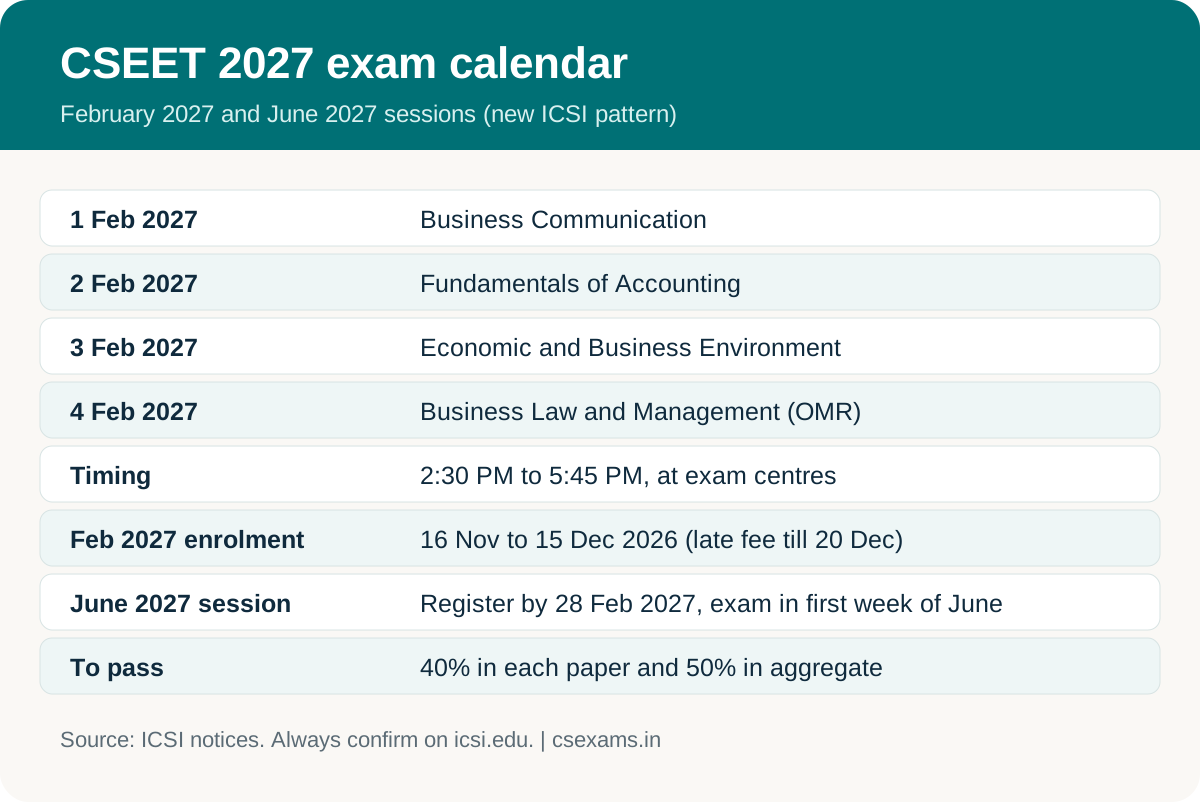
| CSEET 2027 | Details |
|---|---|
| CSEET Feb 2027 exam | 1, 2, 3 and 4 February 2027, 2:30 PM to 5:45 PM, at exam centres |
| Papers | Business Communication, Fundamentals of Accounting, Economic and Business Environment, Business Law and Management (OMR) |
| Feb 2027 enrolment | 16 Nov to 15 Dec 2026 (late fee 16 to 20 Dec 2026) |
| Admit card | Expected in the third week of January 2027 on icsi.edu |
| CSEET June 2027 | Registration till 28 Feb 2027, enrolment 16 Mar to 15 Apr 2027, exam in the first week of June 2027 |
| To pass | 40% in each paper and 50% in aggregate |
Practise on the new pattern with our CSEET test series for February 2027, with written answers checked by Company Secretaries.
Always confirm dates on the official ICSI website, icsi.edu.
That gives you roughly ten weeks. For a paper at a basic level, that is plenty if you practise on paper every day. Here is what is in the syllabus, how ICSI's own sample paper is built, and a plan that works for commerce and non-commerce students alike.
How the restructured CSEET is built
The new CSEET has four papers. Three are subjective and one is OMR based. Fundamentals of Accounting is Paper 2.
| Day | Paper | Marks | Type | Duration |
|---|---|---|---|---|
| 1 | Business Communication | 100 | Subjective | 3 hours |
| 2 | Fundamentals of Accounting | 100 | Subjective | 3 hours |
| 3 | Economic and Business Environment | 100 | Subjective | 3 hours |
| 4 | Business Laws and Management | 100 (60 laws, 40 management) | OMR based | 2 hours |
Each paper has 15 minutes of reading time. To pass, you need at least 40 percent in each paper and 50 percent in aggregate of all papers, in one sitting. The OMR paper has no negative marking. You can read the official announcement and syllabus on the ICSI CSEET page.
The 50 percent aggregate rule matters for accounting. A strong accounting score can carry a weaker Business Communication or Economics paper, because accounting answers are either right or wrong and there is less subjectivity in checking.
CSEET Fundamentals of Accounting syllabus
The restructured syllabus lists 8 units, at a basic level of knowledge. The stated objective is to build an understanding of basic accounting concepts and principles.
- Basic concepts and principles of accounting
- Accounting process (journal, ledger, trial balance)
- Bank reconciliation statement
- Depreciation and amortization
- Preparation of final accounts for sole proprietorship
- Partnership and LLP accounts
- Introduction to company accounts
- Accounting for non-profit organisations
ICSI has not given unit-wise weightage. The sample paper, though, tells you a lot about where marks come from. For the other papers and the full picture, see our CSEET syllabus guide.
What the ICSI sample paper tells you
ICSI has released sample question papers for the restructured CSEET. In the Fundamentals of Accounting sample (Set 2), Question 1 is compulsory and carries 20 marks. You then attempt any 5 questions out of Questions 2 to 8, each worth 16 marks. That makes 100 marks in six answers.
The compulsory question is final accounts: a Trading and Profit and Loss Account and a Balance Sheet from a trial balance, with nine adjustments such as outstanding and prepaid expenses, provisions, depreciation and closing stock. The optional questions cover a bank reconciliation statement, types of share capital, journal and ledger theory, admission of a partner with different goodwill treatments, adjustment entries, converting a receipts and payments account into an income and expenditure account, depreciation under the written down value method, and issue of shares with under and over subscription.
What this means for your preparation
Final accounts with adjustments is the one topic you cannot skip, since it is the compulsory question. After that, partnership, non-profit accounts, depreciation and BRS give you safe 16-mark choices. Theory parts are short, worth about 4 marks each, so keep crisp definitions and differences ready, such as journal vs ledger or partnership vs joint venture.
A 10-week plan for 2 February 2027
Practise on paper, with a pencil and ruler, every day. Accounting is learnt by doing entries, not by reading them.
- Weeks 1 and 2: Concepts, principles and the accounting process. Fifteen journal entries a day, posted to ledgers, with a trial balance at the end of each week.
- Week 3: Bank reconciliation statement and depreciation (straight line and written down value methods).
- Weeks 4 and 5: Final accounts of sole proprietors with adjustments. Do at least eight full questions.
- Week 6: Partnership: fixed and fluctuating capital, admission, goodwill, and the basics of LLP accounts.
- Week 7: Non-profit organisations: receipts and payments, income and expenditure, balance sheet.
- Week 8: Introduction to company accounts: types of shares, issue of shares, under and over subscription.
- Weeks 9 and 10: Three full timed papers, plus theory revision and your error list.
The other three CSEET papers need time too, so keep accounting to about two hours a day. Our CSEET February 2027 preparation plan shows how to fit all four papers together.
If you are from a non-commerce stream
Many CSEET candidates come from science or humanities, and accounting is the paper they worry about most. The level is basic, and the syllabus starts from the very first principles, so you are not behind. You just need a slower first three weeks.
Start with the accounting equation and the rules of debit and credit for each type of account. Write them on a card and keep it on your desk. Then do journal entries in small sets, ten at a time, and check each set before you move on. Do not jump to final accounts until you can post entries to ledgers and draw up a trial balance that tallies without help.
Once the process is clear, final accounts become mechanical. You are simply sorting balances into the Trading Account, the Profit and Loss Account and the Balance Sheet, and then applying adjustments. Most non-commerce students who practise daily catch up with commerce students by week five.
Theory you should have ready
Short theory parts carry about 4 marks each in the sample paper. Keep crisp notes on accounting concepts and conventions, the qualitative characteristics of financial statements, capital and revenue items, the need for a bank reconciliation statement, causes of depreciation, and the features of a partnership firm, an LLP and a company. Write them as four or five clear points with a one-line example. Long theory paragraphs rarely earn more marks than sharp points.
Presentation: how to get step marks
In a subjective accounting paper, presentation earns marks. Draw proper formats with ruled columns. Give working notes below each answer, numbered and referenced in the main statement. Write narrations under journal entries. Show adjustments clearly, for example the outstanding wages added in the P&L and shown as a liability in the balance sheet.
The most common mistake we see from CSEET students is doing an adjustment only once. Every adjustment in final accounts has two effects. If you show it in the P&L, it must also appear in the balance sheet.
Even if your final figure is wrong, correct formats and working notes pick up step marks. A blank answer gets zero.
Mock tests and exam day
Write full papers under a three-hour timer at least three times before February. You will find that the compulsory final accounts question takes longer than expected, so learn to finish it in about 40 minutes. Our CSEET test series has full subjective accounting papers checked by Company Secretaries, with feedback on formats and step marks.
On 2 February, use the 15 minutes of reading time to choose your five optional questions. Pick the ones with clear numbers and familiar formats first. Do the compulsory question early while you are fresh, and keep ten minutes at the end to check that your balance sheet tallies and your totals are carried correctly.
Accounting is the most predictable of the four CSEET papers. With ten weeks of daily practice, it can be your highest-scoring paper and the one that lifts your aggregate above 50 percent.
Frequently asked questions
Is CSEET Fundamentals of Accounting a subjective paper?
Yes. Under the restructured CSEET from the June 2026 session, Fundamentals of Accounting is a 100-mark subjective paper of 3 hours, held on the second day.
What is the syllabus of CSEET Fundamentals of Accounting?
It has 8 units: basic concepts and principles, accounting process, bank reconciliation statement, depreciation and amortization, final accounts of sole proprietors, partnership and LLP accounts, introduction to company accounts, and accounting for non-profit organisations.
What is the pattern of the CSEET accounting sample paper?
The ICSI sample paper has Question 1 compulsory for 20 marks on final accounts, and you attempt any 5 of Questions 2 to 8, each worth 16 marks.
When is the CSEET Fundamentals of Accounting paper in February 2027?
As per the CSEET February 2027 schedule, Fundamentals of Accounting is on 2 February 2027, the second day of the exam.
What are the passing marks for the restructured CSEET?
You need at least 40 percent in each paper and 50 percent in aggregate of all four papers in one sitting. There is no exemption or carry forward of marks.
Can a non-commerce student clear CSEET accounting?
Yes. The level of knowledge is basic. Start with the accounting process and practise journal entries daily, then move to final accounts and partnership.
Practise what you just read