In this article (16)
- CS Professional Drafting, Pleadings and Appearances at a glance
- Part I: drafting and conveyancing (70 marks)
- The skeleton that works for every deed
- Part II: pleadings and appearances (30 marks)
- A 30-day plan for the Drafting paper
- How examiners mark a draft
- Common mistakes in the Drafting paper
- Opinion writing
- Mock papers and exam day
- Frequently asked questions
- When is the CS Professional Drafting paper in December 2026?
- How are marks divided in CS Professional Drafting, Pleadings and Appearances?
- Which drafts are most worth practising for CS Professional Drafting?
- Do I need to remember the exact wording of drafts?
- Is CS Professional Drafting an open book paper?
- How many drafts should I write before the exam?
CS Professional Drafting, Pleadings and Appearances is on Wednesday, 23 December 2026, and it is a paper you clear with your pen, not with your highlighter. Seventy of its 100 marks come from drafting and conveyancing. If you have read the module but not written drafts by hand, the next month is for writing.
Latest update (18 Nov 2026): the CS Professional December 2026 exams run from 21 to 28 December 2026 (2:00 PM to 5:15 PM, no paper on 25 December). The next attempt after that is June 2027; ICSI announces its dates closer to the time.
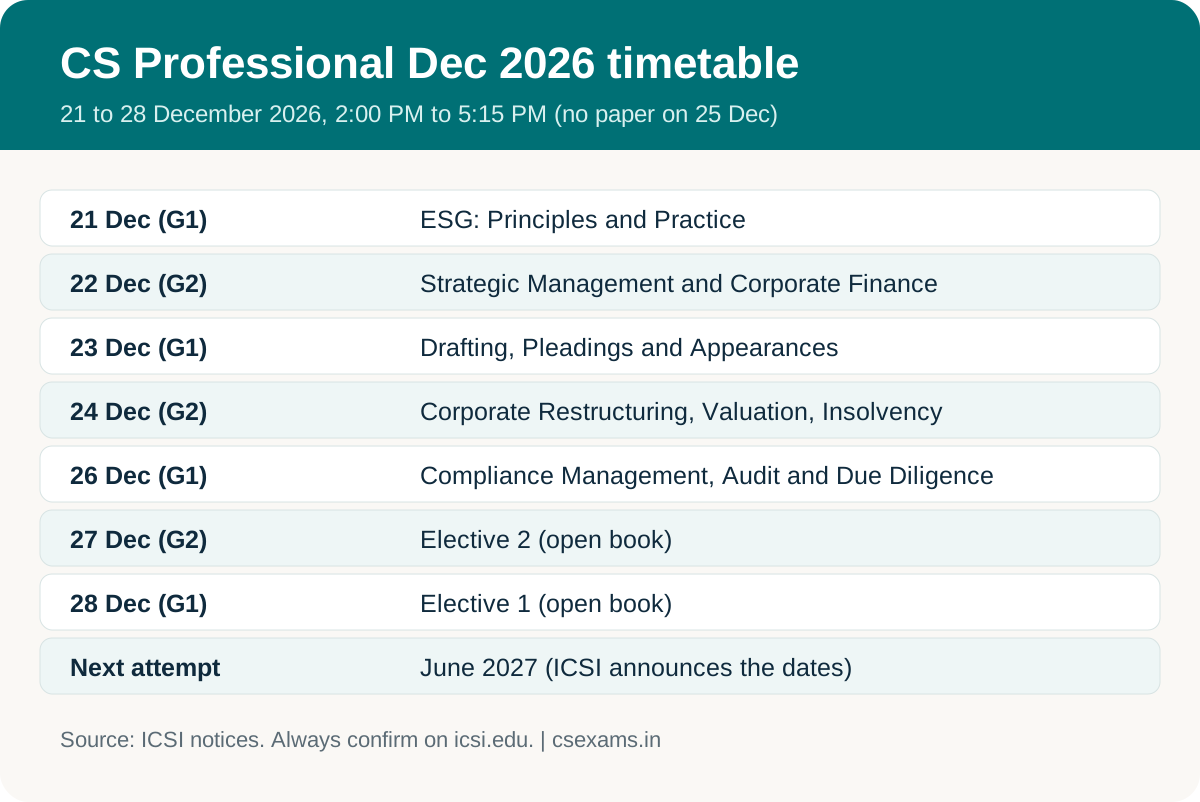
| What | Date |
|---|---|
| CS Professional Dec 2026 exams | 21 to 28 December 2026 |
| Admit card | Expected in the second week of December 2026 on icsi.edu, based on past years (the Dec 2025 cards came on 12 December 2025) |
| Dec 2026 result | Expected around 25 February 2027, based on past years (the Dec 2025 result came on 25 February 2026) |
| Next attempt | June 2027 |
Write full papers under time before the exam: our CS Professional test series has papers on the ICSI pattern, checked by Company Secretaries. See plans and prices.
Always confirm dates on the official ICSI website, icsi.edu.
The good news is that this paper is predictable in form. The same families of documents come again and again. Once you know the structure of each, you can draft almost any variation the examiner gives you.
CS Professional Drafting, Pleadings and Appearances at a glance
These details come from the ICSI December 2026 time table and the Syllabus 2022 document.
| Point | Detail |
|---|---|
| Paper | Drafting, Pleadings and Appearances, Group 1, Paper 2 |
| Date and time | Wednesday, 23 December 2026, 2:00 PM to 5:15 PM (15 minutes reading time) |
| Part I | Drafting and Conveyancing, 70 marks |
| Part II | Pleadings and Appearances, 30 marks |
| Open book | No. Only electives are open book in this session |
| Level of knowledge | Expert knowledge (Syllabus 2022) |
You can check the time table and study material on the ICSI examination page. The paper falls two days after ESG and one day after Strategic Management for students writing both groups, so plan your revision around those dates.
Part I: drafting and conveyancing (70 marks)
This part covers types of documents, general drafting principles, laws relating to conveyancing, deeds and agreements, commercial contracts, documents under the Companies Act and opinion writing. Think of it as five families of drafts.
- Deeds: power of attorney, lease, sale, gift, mortgage, settlement and partition.
- Commercial contracts: joint venture, franchise, distributorship, outsourcing, non-disclosure, LLP agreements and e-contracts.
- Employment and service: appointment letters and employment contracts with standard covenants.
- Company documents: board and shareholder resolutions, notices of meetings, explanatory statements and circulars.
- Other instruments: bonds, bank guarantees, show cause notices, bye-laws and legal opinions.
Theory questions in this part are usually on principles of drafting, stamp duty, registration and the components of a deed. Keep short notes on these, but spend most of your hours writing actual drafts.
One theory area deserves a little extra care: the difference between documents that must be registered and those that are optional, and the basic idea of stamp duty on instruments. These come as short notes or as a part of a drafting question, where the examiner expects one line on stamping and registration at the end of a deed. Adding that line costs you nothing and shows you know the practice.
The skeleton that works for every deed
Every deed you write should follow the same skeleton: title, date and place, parties with descriptions, recitals starting with WHEREAS, operative part starting with NOW THIS DEED WITNESSETH, the main covenants, the schedule of property where relevant, the testimonium, and signatures with witnesses. Learn this once and you have the frame of most deeds in the module.
Most students lose marks because they write a draft like an essay, with no recitals and no numbered clauses. The examiner wants to see that you can produce a document a client could sign.
Part II: pleadings and appearances (30 marks)
This part covers the judicial and quasi-judicial framework, pleadings such as plaints, written statements, petitions, affidavits and legal notices, advocacy and appearance etiquette, and applications and appeals under the Companies Act before NCLT and NCLAT and under SEBI laws before the adjudicating officer and SAT.
For a Company Secretary, the most useful drafts here are petitions and applications before NCLT, appeals to NCLAT and SAT, replies to show cause notices, and legal notices. Learn the cause title format, the list of facts, grounds, prayer and verification. A petition with a clear prayer clause often gets more marks than a long one with no relief asked.
A 30-day plan for the Drafting paper
Write by hand, every day. Typing your drafts on a laptop will not prepare your hand or your timing for a three-hour paper.
- Days 1 to 3: General principles of drafting, components of a deed, stamp and registration basics. One-page notes only.
- Days 4 to 10: Deeds. Write one deed a day: power of attorney, lease, sale, gift, mortgage, partnership and settlement.
- Days 11 to 16: Commercial contracts. Joint venture, franchise, distributorship, non-disclosure, outsourcing and an employment agreement.
- Days 17 to 20: Company documents. Board resolutions, special resolutions with explanatory statements and notices of general meetings.
- Days 21 to 25: Pleadings. Plaint, written statement, affidavit, legal notice, NCLT petition and an appeal to SAT.
- Days 26 to 28: One full timed paper, checked against the suggested answers.
- Days 29 and 30: Revise only your skeletons and clause lists.
For how this paper fits with the rest of your group, see our CS Professional last month revision plan.
How examiners mark a draft
From the sheets we check, marks usually go to four things: correct format, correct parties and description, the key clauses for that type of document, and the execution part. Fancy legal language earns little on its own. A clear, numbered, complete draft earns a lot.
Read the question twice before you draft. If it says the lease is for 11 months, or that the agreement is between two companies, those facts must appear in your draft. Many students write a standard lease from memory and miss the facts given, which costs marks even when the format is right.
A quick tip: keep a list of 8 to 10 boilerplate clauses (term, termination, confidentiality, indemnity, force majeure, dispute resolution, governing law, notices, severability, entire agreement). Adding the relevant ones to any commercial contract makes it look complete.
Common mistakes in the Drafting paper
These come up in almost every batch of answer sheets we check. Fix them in your practice drafts and you will pick up marks without learning anything new. For general presentation habits across papers, see our guide on writing high-scoring answers in ICSI exams.
- No title or a vague title. Write "Deed of Gift" or "Special Power of Attorney", not just "Draft".
- Parties without description. Give name, age or incorporation details, address and what the party will be called in the deed, such as "the Donor".
- Missing recitals. The background of the transaction belongs in the recitals, not in the operative clauses.
- No consideration clause in a sale or lease, or no rent and term details in a lease.
- Forgetting the schedule of property in a property deed, or the witnesses and signatures at the end.
- In resolutions, writing the resolution without "RESOLVED THAT" and "RESOLVED FURTHER THAT", or without naming who is authorised to act.
- In petitions, no prayer clause and no verification.
Opinion writing
Opinion questions ask you to advise a client on a set of facts. Use a simple order: facts as understood, issues, relevant law, analysis and opinion. Keep your conclusion firm and practical. An opinion that ends with "it depends" and no advice reads weak, even if the law is right.
Mock papers and exam day
One or two full mock papers are enough for this paper, provided they are checked properly. The feedback you need is about structure and missing clauses, which you cannot judge on your own. Our CS Professional test series has full Drafting papers checked by Company Secretaries, with comments on format and clauses.
In the hall, use the reading time to pick the drafts you know best. Write the long drafting questions first while your hand is fresh, and leave theory questions for the end. Draw a line between questions and give each draft a clear title. If time runs short, write the skeleton with headings and the main clauses in one line each. A complete skeleton earns more than half a polished draft.
Drafting rewards practice more than any other Professional paper. Thirty drafts written by hand over the next month will do more for your marks than three more readings of the module.
Frequently asked questions
When is the CS Professional Drafting paper in December 2026?
Drafting, Pleadings and Appearances (Group 1) is on Wednesday, 23 December 2026, from 2:00 PM to 5:15 PM including 15 minutes of reading time.
How are marks divided in CS Professional Drafting, Pleadings and Appearances?
As per the Syllabus 2022, Part I Drafting and Conveyancing carries 70 marks and Part II Pleadings and Appearances carries 30 marks, out of 100.
Which drafts are most worth practising for CS Professional Drafting?
Practise deeds such as power of attorney, lease, sale, gift and mortgage, commercial contracts like joint venture, franchise and non-disclosure agreements, board and shareholder resolutions, legal notices, plaints, written statements and petitions before NCLT.
Do I need to remember the exact wording of drafts?
No. Examiners look for the correct structure, parties, recitals, operative clauses, key covenants and execution details. Clear format and relevant clauses matter more than exact wording.
Is CS Professional Drafting an open book paper?
No. In the December 2026 time table only the elective papers are marked as open book. Drafting, Pleadings and Appearances is a regular paper.
How many drafts should I write before the exam?
Aim to write each major draft type at least once by hand under time, and the most common ones like power of attorney, resolutions and legal notices two or three times.
Practise what you just read