In this article (17)
- CS Executive JIGL Dec 2026 at a glance
- What the Dec 2026 supplement adds
- New criminal laws
- The syllabus, grouped the way you should revise it
- Interpretation is the easiest place to gain marks
- Constitution: learn the structure, not every article
- A 30-day JIGL plan
- How to write JIGL answers that score
- Mock papers and the final days
- On 20 and 21 December
- Frequently asked questions
- When is the CS Executive JIGL paper in December 2026?
- Is there a JIGL supplement for Dec 2026?
- Should I write IPC or Bharatiya Nyaya Sanhita in JIGL answers?
- How many marks is the JIGL paper?
- Can JIGL be cleared in one month?
- Which JIGL areas need the most practice?
CS Executive JIGL Dec 2026 is the paper that opens your exams, on Monday, 21 December 2026. That gives you about 30 days from today. JIGL is wide, but it is not deep in every area, and the students who clear it well are the ones who revise smart notes and write answers with sections and cases, not the ones who read the whole module again.
Latest update (18 Nov 2026): the CS Executive December 2026 exams run from 21 to 28 December 2026 (2:00 PM to 5:15 PM, no paper on 25 December). The next attempt after that is June 2027; ICSI announces its dates closer to the time.
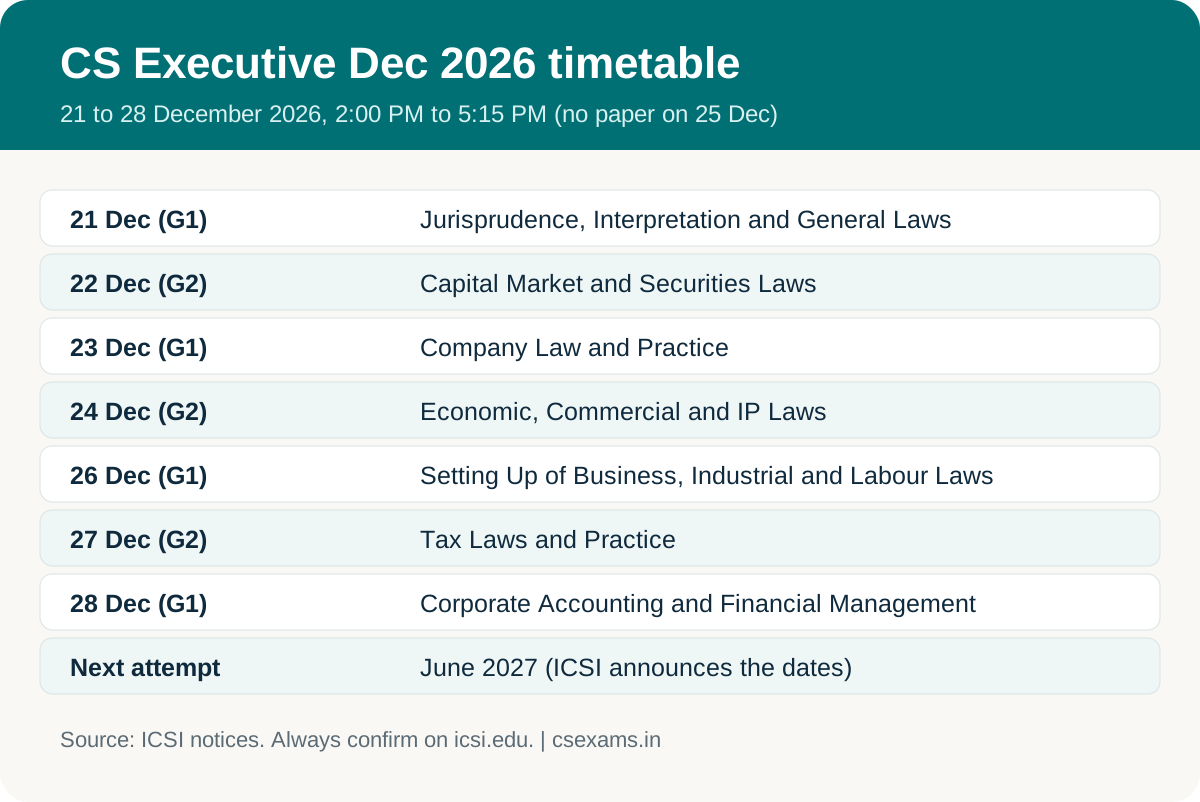
| What | Date |
|---|---|
| CS Executive Dec 2026 exams | 21 to 28 December 2026 |
| Admit card | Expected in the second week of December 2026 on icsi.edu, based on past years (the Dec 2025 cards came on 12 December 2025) |
| Dec 2026 result | Expected around 25 February 2027, based on past years (the Dec 2025 result came on 25 February 2026) |
| Next attempt | June 2027 |
Write full papers under time before the exam: our CS Executive test series has papers on the ICSI pattern, checked by Company Secretaries. See plans and prices.
Always confirm dates on the official ICSI website, icsi.edu.
The first paper also sets your mood for the week. A good JIGL paper makes Capital Market the next day feel lighter. So let us plan it properly.
CS Executive JIGL Dec 2026 at a glance
Here are the confirmed facts for this session, from the ICSI time table, the Syllabus 2022 document and the JIGL supplement for December 2026.
| Point | Detail |
|---|---|
| Paper | Jurisprudence, Interpretation and General Laws, Group 1, Paper 1 |
| Date and time | Monday, 21 December 2026, 2:00 PM to 5:15 PM (15 minutes reading time) |
| Marks | 100 |
| Supplement | JIGL supplement for Dec 2026, updates from 1 December 2025 to 31 May 2026 |
| Read with | JIGL study material (Syllabus 2022) updated to November 2025 |
| Criminal law references | BNS, BNSS and BSA, 2023 have replaced the IPC, CrPC and Indian Evidence Act |
The full time table and supplements are on the ICSI examination page. Download the supplement today if you have not. It is short, and examiners do like to ask recent decisions.
What the Dec 2026 supplement adds
The supplement does not bring in new statutes. It adds recent Supreme Court decisions to five lessons: Constitution of India (Lesson 2), Civil Procedure (Lesson 6), Limitation (Lesson 9), Arbitration, Mediation and Conciliation (Lesson 10) and Negotiable Instruments (Lesson 14). The points covered include High Court jurisdiction under Article 227, res judicata across stages of the same case, acknowledgment of debt under Section 18 of the Limitation Act, Section 9 arbitration petitions after an award, and compounding of Section 138 cheque bounce offences through settlement.
You do not need to memorise every party name. Learn the principle each case settles and attach it to the right section. If a question on cheque bounce comes, a one-line reference to the recent settlement ruling shows the examiner you are current.
New criminal laws
The supplement also reminds students that the Bharatiya Nyaya Sanhita, the Bharatiya Nagarik Suraksha Sanhita and the Bharatiya Sakshya Adhiniyam, all of 2023, have replaced the IPC, CrPC and Evidence Act. Under Section 8 of the General Clauses Act, references to the old laws are read as references to the new ones. In your answers, write the new law first. Many students still write only IPC sections, which looks dated.
The syllabus, grouped the way you should revise it
ICSI does not give lesson-wise weightage for JIGL, so we group the syllabus by how you study it rather than by marks. Three clusters work well.
- Theory and Constitution: sources of law, schools of jurisprudence, Constitution of India (fundamental rights, directive principles, writs, legislative process), and administrative law.
- Interpretation: rules of interpretation, aids, provisos and definition clauses, Latin maxims, General Clauses Act, 1897.
- Procedural and general laws: civil procedure, criminal law and procedure, evidence, torts, specific relief, limitation, arbitration and ADR, stamp and registration, RTI, IT Act, contract, sale of goods, negotiable instruments.
The third cluster is the biggest. That is where most of your days go.
Interpretation is the easiest place to gain marks
Interpretation of statutes is short, it is asked regularly, and it is mostly logic. Learn the literal rule, the golden rule, the mischief rule from Heydon's case and the harmonious construction rule, each with one line on when courts use it. Add internal aids like the preamble, definitions, provisos and explanations, and external aids like debates and dictionaries. Then pick around fifteen Latin maxims you can explain in two lines each, such as ejusdem generis, noscitur a sociis and expressio unius est exclusio alterius.
A student who writes the rule, explains it in plain words and gives one example of its use can score full marks on a short question. This is also the area where many students lose easy marks by writing only the name of the maxim with no explanation.
Constitution: learn the structure, not every article
For the Constitution, focus on fundamental rights, the writ jurisdiction under Articles 32 and 226, directive principles, the legislative process including money bills and the Finance Bill, and the division of powers between the Union and States. Draw a small table of the five writs with what each one does and against whom it lies. You will use that table in at least one answer.
A 30-day JIGL plan
JIGL shares the month with your other Group 1 papers, so give it about two hours a day for now and a full day just before 21 December.
- Days 1 to 5: Constitution and interpretation. Make a one-page chart of writs, articles and rules of interpretation with one example each.
- Days 6 to 8: Jurisprudence and administrative law. Short notes on each school of thought and on natural justice.
- Days 9 to 16: Civil Procedure, criminal law, evidence and limitation. Write section numbers in the margin as you revise.
- Days 17 to 21: Contract, sale of goods, negotiable instruments, specific relief and torts.
- Days 22 to 24: Arbitration, stamp, registration, RTI and IT Act. Then read the Dec 2026 supplement twice.
- Days 25 to 28: Two full timed papers with checking.
- Days 29 and 30: Only your charts, Latin maxims and the supplement points.
If you are writing both groups, the CS Executive last month revision plan shows how to fit JIGL with the other papers.
How to write JIGL answers that score
JIGL answers are graded on how well you state the law and apply it. A good answer has a short opening line, the relevant section or article, a case reference where you know one, and a clear conclusion. For problem questions, use the simple order of provision, facts, application and conclusion.
Underline section numbers and case names. Keep paragraphs short. Examiners read hundreds of sheets, and a neat answer with headings gets more patient reading. Our guide on writing high-scoring answers in ICSI exams has examples.
The most common JIGL mistake we see in evaluated sheets is a long story with no section number. You may know the concept, but without the section the examiner cannot give full marks.
Mock papers and the final days
Write at least two full JIGL papers in the 2:00 PM to 5:15 PM slot. You will learn quickly that three hours go fast when every answer needs a section and a case. Time yourself per question, and leave the long theory answers for after the problem questions you are sure of.
Our CS Executive test series includes full JIGL papers checked by Company Secretaries, with comments on structure, section quoting and time use. Use the feedback to fix two or three habits before the real paper, not to rewrite your notes.
On 20 and 21 December
On the day before the paper, read only your one-page charts, the maxims list and the supplement. On exam day, use the 15 minutes of reading time to pick your problem questions first. Do not try to learn a new lesson in the hall corridor. Walk in calm, write clean answers, and let the rest of the week build on a strong start.
JIGL rewards students who keep it simple: the right section, the right principle, a short case reference and a neat conclusion. Thirty days is enough to get there if you start your charts this week.
Frequently asked questions
When is the CS Executive JIGL paper in December 2026?
Jurisprudence, Interpretation and General Laws is on Monday, 21 December 2026, from 2:00 PM to 5:15 PM including 15 minutes of reading time. It is the first Executive paper of the session.
Is there a JIGL supplement for Dec 2026?
Yes. ICSI has released a JIGL supplement for the December 2026 exam covering updates from 1 December 2025 to 31 May 2026. It adds recent Supreme Court decisions in lessons such as Constitution, Civil Procedure, Limitation, Arbitration and Negotiable Instruments.
Should I write IPC or Bharatiya Nyaya Sanhita in JIGL answers?
The supplement notes that the BNS, BNSS and BSA, 2023 have replaced the IPC, CrPC and Indian Evidence Act. Write the new law and, where useful, mention the old section in brackets.
How many marks is the JIGL paper?
JIGL is a 100-mark paper in Group 1 of the CS Executive Syllabus 2022. ICSI does not give a fixed weightage for each lesson.
Can JIGL be cleared in one month?
Yes, if you have read the study material once. Use the month for short notes, Constitution and interpretation rules, and two timed papers instead of fresh reading.
Which JIGL areas need the most practice?
Constitution, interpretation of statutes, Civil Procedure, Evidence, Limitation, Arbitration and Contract are wide areas with many provisions. Practise writing them with section numbers and short case references.
Practise what you just read