In this article (17)
- CS Professional ESG paper at a glance
- Part I: Governance and Sustainability (65 marks)
- Ethics, stakeholders and the CS role
- Part II: Risk Management (20 marks)
- Part III: Environment and Sustainability Reporting (15 marks)
- A 30-day plan for the ESG paper
- Common mistakes in the CS Professional ESG paper
- Link it with your other Professional papers
- Writing case-based ESG answers
- Mock practice
- Frequently asked questions
- When is the CS Professional ESG paper in December 2026?
- What is the weightage of each part in the CS Professional ESG paper?
- Is the CS Professional ESG paper open book?
- Is BRSR part of the CS Professional ESG syllabus?
- Which part of ESG should I revise first?
- How should I write case study answers in the ESG paper?
The CS Professional ESG paper opens your exams on Monday, 21 December 2026. Its full name is Environmental, Social and Governance (ESG) Principles and Practice, and despite the name, most of its marks are about corporate governance. Sixty-five of the 100 marks sit in Part I, Governance and Sustainability. Plan your month on that fact and the paper becomes far more manageable.
Latest update (18 Nov 2026): the CS Professional December 2026 exams run from 21 to 28 December 2026 (2:00 PM to 5:15 PM, no paper on 25 December). The next attempt after that is June 2027; ICSI announces its dates closer to the time.
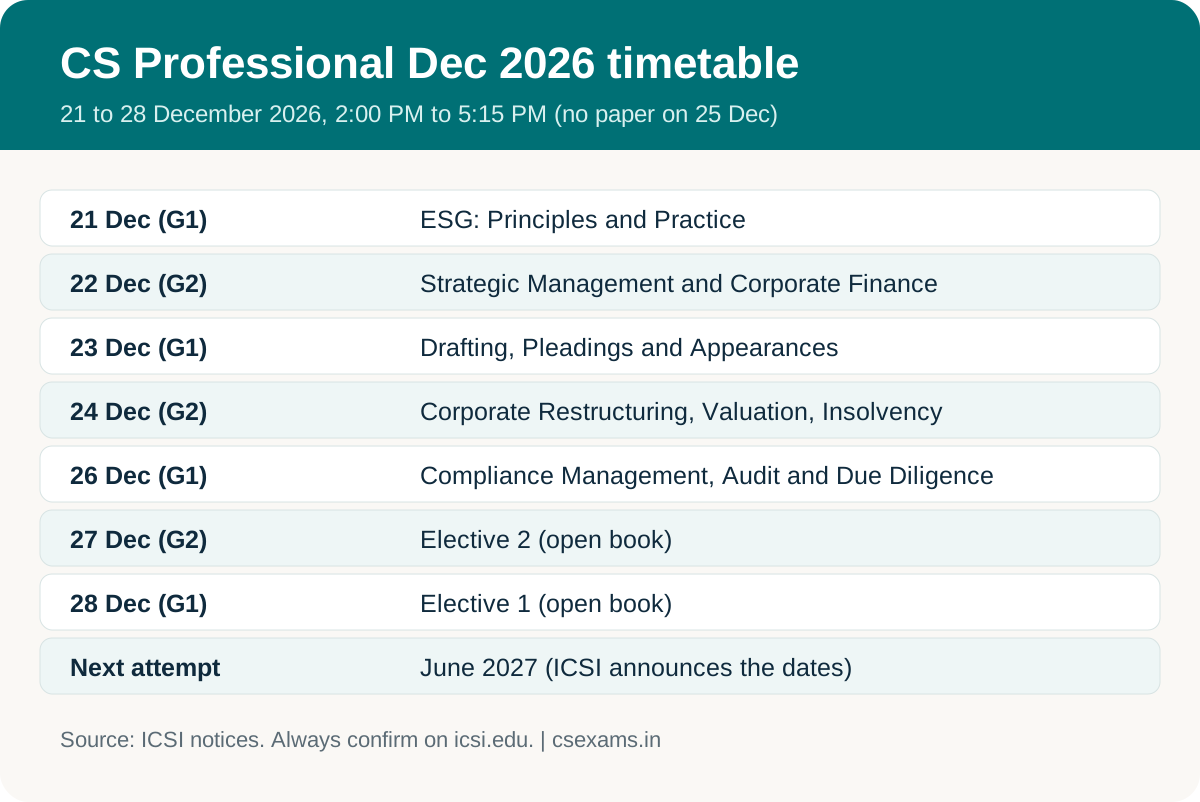
| What | Date |
|---|---|
| CS Professional Dec 2026 exams | 21 to 28 December 2026 |
| Admit card | Expected in the second week of December 2026 on icsi.edu, based on past years (the Dec 2025 cards came on 12 December 2025) |
| Dec 2026 result | Expected around 25 February 2027, based on past years (the Dec 2025 result came on 25 February 2026) |
| Next attempt | June 2027 |
Write full papers under time before the exam: our CS Professional test series has papers on the ICSI pattern, checked by Company Secretaries. See plans and prices.
Always confirm dates on the official ICSI website, icsi.edu.
You have about 30 days. Here is how the paper is built, what to revise in each part, and how to write answers that read like a practising Company Secretary wrote them.
CS Professional ESG paper at a glance
These details come from the ICSI December 2026 time table and the Syllabus 2022 document.
| Part | Topics | Marks |
|---|---|---|
| Part I: Governance and Sustainability | Corporate governance concepts and law in India, board effectiveness, board committees, board training and evaluation, data governance, stakeholder rights, business ethics, board accountability on ESG, CSR, green initiatives, role of the Company Secretary | 65 |
| Part II: Risk Management | Risk identification, analysis and mitigation, internal control, crisis and disaster management, business continuity, fraud and cyber risk | 20 |
| Part III: Environment and Sustainability Reporting | Sustainability audit, ESG ratings, government mandates, Integrated Reporting, GRI, BRSR | 15 |
The paper is in Group 1, Paper 1, on 21 December 2026 from 2:00 PM to 5:15 PM, with the first 15 minutes for reading. It is not open book. The study material and any supplement are on the ICSI examination page.
Part I: Governance and Sustainability (65 marks)
This is the heart of the paper. You need a clear picture of how a listed company's board works under the Companies Act, 2013 and the SEBI Listing Regulations: board composition, independent directors, women directors, board meetings, and the main committees, which are audit, nomination and remuneration, stakeholders relationship, risk management and CSR.
Build one master chart: each committee, who must have it, its composition and its key role. You will use that chart in several answers. Add board evaluation, director training and familiarisation, related party oversight and whistle blower mechanism.
Ethics, stakeholders and the CS role
Questions on business ethics, stakeholder rights and the role of the Company Secretary in governance are frequent and they are easier to score than students think. Answer them with a framework: who the stakeholder is, what right or expectation they have, what the law or code says, and what the board or CS should do. Avoid writing pure opinion. Quote the provision or principle and then give your view.
CSR also sits here. Revise Section 135 of the Companies Act, 2013, the CSR committee, the spending obligation and the reporting of CSR in the board's report. Green initiatives such as electronic meetings and e-communication with shareholders are small topics that come as short notes.
Part II: Risk Management (20 marks)
Risk management is concept heavy but compact. Learn the risk management process step by step: identification, analysis, evaluation, treatment, monitoring and reporting. Then add types of risk, internal control, the role of the risk management committee, crisis and disaster management, business continuity planning, fraud risk and cyber risk.
The common mistake here is writing a general essay about risk. Examiners want structure. A risk question answered with the process steps as headings and one or two lines of application to the facts scores well.
Part III: Environment and Sustainability Reporting (15 marks)
Only 15 marks, but this is the part students skip and regret. Revise BRSR (Business Responsibility and Sustainability Reporting), the GRI standards, the Integrated Reporting Framework and its six capitals, ESG ratings and what they measure, and sustainability audit. Short notes on each are enough.
A good habit is to open the BRSR section of any large listed company's annual report and see how the principles are reported. It takes twenty minutes and makes the topic real, which helps you write with confidence.
A 30-day plan for the ESG paper
ESG is your first Professional paper, so your last two days before 21 December belong to it. Until then, give it about two hours a day alongside your other Group 1 papers.
- Days 1 to 4: Governance concepts, codes and the legal framework in India. Make your committee chart.
- Days 5 to 10: Board effectiveness, independent directors, board evaluation, training, data governance and related party oversight.
- Days 11 to 14: Stakeholders, ethics, CSR, green initiatives and the role of the Company Secretary.
- Days 15 to 19: Risk management in full, including internal control, business continuity, fraud and cyber risk.
- Days 20 to 23: BRSR, GRI, Integrated Reporting, ESG ratings and sustainability audit.
- Days 24 to 27: One or two full timed papers with checking.
- Days 28 to 30: Charts, short notes and the questions you got wrong.
Our CS Professional last month revision plan shows how ESG fits with the other papers in both groups.
Common mistakes in the CS Professional ESG paper
ESG reads like a light subject, and that is exactly why students underprepare it. Here are the mistakes we see most often in checked answers.
- Treating it as an environment paper. Most of the marks are governance, so a student strong on climate topics but weak on board committees will struggle.
- Mixing up the Companies Act and the SEBI Listing Regulations. When you state a requirement, say which law it comes from and which companies it applies to.
- Writing long introductions. Two lines of context are enough. The marks are in the provision and the application.
- Skipping Part III. Fifteen marks of reporting topics can be revised in three or four focused days.
- No recommendation in case questions. The question usually asks what the company or board should do. Answer that directly.
Link it with your other Professional papers
ESG overlaps with Compliance Management, Audit and Due Diligence on 26 December, especially around board processes, secretarial audit and internal control. When you revise board committees and internal control for ESG, you are also preparing for that paper. Use the same charts for both and you save several hours in the last week.
Keep a small list of recent ESG terms from your study material, such as ESG ratings, sustainability audit and the capitals of integrated reporting, and learn what each means in one or two lines. These help with short notes, which are quick marks when you are short on time.
Writing case-based ESG answers
Many ESG questions give a short case about a company and ask what is wrong or what the board should do. Use a four-step answer: issue, provision or framework, application to facts, recommendation. Keep the recommendation practical, the way a CS would advise a board. If you want more on this format, read how to write case-based answers in the CS exam.
A pattern we see in checked sheets: students who quote the specific regulation or section, even in one line, score noticeably higher than those who write general ESG ideas. Name the law, then explain.
Mock practice
Write at least one full ESG paper in the 2:00 PM to 5:15 PM slot before 21 December. Our CS Professional test series includes ESG papers checked by Company Secretaries, with comments on structure and on where you missed the provision.
On exam day, use the 15 minutes of reading time to choose the case questions you can answer with a clear provision. Start with Part I questions, since they carry most of the marks, and keep the last 15 minutes to add headings and underline key terms. ESG is a scoring paper for students who write structured, provision-backed answers, and the first paper is the best place to start the week strong.
Frequently asked questions
When is the CS Professional ESG paper in December 2026?
Environmental, Social and Governance (ESG) Principles and Practice is on Monday, 21 December 2026, from 2:00 PM to 5:15 PM including 15 minutes of reading time. It is the first Professional paper.
What is the weightage of each part in the CS Professional ESG paper?
As per the Syllabus 2022, Part I Governance and Sustainability carries 65 marks, Part II Risk Management carries 20 marks and Part III Environment and Sustainability Reporting carries 15 marks.
Is the CS Professional ESG paper open book?
No. In the December 2026 time table only the electives are marked as open book. ESG is a regular Group 1 paper.
Is BRSR part of the CS Professional ESG syllabus?
Yes. Part III covers sustainability reporting, including Business Responsibility and Sustainability Reporting, GRI, the Integrated Reporting Framework, ESG ratings and sustainability audit.
Which part of ESG should I revise first?
Start with Part I, Governance and Sustainability, since it carries 65 marks. Board structure, committees, board evaluation, stakeholder rights and the role of the Company Secretary are the core.
How should I write case study answers in the ESG paper?
Identify the governance or ESG issue, state the relevant provision or framework, apply it to the facts and end with a practical recommendation for the board or company.
Practise what you just read