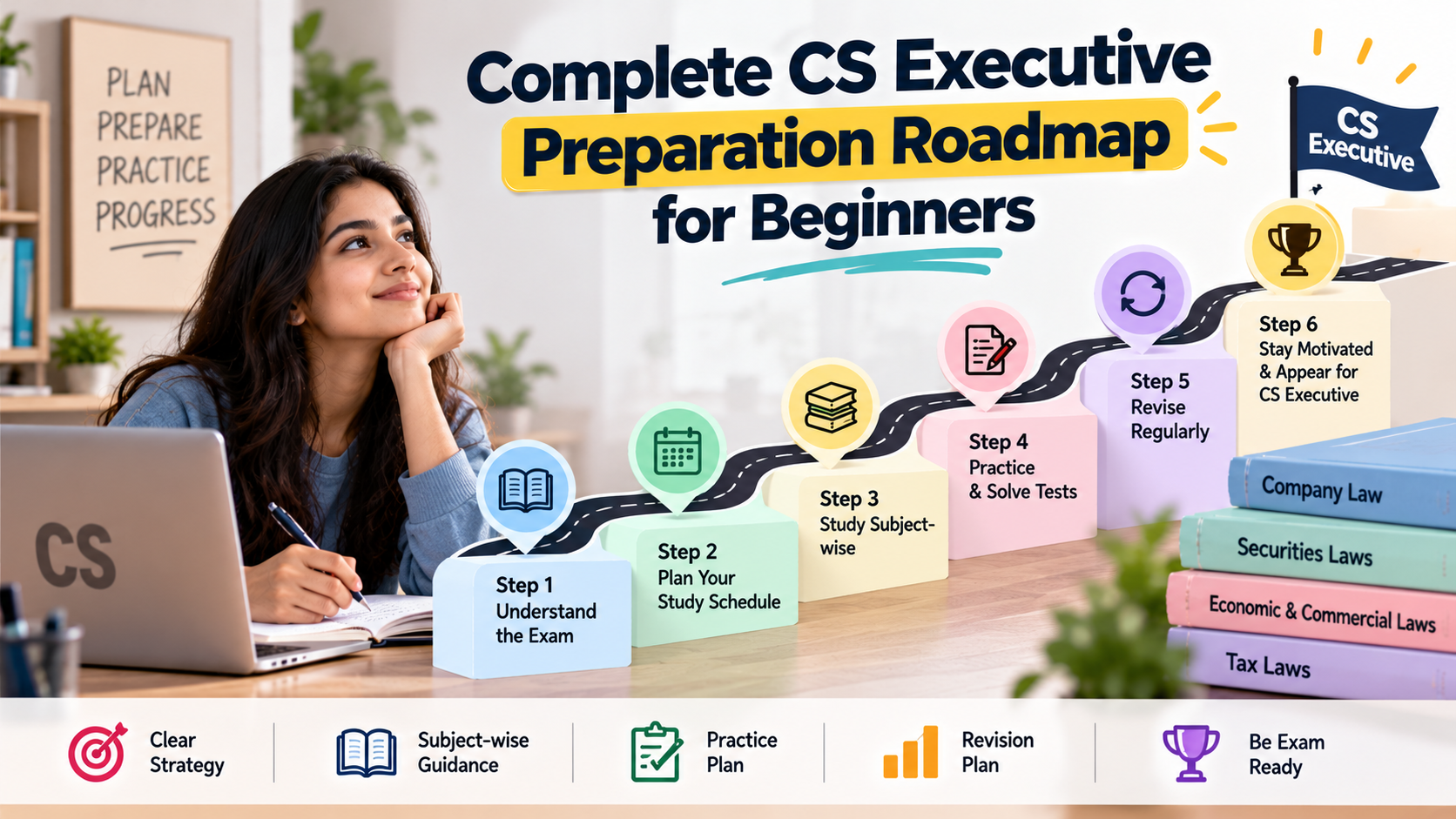
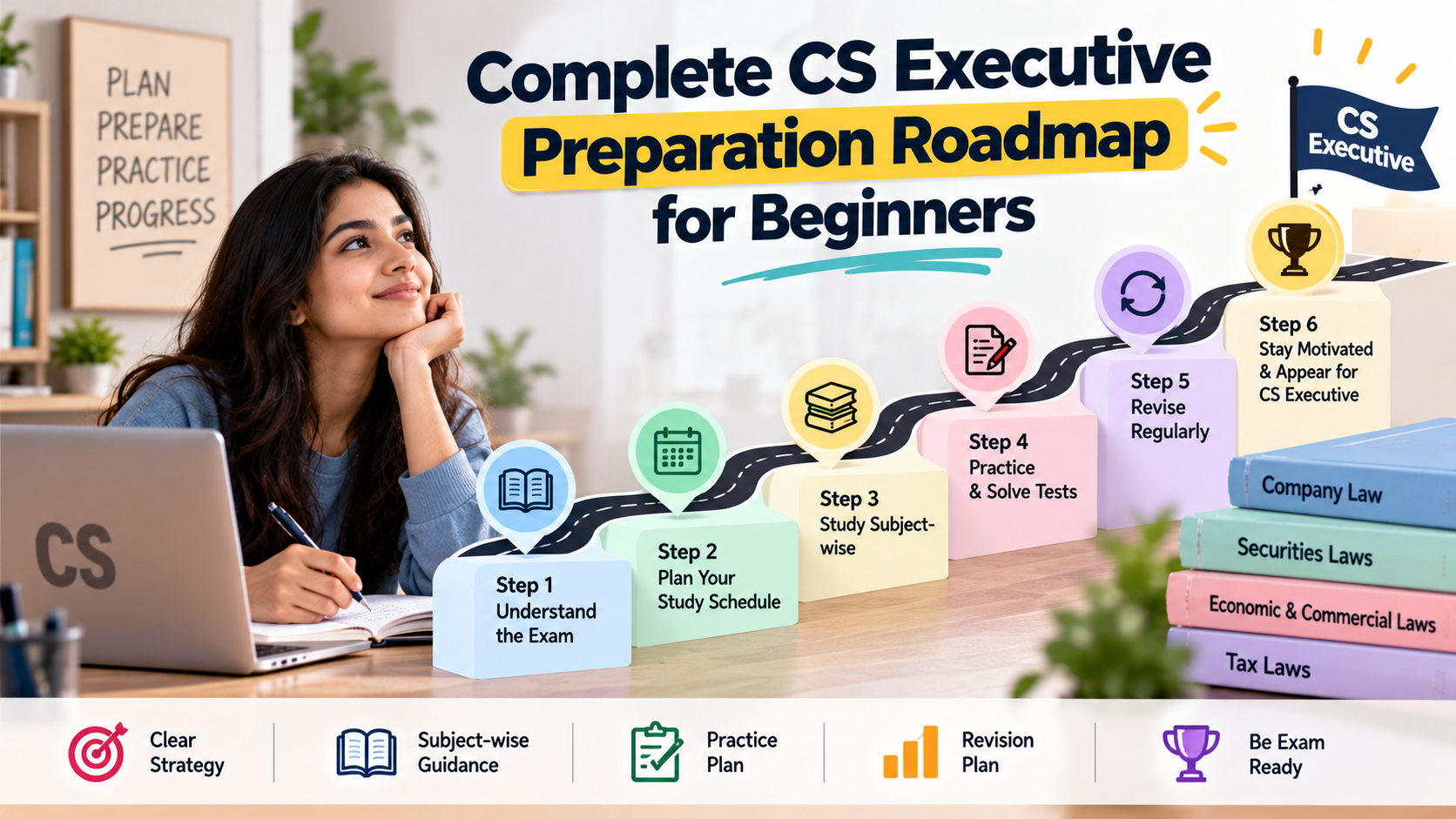
Preparing for CS examinations becomes more manageable when you begin with the current official syllabus, make a realistic plan and practise consistently. Use this guide as a practical framework, and verify programme-specific requirements and updates directly on the ICSI website.
CS Exams Test Series can be used as an additional practice resource alongside official ICSI study material. A good preparation routine balances learning, active recall, question practice and revision instead of relying on reading alone.
Quick Overview
| Area | Recommended approach |
|---|---|
| Syllabus | Use the current official ICSI syllabus and study material. |
| Study plan | Set realistic weekly targets and rotate subjects. |
| Practice | Attempt questions independently and analyse errors. |
| Revision | Use active recall and revisit weak topics at intervals. |
| Test support | Use CS Exams Test Series as a supplement to official resources. |
Confirm the syllabus and exam plan
Check the applicable CS Executive syllabus, registration status and examination enrolment requirements on the official ICSI website. Use the current programme portal rather than an old timetable or coaching post. Save the syllabus and official study material for each paper you intend to attempt.
Decide which group or groups to prepare for after considering available time, prior knowledge and other responsibilities. A plan that allows proper learning and revision is usually more useful than choosing a heavier workload simply to finish sooner.
Map the syllabus into weekly tasks
Break every paper into units and smaller topics. Estimate the effort each topic needs: introductory reading, detailed learning, written practice or numerical problem-solving. Mark familiar topics, partly understood areas and topics that are completely new.
Create a tracker for first study, question practice, revision and test status. Keep it simple enough to update quickly. A chapter should be marked complete only when you can recall the main ideas and answer relevant questions independently.
Set a routine you can maintain
Choose study blocks around your daily commitments. If you have classes or work, use shorter sessions on busy days and longer blocks for demanding topics at the weekend. If you study full-time, still plan breaks and a weekly review. Consistency matters more than an unrealistic timetable.
Rotate subjects through the week. Alternate law-heavy sessions with numerical or application-based work, then add short recall sessions for earlier topics. Leave a buffer for unexpected delays. If you repeatedly fall behind, adjust the workload instead of abandoning the routine.
Read law with an answer-writing method
Understand the legal principle, its conditions, exceptions and practical effect. Use official material to check provisions and distinguish similar concepts. Where relevant, learn how the principle applies to a factual situation rather than memorising a paragraph without understanding it.
Practise structured answers: identify the issue, state the relevant rule, apply it to the facts and reach a clear conclusion. For direct theory questions, organise the response around the points asked. Compare your practice with guideline answers to learn the expected level of detail.
Handle numerical and application topics actively
For numerical subjects, study a worked example and then solve a similar question from scratch. Show each step and label workings so you can locate an error. Keep a record of recurring mistakes, such as selecting the wrong method or overlooking an adjustment.
For application-heavy topics, practise explaining how a concept works in a business situation. Build short examples and ask which principle applies and why. This helps when a question combines several ideas rather than asking for a definition alone.
Use official questions to test understanding
Use ICSI question papers, sample materials and guideline answers where available. Begin with topic-wise questions, then try mixed questions that require you to choose the right concept. Check accuracy, completeness, relevance and clarity rather than only comparing the final conclusion.
Create a question log with the paper, topic, error type and next practice date. Reattempt questions after a gap instead of immediately rereading the solution. This shows whether you can reproduce the reasoning independently.
Start mock tests before the final phase
Do not wait until you feel fully prepared before attempting a timed test. Early topic tests show how questions are framed and where your knowledge is incomplete. As syllabus coverage improves, attempt longer tests and eventually full papers under realistic conditions.
Analyse errors by cause: concept gaps, incomplete recall, misreading, poor structure or time management. Select a few improvements for the next study cycle. The score matters, but the main benefit comes from changing your preparation based on what the test reveals.
Revise with active recall and spaced practice
Schedule revision from the beginning. Revisit a topic after first study, test it again a few days later and return to it in a weekly cycle. Use questions, flashcards, blank-page recall or short written summaries to retrieve information rather than merely recognise it.
Keep a compact revision file for formulas, legal distinctions, key concepts and repeated mistakes. Do not turn it into another textbook. Review it alongside question practice so that recall remains connected to application.
Use CS Exams Test Series with a purpose
CS Exams Test Series can provide additional structured practice. Check syllabus and paper coverage before using a test, and keep official ICSI material as your primary reference. Use tests to assess how well you can apply knowledge under time constraints.
Translate feedback into specific actions. Instead of ‘improve presentation’, set a target such as using clear headings and answering each command word directly. Instead of ‘revise tax’, practise a defined set of questions on the topics where errors recur. Review the same skill in a later test.
Plan the final month and exam week
In the final month, move gradually from first-time learning to revision and exam-style practice. Use your tracker to prioritise unfinished topics and recurring weaknesses. Avoid adding new resources without a clear reason and check official updates and exam instructions.
In the final week, revise compact notes, practise selected questions and maintain a reasonable sleep schedule. Confirm the timetable, venue and required documents through official instructions. Read questions carefully, allocate time and leave a few minutes for review when possible.
Balance syllabus coverage with depth
Beginners sometimes spend too long perfecting one chapter while leaving other papers untouched. On the other hand, rushing through every topic without practising can create weak understanding. Use an initial coverage target, then return to topics that need more depth based on questions and test results. Your timetable should include both broad coverage and repeated practice.
Set a time limit for first learning. At the end of the block, summarise the concept and attempt a basic question. If you remain confused, note the precise issue and schedule a follow-up rather than letting one topic consume the whole day. This keeps the overall plan moving while giving difficult material another opportunity.
Use feedback as a plan, not a judgement
A low test score can feel discouraging, but it is useful when you can explain what caused it. Separate knowledge gaps from errors in reading, structure or timing. These problems need different solutions: revise the concept, practise careful question reading, use a consistent answer format or attempt timed sections. Avoid concluding that you are bad at a subject based on one result.
Track whether the same error appears less often over time. If it does, your correction is working even if the overall score takes longer to rise. If it continues, try a different explanation or practice method. Progress is easier to see when you compare the same skill across several attempts rather than focusing only on one total mark.
Prepare an exam-week routine
In the last week, avoid making major changes to your preparation system. Use your tracker to choose the most valuable revision tasks, review common mistakes and practise selected questions. Keep the final sessions short enough to maintain concentration. If a new resource appears online, ask whether it directly addresses a known gap before spending time on it.
Confirm the official examination instructions, schedule and required documents in advance. Keep study materials organised and plan practical arrangements where relevant. The goal is to reduce avoidable decisions on the day so your attention can remain on the paper. A steady final routine is more useful than a last-minute surge of unfocused study.