In this article (23)
- CS Executive December 2026 paper order and timing
- The rules that decide what you write this attempt
- How many full papers to write in each subject
- Day-by-day CS Executive December 2026 preparation strategy
- Days 1 to 10 (21 to 30 November): first round in exam order
- Days 11 to 20 (1 to 10 December): second round with fixes
- Days 21 to 26 (11 to 16 December): weak papers and amendments
- Days 27 to 30 (17 to 20 December): no new full papers
- Exam week: what to revise between papers
- Writing both groups
- Group 1 only
- Group 2 only
- Where CS Executive answers lose marks
- Why a Company Secretary should check your mock papers
- Get your answer sheets checked by Company Secretaries
- Frequently asked questions
- When is the CS Executive December 2026 exam?
- Is 30 days enough to prepare for CS Executive December 2026?
- How many mock papers should I write for CS Executive?
- Which amendments apply to CS Executive December 2026?
- Which Finance Act applies to CS Executive Tax Laws in December 2026?
- When will the CS Executive December 2026 admit card be released?
- What are the passing marks for CS Executive?

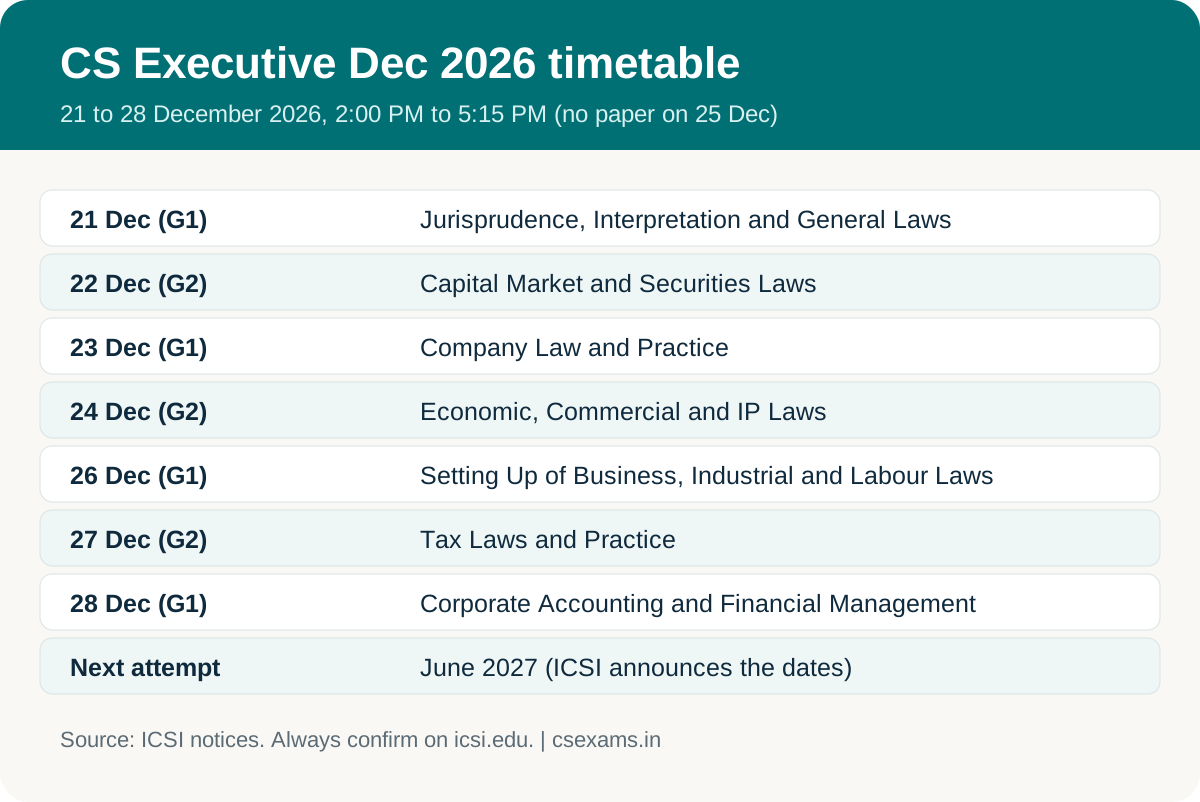
You have about 30 days left. The CS Executive December 2026 papers start on Monday, 21 December and finish on Monday, 28 December, with no paper on Christmas Day. At this stage, a CS Executive December 2026 preparation strategy is not about opening new chapters. It is about writing full papers in the real 2:00 PM slot, getting them checked, and fixing the same few mistakes before they cost you the attempt.
Latest update (18 Nov 2026): the CS Executive December 2026 exams run from 21 to 28 December 2026 (2:00 PM to 5:15 PM, no paper on 25 December). The next attempt after that is June 2027; ICSI announces its dates closer to the time.
| What | Date |
|---|---|
| CS Executive Dec 2026 exams | 21 to 28 December 2026 |
| Admit card | Usually about two weeks before the first paper, on icsi.edu |
| Dec 2026 result | Usually declared in late February 2027 |
| Next attempt | June 2027 |
Write full papers under time before the exam: our CS Executive test series has papers on the ICSI pattern, checked by Company Secretaries. See plans and prices.
Always confirm dates on the official ICSI website, icsi.edu.
The plan below runs from 21 November to 20 December and follows the actual paper order. It also tells you how many full papers to write in each subject. We built it for students writing both groups. If you are writing only one group, look for your notes in the exam-week section.
CS Executive December 2026 paper order and timing
ICSI has published the date sheet on icsi.edu. Every paper runs from 2:00 PM to 5:15 PM, and the first 15 minutes, 2:00 to 2:15, are for reading the question paper. Each paper carries 100 marks.
| Date | Day | Paper | Group |
|---|---|---|---|
| 21 December 2026 | Monday | Jurisprudence, Interpretation and General Laws | Group 1 |
| 22 December 2026 | Tuesday | Capital Market and Securities Laws | Group 2 |
| 23 December 2026 | Wednesday | Company Law and Practice | Group 1 |
| 24 December 2026 | Thursday | Economic, Commercial and Intellectual Property Laws | Group 2 |
| 25 December 2026 | Friday | No examination | None |
| 26 December 2026 | Saturday | Setting Up of Business, Industrial and Labour Laws | Group 1 |
| 27 December 2026 | Sunday | Tax Laws and Practice | Group 2 |
| 28 December 2026 | Monday | Corporate Accounting and Financial Management | Group 1 |
Look at the gaps carefully. If you are writing both groups, your only free day is 25 December, and it falls just before Setting Up of Business, Industrial and Labour Laws. Tax Laws and CAFM come one after the other on 27 and 28 December. That means your two numerical papers get no revision day between them. That one fact shapes most of the plan below.
The rules that decide what you write this attempt
- Amendments: for a December session, ICSI applies changes in the law made up to 31 May of the same year. For you, that date is 31 May 2026. ICSI's December 2026 supplements cover everything from each study material's cut-off date up to 31 May 2026, so read them along with the books.
- Tax Laws: ICSI has notified that the Finance Act, 2025 (Assessment Year 2026-27) applies to the December 2026 exam, and that the Income Tax Act, 2025 does not apply to this session. Some students still lose marks by quoting new section numbers they picked up from the news.
- Passing: you need 40% in each paper and 50% aggregate in the group. The full rules are in our post on CS Executive passing criteria.
- Pattern: under Syllabus 2022, every paper except Paper 4 (CAFM) is meant to have 20% case-based objective questions and 80% descriptive questions, and CAFM is fully descriptive. Recent papers have been mostly written answers. One analysis of June 2026 found six questions per paper and no multiple choice questions. So before your first mock, solve the June 2026 paper from our CS Executive previous year question papers page and practise the format you actually see.
Two dates for this week. The last date to change your centre, group or medium is 21 November 2026, until 4:00 PM. ICSI has not yet announced when the December 2026 admit card will be released, and we will update this page when it does. In past sessions it came out about 10 days before the first paper, so expect it around 11 December.
How many full papers to write in each subject
These numbers are our recommendation, based on the answer sheets we check every session. They are not an ICSI rule. If you write fewer than three full papers in a subject, you walk into the hall without knowing how long that paper takes you. If you write more than five, you are usually using mocks to avoid revising.
- Jurisprudence, Interpretation and General Laws: 3 full papers. Interpretation answers score on clean structure, not length.
- Company Law and Practice: 4 full papers. Part II, Company Administration and Meetings (40 marks), is procedural, and you only remember procedures in order by writing them out.
- Setting Up of Business, Industrial and Labour Laws: 3 full papers. Part II, Industrial and Labour Laws, carries 40 marks and is where most students write vague answers.
- Corporate Accounting and Financial Management: 4 full papers, plus a few one-hour sectional tests on either accounting or FM.
- Capital Market and Securities Laws: 3 full papers.
- Economic, Commercial and Intellectual Property Laws: 3 full papers.
- Tax Laws and Practice: 4 full papers, plus short GST sets for the 40-mark indirect tax part.
That adds up to 14 papers for Group 1, 10 for Group 2 and 24 if you are writing both. To pick chapters for your sectional tests, use our CS Executive chapter-wise weightage post instead of guessing.
Day-by-day CS Executive December 2026 preparation strategy
Write every full paper from 2:00 PM to 5:15 PM, the same slot as the exam. Your brain should be used to that time by 21 December. Use mornings to revise the subject you are writing that day. Use evenings to check the paper against the guideline answer and add every mistake to a one-page error log for that subject.
Days 1 to 10 (21 to 30 November): first round in exam order
- 21 Nov: Jurisprudence, Interpretation and General Laws
- 22 Nov: Capital Market and Securities Laws
- 23 Nov: Company Law and Practice
- 24 Nov: Economic, Commercial and IP Laws
- 25 Nov: Setting Up of Business, Industrial and Labour Laws
- 26 Nov: Tax Laws and Practice
- 27 Nov: CAFM
- 28 Nov: Company Law and Practice (second paper)
- 29 Nov: Tax Laws and Practice (second paper)
- 30 Nov: CAFM (second paper)
Round one is meant to show you your gaps. A low score here is useful information, not a verdict. Do not spend two days revising a subject before you write its first paper.
Days 11 to 20 (1 to 10 December): second round with fixes
Write the same ten papers again in the same order. Read that subject's error log before you start each one. By the end of this round, you should be finishing every question with about ten minutes to spare. If you are not, the problem is usually that your answers are too long.
Days 21 to 26 (11 to 16 December): weak papers and amendments
Write four more full papers: Company Law, Tax, CAFM and whichever paper scored lowest in round two. Use the other two days for the 31 May 2026 supplements and for downloading and checking your admit card once ICSI releases it.
Days 27 to 30 (17 to 20 December): no new full papers
Stop writing full papers now. On 17 December, make one working sheet each for Tax and CAFM with formats, rates and FM formulas. You will need these on the night of 27 December. Use 18 December for Company Law and Setting Up of Business notes, and 19 December for Capital Market and Economic Laws. Keep 20 December for Jurisprudence only, and sleep early.
Exam week: what to revise between papers
Writing both groups
- Evening of 21 Dec: Capital Market and Securities Laws
- Evening of 22 Dec: Company Law and Practice
- Evening of 23 Dec: Economic, Commercial and IP Laws
- Evening of 24 Dec and all of 25 Dec: Setting Up of Business, Industrial and Labour Laws
- Evening of 26 Dec: Tax Laws and Practice
- Evening of 27 Dec: CAFM, from your working sheet only
Do not try to solve new CAFM sums on 27 December. Read your formats, your FM formulas and your error log, and stop there.
Group 1 only
Your papers are on 21, 23, 26 and 28 December. You get 22 December for Company Law, 24 and 25 December for Setting Up of Business, and 27 December for CAFM. In the 30-day plan, use the Group 2 slots for extra revision of your weakest Group 1 paper.
Group 2 only
Your papers are on 22, 24 and 27 December. You get 23 December for Economic Laws, and 25 and 26 December for Tax, the paper with the most computation. This is the best gap in the whole timetable, so plan to use both days.
Where CS Executive answers lose marks
The same mistakes show up in almost every batch of sheets we check. Most of them have nothing to do with how much you know.
- Writing theory for a practical question. The question asks whether the company can do something on the given facts, and the student writes out the whole chapter. Use four parts instead: the provision, the facts, your analysis and a clear conclusion.
- No conclusion. End a case-based answer with a direct line, such as "Hence, the company cannot do this without approval." Examiners look for it.
- Guessing section numbers. If you are sure, quote the Act and the section. If you are not, state the provision correctly without a number. A wrong section number looks worse than no number.
- Tax answers without the assessment year or working notes. Write AY 2026-27 where it matters and show every adjustment.
- CAFM without working notes and assumptions. Marks are given for steps, so a wrong final figure with clear workings still scores.
- Poor time split. After reading time you have 180 minutes for 100 marks, which is about 1.8 minutes per mark. A 5-mark part gets roughly nine minutes.
Most students lose marks in the last 40 minutes, not the first. They spend 20 minutes on the first question they love and then rush or skip the last one. Write the time limit for each question in the margin during reading time, and move on when it is up. For more on structuring answers, see our guide to CS Executive descriptive answers.
Why a Company Secretary should check your mock papers
Checking your own paper against a guideline answer tells you whether the content matches. It does not tell you whether an examiner would give that answer 3 out of 5 or 5 out of 5. A Company Secretary reading your sheet notices what you cannot see yourself: a missing step in a meeting procedure, a missing conclusion, a paragraph of padding, or a provision quoted from a law that has since changed.
Speed matters as much as accuracy this month. A sheet that comes back after your second round is over is of little use. You need the comments while you still have papers left to write, so the next sheet actually improves.
Get your answer sheets checked by Company Secretaries
The CS Executive test series on CS Exams gives you full papers for the December 2026 attempt in the format this plan uses. Company Secretaries check every answer sheet, and you get marks and comments for each answer. Write the papers in the 2:00 PM slot, read the feedback that evening, and use your 30 days on what actually moves your score.
Frequently asked questions
When is the CS Executive December 2026 exam?
The CS Executive December 2026 papers are on 21, 22, 23, 24, 26, 27 and 28 December 2026. There is no paper on 25 December. Every paper runs from 2:00 PM to 5:15 PM, including 15 minutes of reading time.
Is 30 days enough to prepare for CS Executive December 2026?
Thirty days is enough to revise and practise if you have already finished the syllabus once. It is not enough to study most chapters from scratch, so use this month for full mock papers, the 31 May 2026 amendments and fixing your answer-writing mistakes.
How many mock papers should I write for CS Executive?
We suggest at least three full papers per subject, and four for Company Law, Tax and CAFM. That comes to about 14 papers for Group 1 and 10 for Group 2.
Which amendments apply to CS Executive December 2026?
For a December session, ICSI applies changes in the law made up to 31 May of the same year, so 31 May 2026 applies to this attempt. ICSI's December 2026 supplements cover the changes after each study material's cut-off date.
Which Finance Act applies to CS Executive Tax Laws in December 2026?
ICSI has notified that the Finance Act, 2025 (Assessment Year 2026-27) applies to the December 2026 exam. The Income Tax Act, 2025 does not apply to this session.
When will the CS Executive December 2026 admit card be released?
ICSI has not announced the date yet. In past sessions the admit card came out about 10 days before the exam, so expect it around 11 December 2026.
What are the passing marks for CS Executive?
You need at least 40% in each paper and 50% aggregate across all papers in the group.
Practise what you just read