In this article (18)
- CMADD Dec 2026 date and the Group 1 order
- CS Professional CMADD syllabus and weightage
- Part I: compliance chapters
- Part II: audit and due diligence
- Secretarial audit
- Audit process and reporting
- Due diligence
- Internal audit, performance audit and peer review
- A 30-day CMADD plan
- Writing answers that score in CMADD
- Final week checklist
- Frequently asked questions
- When is the CS Professional CMADD exam in December 2026?
- What is the weightage of audit in CS Professional CMADD?
- Is there a supplement for CMADD for December 2026?
- Is CMADD in Group 1 or Group 2 of CS Professional?
- Is CMADD an open book paper?
- Which chapters are most important in CMADD?
CS Professional CMADD, Compliance Management, Audit and Due Diligence, is on Saturday, 26 December 2026. Like the other papers it runs from 2:00 PM to 5:15 PM including 15 minutes of reading time. It is Paper 3 in Group 1, and it is the paper closest to what a practising Company Secretary does every day. That helps, because most questions are about how you would actually do the work.
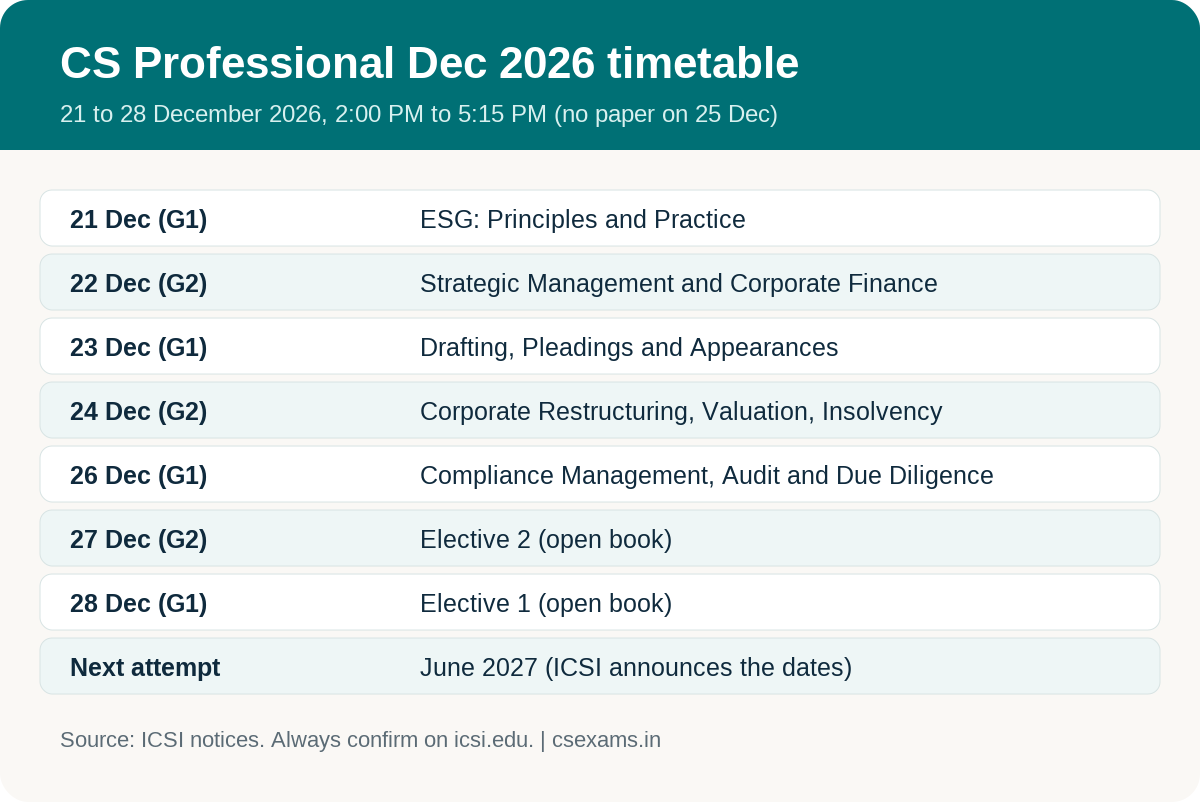
Latest update (18 Nov 2026): the CS Professional December 2026 exams run from 21 to 28 December 2026 (2:00 PM to 5:15 PM, no paper on 25 December). The next attempt after that is June 2027; ICSI announces its dates closer to the time.
| What | Date |
|---|---|
| CS Professional Dec 2026 exams | 21 to 28 December 2026 |
| Admit card | Expected in the second week of December 2026 on icsi.edu, based on past years (the Dec 2025 cards came on 12 December 2025) |
| Dec 2026 result | Expected around 25 February 2027, based on past years (the Dec 2025 result came on 25 February 2026) |
| Next attempt | June 2027 |
Write full papers under time before the exam: our CS Professional test series has papers on the ICSI pattern, checked by Company Secretaries. See plans and prices.
Always confirm dates on the official ICSI website, icsi.edu.
You have around a month. Here is how to split it.
CMADD Dec 2026 date and the Group 1 order
| Date | CS Professional paper | Group |
|---|---|---|
| 21 Dec 2026 (Mon) | ESG, Principles and Practice | Group 1 |
| 23 Dec 2026 (Wed) | Drafting, Pleadings and Appearances | Group 1 |
| 26 Dec 2026 (Sat) | Compliance Management, Audit and Due Diligence | Group 1 |
| 28 Dec 2026 (Mon) | Elective 1 (open book) | Group 1 |
CMADD comes after the 25 December holiday, so you get two clear days after Drafting. Use them for CMADD only. Do not spend them on the elective, which is an open book paper and needs a different kind of preparation.
CS Professional CMADD syllabus and weightage
The ICSI 2022 syllabus gives Part I Compliance Management 40 marks and Part II Audit and Due Diligence 60 marks.
| Part | Weightage | Chapters |
|---|---|---|
| Part I: Compliance Management | 40% | Compliance Framework; Documentation and Maintenance of Records; Signing and Certification; Legal Framework Governing Company Secretaries; Values, Ethics and Professional Conduct; Non Compliances, Penalties and Adjudications; Relief and Remedies |
| Part II: Audit and Due Diligence | 60% | Concepts of Various Audits; Audit Engagement; Audit Principles and Techniques; Audit Process and Documentation; Forming an Opinion and Reporting; Secretarial Audit; Internal Audit and Performance Audit; Peer Review and Quality Review; Due Diligence |
ICSI has published a supplement for CMADD for the December 2026 session, and its study material list says most Professional papers are updated till 31 May 2026. Read the supplement first, before your revision round, so the changes go into your notes and not into a last-minute panic.
Part I: compliance chapters
Part I tests whether you know what a company must file, keep and sign, and what happens if it does not. Signing and Certification is a scoring chapter: which forms and documents need certification by a practising professional, and what that certification means. Our post on the Company Secretary as scrutinizer is a good refresher on one such role.
Values, Ethics and Professional Conduct links to the Company Secretaries Act and the code of conduct. Questions often describe what a professional did and ask whether it is misconduct. Learn the schedules of professional misconduct and practise writing a short answer with the rule and a conclusion.
Non Compliances, Penalties and Adjudications and Relief and Remedies are about consequences: penalty provisions, adjudication, compounding and relief options. Keep a one-page table of the main penalty and compounding routes.
Part II: audit and due diligence
Secretarial audit
This is the heart of Part II. Know who must get a secretarial audit, the auditor's duties, the format of the report and how qualifications are reported. Practical questions often ask you to draft an observation or list the documents you would check.
Audit process and reporting
Audit Engagement, Audit Principles and Techniques, Audit Process and Documentation, and Forming an Opinion and Reporting work as one process. Write them out as a flow: engagement letter, planning, evidence, working papers, opinion, report. When you see a question on any one stage, place it in that flow and answer.
Due diligence
Due diligence questions are practical. They describe a transaction and ask what you would check. Answer in categories: legal, financial, regulatory, intellectual property, employees, contracts. Most students lose marks here because they write a list of documents with no reason for each. One line of purpose beside each item makes the answer look like real work.
Internal audit, performance audit and peer review
These three chapters often get less time than they deserve. They sit late in the study material and students reach them tired. Yet they produce regular short and medium questions, and the answers are easy to structure.
For internal audit, learn its scope, how it differs from statutory audit, and the role of the audit committee in relation to it. For performance audit, focus on what is measured: economy, efficiency and effectiveness of operations, and how the auditor reports findings. Keep a small table comparing statutory audit, internal audit, secretarial audit and performance audit on purpose, who appoints, who reports to whom, and the output. That one table can answer several distinguish-between questions.
Peer review and quality review are about checking the work of practising professionals. ICSI runs a peer review mechanism for practice units. Know why peer review exists, what the reviewer checks and how it supports the quality of attestation work. Quality review questions are usually about the objectives and process.
A practical tip: when a question asks you to compare two kinds of audit, draw the table straight away in the answer book. A neat table with five rows earns marks faster than two pages of text, and examiners in CMADD clearly reward it.
A 30-day CMADD plan
This assumes 2 hours a day for CMADD alongside your other Group 1 papers.
| Days | Focus |
|---|---|
| 1 to 2 | Read the Dec 2026 supplement and update notes |
| 3 to 6 | Compliance framework, records, signing and certification |
| 7 to 9 | Legal framework, ethics, penalties, relief and remedies |
| 10 to 14 | Audit concepts, engagement, principles, process, reporting |
| 15 to 18 | Secretarial audit in detail, with sample report formats |
| 19 to 21 | Internal audit, performance audit, peer review, quality review |
| 22 to 24 | Due diligence with practice questions |
| 25 to 27 | One full 3-hour paper and its review |
| 28 to 30 | Fast revision; 24 and 25 Dec for final reading |
For how this fits with the other Professional papers, see our CS Professional Dec 2026 last month revision plan.
Writing answers that score in CMADD
CMADD answers are judged on whether they read like a professional's work. Use headings, cite the relevant law or standard where you are sure of it, and give a clear conclusion. When asked to draft, use the format: heading, addressee, body, signature block with date and place.
- Do not write audit answers as theory alone. Add what you would check and what you would report.
- In ethics questions, state the rule, apply it to the facts, then conclude.
- Keep due diligence answers in category tables or short headed lists.
- Leave two lines between answers so the examiner sees where each one ends.
Writing one full paper under time pressure shows you if you can finish a long due diligence answer and still reach the last question. In our CS Professional test series, a practising Company Secretary checks CMADD papers and tells you which answers missed the expected structure. That feedback in the last month is worth more than one more reading round.
Final week checklist
By 20 December you should have read every chapter twice and written at least one full paper. In the last days, read only your own notes: the penalty table, the audit flow, the secretarial audit report format and the due diligence categories. Sleep well before 26 December. CMADD is long, and a tired hand writes short answers.
Frequently asked questions
When is the CS Professional CMADD exam in December 2026?
Compliance Management, Audit and Due Diligence is scheduled for Saturday, 26 December 2026, from 2:00 PM to 5:15 PM including reading time.
What is the weightage of audit in CS Professional CMADD?
Part II Audit and Due Diligence carries 60 marks and Part I Compliance Management carries 40 marks under the 2022 syllabus.
Is there a supplement for CMADD for December 2026?
Yes. ICSI has published a CMADD supplement for the December 2026 session on its website, and students are advised to read it with the study material.
Is CMADD in Group 1 or Group 2 of CS Professional?
CMADD is Paper 3 in Group 1 of the CS Professional Programme.
Is CMADD an open book paper?
No. Only the elective papers of CS Professional are open book. CMADD is a regular written paper.
Which chapters are most important in CMADD?
Secretarial audit, the audit process and reporting chapters, and due diligence carry the most weight, while signing and certification and ethics are scoring chapters in Part I.
Practise what you just read