In this article (16)
- CS vs LLB: the basic comparison
- What CS gives you that LLB does not
- What LLB gives you that CS does not
- Doing CS with LLB: how the two fit together
- Common ways students combine them
- Study style: reading cases vs writing compliance answers
- How long each route takes
- Which one should you pick
- A note from our checkers
- Frequently asked questions
- Which is better, CS or LLB?
- Can I do CS and LLB together?
- Do LLB graduates get exemption in CS Executive?
- Can a company secretary appear in court?
- Is CS harder than LLB?
- Which pays more, CS or LLB?
CS vs LLB is not really a fight between two courses. LLB makes you a lawyer who can be enrolled with a State Bar Council and argue in court. CS makes you a governance and compliance professional who works inside companies or runs a practice. If corporate law is your target, the most useful answer is often "both, in the right order".
Latest update (18 Nov 2026): CS Executive and CS Professional December 2026 exams run from 21 to 28 December 2026; the next attempt is June 2027. The next CSEET is on 1 to 4 February 2027, and June 2027 CSEET registration is open till 28 February 2027.
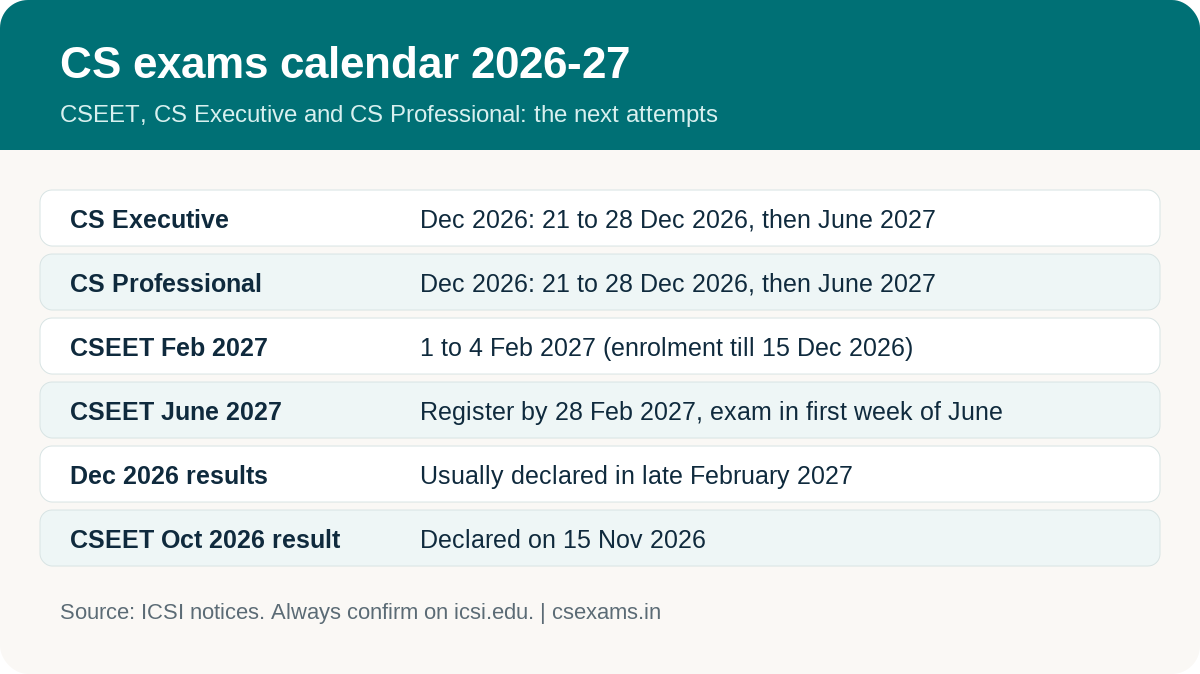
| Exam | Next dates |
|---|---|
| CS Executive | 21 to 28 Dec 2026, then June 2027 |
| CS Professional | 21 to 28 Dec 2026, then June 2027 |
| CSEET | 1 to 4 Feb 2027, then the first week of June 2027 |
| Dec 2026 results | Expected around 25 February 2027, based on past years |
Test series for every level: CSEET, CS Executive and CS Professional, checked by Company Secretaries.
Always confirm dates on the official ICSI website, icsi.edu.
Still, not everyone wants or needs two qualifications. This post compares CS and LLB on what they let you do, how the study feels, how long they take and where they lead, so you can make the call with real information.
CS vs LLB: the basic comparison
Here is the simple side-by-side picture. Fees are left out on purpose because both universities and ICSI revise them; check the current numbers on the official sites.
| Point | CS (Company Secretary) | LLB (Bachelor of Laws) |
|---|---|---|
| Who runs it | ICSI, a statutory body under the Company Secretaries Act, 1980 | Universities and law colleges, under Bar Council of India rules |
| Routes | CSEET, CS Executive, CS Professional, then training and membership | 3 year LLB after graduation, or 5 year integrated course after Class 12 |
| Main subjects | Company law, securities law, governance, tax, drafting, corporate restructuring | Constitution, contracts, criminal law, civil procedure, evidence, property, plus electives |
| Exams | Professional exams held by ICSI twice a year | University semester exams |
| Right to practise | Practising CS after membership and a certificate of practice | Advocate after enrolment and passing the All India Bar Examination |
| Court work | Can appear before some tribunals where the law permits | Can appear in courts across India as an advocate |
What CS gives you that LLB does not
CS is built around the company. You learn the Companies Act, 2013 in depth, SEBI regulations, listing obligations, insider trading rules, FEMA, insolvency and corporate restructuring. The CS Professional papers go further into drafting, due diligence, valuation and ESG.
The qualification also carries statutory roles. Listed companies and companies above the paid-up capital limit in the rules must appoint a whole-time company secretary. Secretarial audit under section 204 of the Companies Act can only be done by a company secretary in practice. A general law degree does not give you either of these.
So if you want to be the person who runs board meetings, files with the Registrar of Companies and keeps a listed company compliant, CS is the qualification that matters. Read more on this in our post on company secretary career scope.
What LLB gives you that CS does not
LLB gives you the right to become an advocate. After your degree, you enrol with a State Bar Council and pass the All India Bar Examination to practise. That opens litigation, court appearances, criminal and civil work, and the full range of legal practice.
LLB also covers areas CS barely touches: criminal law, family law, evidence, civil procedure and constitutional law in depth. If you want courtroom work, or a career in judiciary exams, LLB is the only route.
Most corporate law firms hire law graduates as associates. A CS alone will not get you an associate role in a law firm's transactional team, though CS knowledge is valued there.
Doing CS with LLB: how the two fit together
The overlap between the two courses is real. Contract law, company law, interpretation of statutes, IPR and labour law appear in both. That is why ICSI gives law graduates a paper-wise exemption at CS Executive level, which we cover in detail in our post on CS Executive exemption for LLB students.
Common ways students combine them
- 5 year law student: take CSEET in the first or second year, then CS Executive in the middle years. You finish law with CS Executive or more done.
- Graduate going for 3 year LLB: join CS Executive alongside the LLB. Your law classes help directly in Jurisprudence, Interpretation and General Laws and in the business law papers.
- CS first, LLB later: some working company secretaries do an LLB from an evening college to add court and tribunal work.
The hard part is time. Law college has attendance rules, moot courts and internships. CS has two exam windows a year with strict passing rules. Plan your CS attempts away from your semester exams, and do not try to clear both CS Executive groups in the same attempt as a heavy law semester unless you are very disciplined.
Study style: reading cases vs writing compliance answers
Both courses are law, but the exams test different skills.
LLB exams reward reading cases, building arguments and citing judgments. CS exams reward quoting the exact provision, applying it to a short fact pattern and reaching a clear answer in limited words. A law student who writes long, essay-style answers often loses marks in CS because the examiner wants the section, the rule, the application and the conclusion.
Most students lose marks here because they write everything they know about a topic instead of answering the question asked. Practice writing CS answers against the clock early. Our CS Executive test series has papers in the ICSI pattern, checked by Company Secretaries, so you learn this format before the real exam.
How long each route takes
Time is often the deciding factor, so plan it honestly. A 5 year integrated law course starts after Class 12 and takes five years. The 3 year LLB starts after a graduation, so from Class 12 you are looking at about six years. After either one, Bar enrolment and the All India Bar Examination come before independent practice.
CS has no fixed calendar length because it depends on how quickly you clear each stage. You clear CSEET, then the two groups of CS Executive, then the two groups of CS Professional, and complete the practical training ICSI requires before membership. Students who pass each stage on the first try finish much faster than the average, and one failed group can add six months. Our CS course duration guide breaks this down stage by stage.
If you do the two together, the total time is far less than doing them one after another. The 5 year law route with CS alongside is the most time-efficient way to end up with both, as long as you protect your CS exam months from moot and internship pressure.
One more practical point: CS gives you a professional title earlier in some cases, because you can clear Executive and start training while still in college. That training experience is a real advantage when you later apply to law firms or company legal teams.
Which one should you pick
Use this simple guide.
| Your goal | Better choice |
|---|---|
| Courtroom practice or judiciary | LLB |
| Compliance or company secretary role in a listed company | CS |
| Corporate law firm associate | LLB, with CS as a strong add-on |
| Your own practice in corporate compliance, ROC and tribunal work | CS, with LLB as a strong add-on |
| Not sure yet, but like law | Start CSEET while doing a law or commerce degree, then decide |
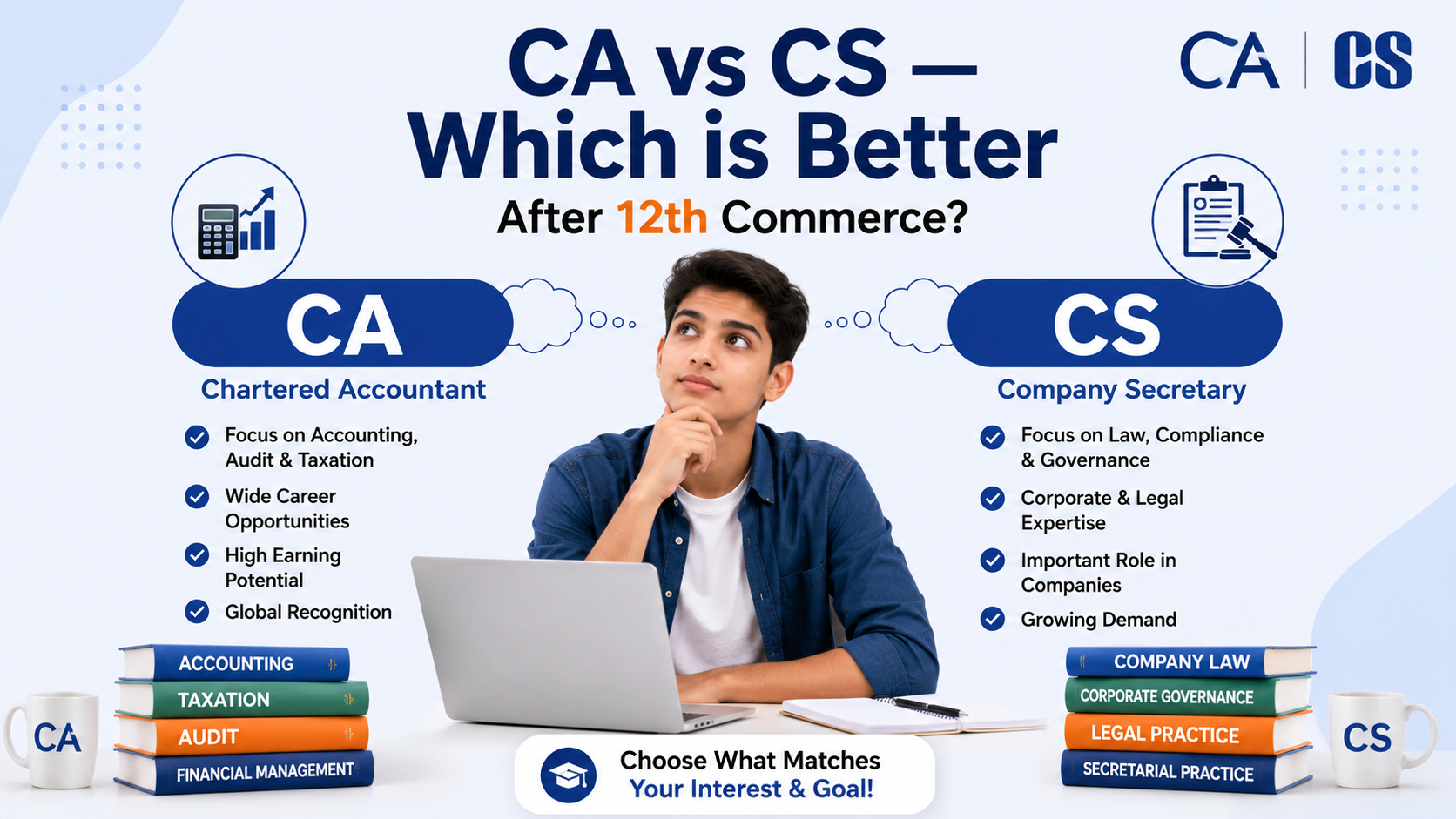
If you are a commerce student comparing other professional courses too, our post on CA vs CS after 12th commerce might help you round out the picture.
A note from our checkers
We check thousands of CS answer sheets, and law students are often our best writers once they adjust to the CS answer format. Their weak spot is usually the numerical papers, Corporate Accounting and Financial Management at Executive level and Tax Laws and Practice. If you are coming from law, give those two papers a head start of a few extra weeks.
When you are ready to start, the CSEET test series is the first step, and you can see the full set of options on our plans page.
Frequently asked questions
Which is better, CS or LLB?
LLB is better if you want to argue cases in court, because only an enrolled advocate can do that. CS is better if you want to work inside companies on compliance and governance. For corporate law, the two together are strongest.
Can I do CS and LLB together?
Yes. ICSI allows you to pursue CS along with a degree, including LLB. Many students take CS Executive exams while in the second or third year of a 5 year law course.
Do LLB graduates get exemption in CS Executive?
ICSI gives law graduates a paper-wise exemption in CS Executive under its exemption rules. Check the current list and the fee for claiming it on icsi.edu before you apply.
Can a company secretary appear in court?
A company secretary in practice can appear before certain tribunals and authorities such as the NCLT where the law allows it, but cannot practise as an advocate in regular courts without an LLB and Bar enrolment.
Is CS harder than LLB?
They are hard in different ways. CS has fewer subjects but tough professional exams with strict passing marks, while LLB is a long university degree with many subjects and moot work.
Which pays more, CS or LLB?
Pay depends on the firm, city and your skill more than the degree. Lawyers in top firms and senior company secretaries in large listed companies both earn well, and the combination opens more doors.
Practise what you just read