In this article (19)
- Where a CS Executive passed student stands
- Jobs after CS Executive: the main roles
- Compliance assistant or secretarial executive
- Assistant in a practising CS firm
- Legal assistant or contract support
- KPO and legal process roles
- Accounts and tax support
- Skills employers actually check
- Building a CV that gets shortlisted
- Where to find openings
- Job, training or full-time study: how to decide
- Keeping CS Professional on track while you work
- Frequently asked questions
- Can I get a job after clearing CS Executive?
- Can a CS Executive student become a company secretary of a company?
- Is a job or training better after CS Executive?
- Where can CS Executive students find jobs?
- Should I take a job while preparing for CS Professional?
- Do I need to clear both groups of CS Executive to get a job?
Yes, you can get a job after CS Executive. Practising CS firms, CA firms with a company law practice, compliance teams in companies and legal process firms regularly hire students who have cleared CS Executive. What you cannot do yet is hold the post of company secretary, because that needs ICSI membership after CS Professional and training.
Latest update (18 Nov 2026): CS Executive and CS Professional December 2026 exams run from 21 to 28 December 2026; the next attempt is June 2027. The next CSEET is on 1 to 4 February 2027, and June 2027 CSEET registration is open till 28 February 2027.
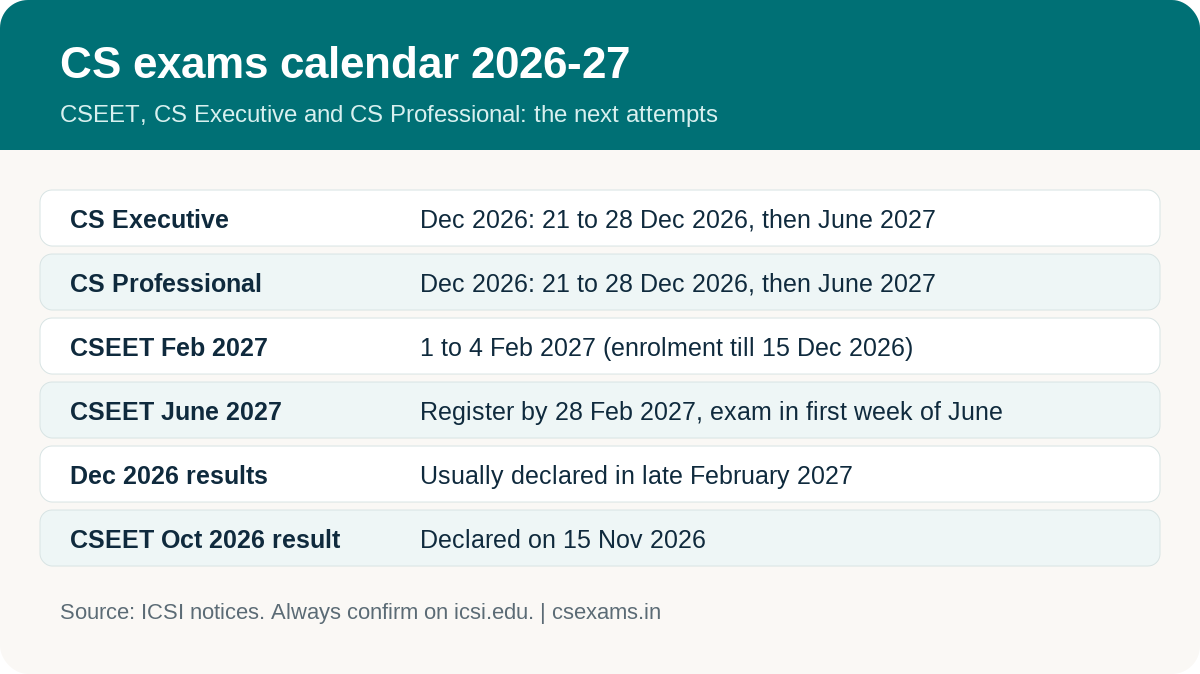
| Exam | Next dates |
|---|---|
| CS Executive | 21 to 28 Dec 2026, then June 2027 |
| CS Professional | 21 to 28 Dec 2026, then June 2027 |
| CSEET | 1 to 4 Feb 2027, then the first week of June 2027 |
| Dec 2026 results | Expected around 25 February 2027, based on past years |
Test series for every level: CSEET, CS Executive and CS Professional, checked by Company Secretaries.
Always confirm dates on the official ICSI website, icsi.edu.
So jobs after CS Executive are support and executive level roles. They are a good way to learn the real work, earn some money and make CS Professional papers easier to understand. This post covers the roles, the skills employers check, where openings come from and how to keep your CS Professional attempt on track.
Where a CS Executive passed student stands
CS Executive is the middle level of the course. Clearing both groups shows an employer that you know company law, securities law, tax basics, business setup and corporate accounting. That is a solid base for compliance work.
What the law reserves for members is also clear. The whole-time company secretary that listed companies and larger companies must appoint has to be a member of ICSI. Secretarial audit and certain certifications need a company secretary in practice. You will support that work, not sign it.
| Stage | What you can usually do | What you cannot do yet |
|---|---|---|
| One group of CS Executive cleared | Internships and entry support roles in CS or CA firms | Most executive roles that ask for CS Executive passed |
| Both groups of CS Executive cleared | Compliance assistant, secretarial executive, legal assistant, KPO roles; start ICSI training | Be appointed as company secretary or sign compliance certificates |
| CS Professional cleared, training done | Apply for ICSI membership, then company secretary roles | Practise on your own without a certificate of practice |
Jobs after CS Executive: the main roles
Compliance assistant or secretarial executive
This is the most common role. You prepare board and general meeting notices, draft minutes, maintain statutory registers, track due dates and prepare ROC filings on the MCA portal. In listed companies you help with stock exchange disclosures under the SEBI listing regulations. Your Company Law and Practice and Capital Market and Securities Laws papers are used every day here.
Assistant in a practising CS firm
CS firms handle incorporations, annual filings, changes in directors and capital, LLP work, trademark filings and due diligence for many clients at once. You get exposure to a wide range of companies quickly. The pace is fast, especially around annual filing season, but the learning is the best you will get at this stage.
Legal assistant or contract support
Some companies and law firms hire CS Executive students to help with contract review, drafting standard agreements and maintaining legal registers. Papers like Jurisprudence, Interpretation and General Laws and Economic, Commercial and Intellectual Property Laws help here.
KPO and legal process roles
Knowledge process firms that serve banks and global clients hire for corporate actions, KYC, governance research and regulatory reporting. These roles value your law reading skill and attention to detail.
Accounts and tax support
If you did well in Corporate Accounting and Financial Management and Tax Laws and Practice, small firms may also use you for GST returns, TDS work and book-keeping support alongside secretarial work.
Skills employers actually check
Your marksheet gets you the interview. These skills get you the job.
- Drafting: can you write a clean board resolution or a notice for a general meeting without copying a template blindly?
- MCA portal basics: knowing the common forms for annual filing, director changes and charge creation, and what each one is for.
- Section recall: interviewers often ask simple questions on key sections of the Companies Act, like board meeting rules or related party transactions.
- Excel and email: compliance trackers live in spreadsheets, and client communication is mostly email.
Most students lose out in interviews because they studied for marks and cannot explain a provision in plain words. Practise explaining five common company law provisions out loud, as if to a client. Our posts on company incorporation in CS Executive and CS Executive company law are good refreshers before an interview.
Building a CV that gets shortlisted
A CS Executive CV is usually one page, and the people reading it are busy partners or compliance heads. Put your CS stage and the groups cleared at the top, with the attempt month. Then list the practical things you can do: drafting notices and minutes, MCA filings you have prepared, registers you have maintained, and software like Excel. If you did an internship, write two lines on the actual tasks, not just the firm name.
Add your BCom, BBA or LLB details below that, and keep hobbies short. A clean CV with specific tasks gets more calls than one with long lists of soft skills. Before an interview, read the firm's website so you know whether it handles listed companies, startups or LLPs, and prepare a few examples that match their work.
Where to find openings
Openings for CS Executive students rarely appear on big job portals with clear titles. Look in these places.
- ICSI placement portal: ICSI runs a portal for students and members. Our post on the ICSI placement portal explains how it works.
- ICSI chapters and regional councils: local chapters share training and job openings from firms in your city.
- Direct approach to CS firms: send a short email with your CV to practising CS firms near you. Many small firms hire this way.
- LinkedIn and job boards: search titles like compliance assistant, secretarial executive and corporate law assistant, not just company secretary.
- Seniors and batchmates: students one level ahead often know which firms are hiring for the next annual filing season.
Job, training or full-time study: how to decide
ICSI training is compulsory before membership, so the first decision after CS Executive is usually where to do it. Some students take training and study CS Professional side by side. Others first take a job and do training later. Check ICSI's current training rules on icsi.edu before you accept any role, so that your work time also counts where possible.
A practical rule we give students: if you have CS Professional papers due in the next attempt, choose a role or training place with predictable hours. A firm that keeps you till 10 pm in every filing season will cost you attempts. If your exam is a year away, a busy firm can be worth it for the learning.
Keeping CS Professional on track while you work
CS Professional is a big step up, with drafting, due diligence, valuation, ESG and two electives. Working students who clear it usually follow a simple routine.
- Two to three hours every weekday, mostly early morning, and longer sessions on weekends.
- One paper at a time in depth, then a rolling revision of the others every weekend.
- Use your work: compliance tasks you do at the office are exactly what Compliance Management, Audit and Due Diligence asks about.
- Write full mock papers in the last two months, not just read.
Our CS Professional test series is built for working students, with flexible paper schedules and answer sheets checked by Company Secretaries. If you are still finishing CS Executive, the CS Executive test series helps you clear both groups first, and you can compare all options on the plans page.
Frequently asked questions
Can I get a job after clearing CS Executive?
Yes. Many companies and practising CS firms hire CS Executive passed students as compliance assistants, secretarial executives or legal assistants. The title of company secretary itself needs full membership.
Can a CS Executive student become a company secretary of a company?
No. The company secretary appointed as key managerial personnel must be a member of ICSI, which needs CS Professional, training and membership.
Is a job or training better after CS Executive?
Training is compulsory for membership, so most students start it after Executive. A job in a compliance team can also give strong experience, but check how it fits ICSI's training rules before you join.
Where can CS Executive students find jobs?
Practising CS firms, CA firms with a corporate compliance practice, company secretarial departments, KPOs and legal process firms, and job boards. ICSI also runs a placement portal for its students and members.
Should I take a job while preparing for CS Professional?
It can work if the job gives you 2 to 3 hours a day for study and leave around the exam. Many students clear CS Professional while working in compliance, because the work itself helps in papers like CMADD.
Do I need to clear both groups of CS Executive to get a job?
Not always. Some firms hire students with one group cleared for support roles, but clearing both groups makes your profile much stronger.
Practise what you just read