In this article (15)
- How the two courses are structured now
- Entry routes into CS for CA students
- Where the exam calendars clash
- An order of levels that works for most students
- Where the two syllabi overlap
- A sample year for a CA Inter and CS Executive student
- Is it worth doing CA and CS together
- Common mistakes when doing both
- Frequently asked questions
- Can I do CA and CS together?
- Do CA students need to write the CSEET?
- Does a CA qualification give exemption in CS Executive papers?
- When do CA and CS exams clash?
- Should I do CS Executive after CA Inter?
- How many times a year are CS Executive exams held?
Yes, you can do CA and CS together. Neither ICAI nor ICSI stops a student from being registered in both courses at the same time, and many Company Secretaries also hold a CA qualification. The real question is not whether it is allowed but whether your calendar and energy can carry both. With the exam cycles of 2026 and 2027, there are a few months where the two collide, and planning around them is what decides whether you finish both or stall in both.
Latest update (18 Nov 2026): CS Executive and CS Professional December 2026 exams run from 21 to 28 December 2026; the next attempt is June 2027. The next CSEET is on 1 to 4 February 2027, and June 2027 CSEET registration is open till 28 February 2027.
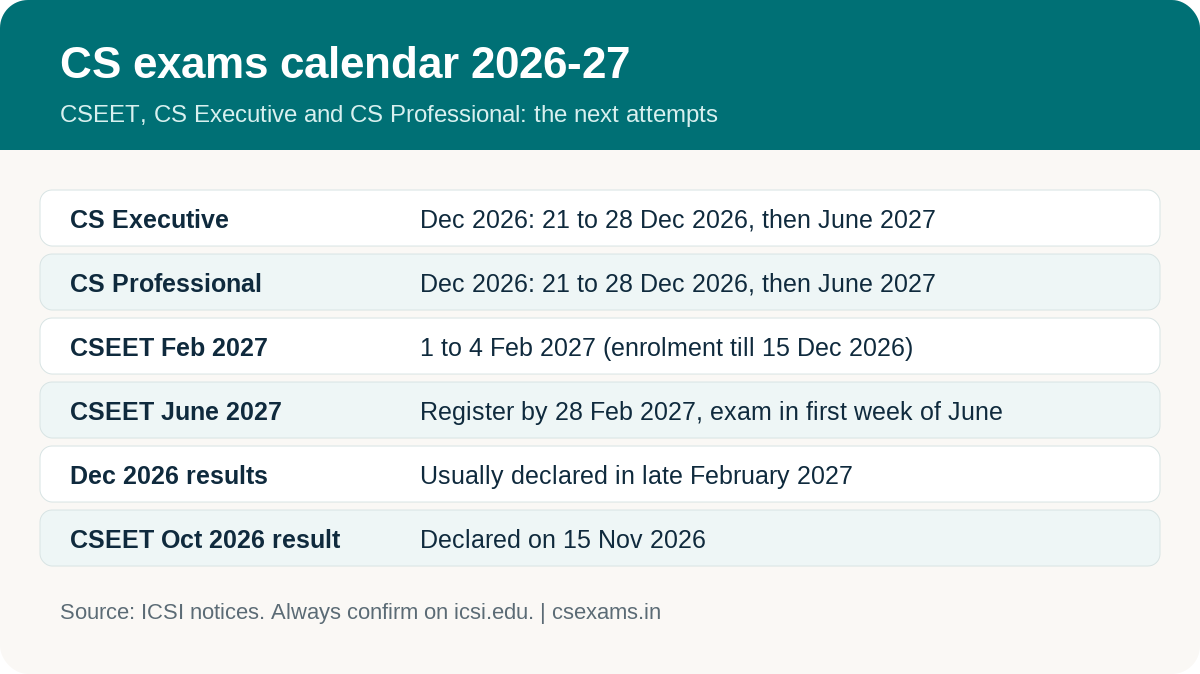
| Exam | Next dates |
|---|---|
| CS Executive | 21 to 28 Dec 2026, then June 2027 |
| CS Professional | 21 to 28 Dec 2026, then June 2027 |
| CSEET | 1 to 4 Feb 2027, then the first week of June 2027 |
| Dec 2026 results | Expected around 25 February 2027, based on past years |
Test series for every level: CSEET, CS Executive and CS Professional, checked by Company Secretaries.
Always confirm dates on the official ICSI website, icsi.edu.
This guide walks through the entry routes, the clash months, an order of levels that works for most students, and an honest look at the workload.
How the two courses are structured now
Both courses have changed in the last few years, so older advice about doing CA and CS together is often out of date.
| Point | CA (ICAI) | CS (ICSI) |
|---|---|---|
| Entry level | CA Foundation, three times a year (January, May, September) | CSEET, three times a year (February, June, October) |
| Middle level | CA Intermediate, three times a year (January, May, September) | CS Executive, twice a year (June, December) |
| Final level | CA Final, twice a year (May, November) since May 2026 | CS Professional, twice a year (June, December) |
| Practical training | Articleship under ICAI rules | Long term training of 21 months after CS Executive, plus EDP and CLDP |
For the CS side in more depth, our CS course duration post explains each level and how long it usually takes.
Entry routes into CS for CA students
You do not always need to write the CSEET. ICSI lets graduates and postgraduates in any discipline, students in the final year of a bachelor's degree, and those who have passed the CA Final or CMA Final register directly for CS Executive. ICSI's current fee table also lists CA Intermediate pass among the direct admission categories, so check your category on icsi.edu before you pay.
- After Class 12: CSEET first, then CS Executive. This is the longest route.
- During or after graduation: skip the CSEET and register for CS Executive directly, paying ICSI's CSEET exemption fee.
- After CA Final: skip the CSEET as well. Note that ICSI's syllabus 2022 circular on paper-wise exemptions lists only LLB and CMA Final, so a CA qualification does not exempt you from any CS Executive paper.
If you are going the graduation route, our guide to preparing for CS after graduation is a good next read.
Where the exam calendars clash
This is the part most students do not map out. Look at the 2026 to 2027 season as an example. CS Executive and Professional exams run from 21 to 28 December 2026. CA Intermediate Group 1 starts on 2 January 2027 and CA Foundation Paper 1 is on 3 January 2027. That leaves only a few days between the last CS paper and the first CA paper.
| Window | CA papers | CS papers | Risk |
|---|---|---|---|
| Late December to early January | CA Foundation and Inter (January) | CS Executive and Professional (December) | High: back to back |
| May to June | CA Foundation, Inter and Final (May) | CS Executive and Professional (June) | High: one month gap at best |
| September to October | CA Foundation and Inter (September) | CSEET (October) only | Low for Executive students |
| November | CA Final (November) | None | Low |
The practical lesson: do not plan to write a full CA level and a full CS level in the same window. Pick one main exam in each window and treat the other course as background study.
An order of levels that works for most students
There is no single right order, but this sequence keeps clashes small and lets each course help the other.
- CA Foundation first. Get into the CA system and clear the entry level.
- CA Intermediate next, with full focus. Its accounting, law and tax papers overlap with several CS Executive papers.
- Register for CS Executive once you are a graduate or in your final year (or eligible under another direct admission category), then write one Executive group in a window where you have no CA paper, such as December when you are not writing the January CA Inter.
- Finish CS Executive during articleship, using study leave carefully. Executive Group 2 papers like Tax Laws and CMSL sit close to what you study for CA.
- CA Final and CS Professional one after the other, not together. Both are heavy, and CS Professional has open book electives and long drafting papers that need their own preparation.
Students who try to write CA Final and CS Professional in back to back months usually end up repeating one of them.
Where the two syllabi overlap
Overlap is the main reason students take both courses. It saves study time but does not remove the need to learn the ICSI style of answers.
- Company law: covered in CA Intermediate law and in depth in CS Executive Company Law and Practice.
- Tax: CA Intermediate taxation and CS Executive Tax Laws and Practice cover income tax and GST.
- Accounting and finance: CA Intermediate accounting and financial management overlap with CS Executive Corporate Accounting and Financial Management.
- Securities law: CS Executive CMSL goes far deeper than CA papers, and it is where CA students most often underestimate the effort.
Most students lose marks here because they write CS answers in the CA style: short computations, few section references. ICSI examiners expect the provision, the section number, case law where relevant and a clear conclusion.
A sample year for a CA Inter and CS Executive student
Here is how one year might look for a graduate who is preparing for CA Intermediate and has registered for CS Executive. It is only an example, but it shows the idea of one main exam per window.
- January: no CA paper this attempt; finish the CS orientation programme and pre-exam test.
- February to May: full focus on CA Intermediate for the May attempt.
- June: rest, then light CS reading. Do not plan a CS Executive group in the same month as the May CA papers unless you are very confident.
- July to December: CS Executive Group 1 for the December exams, with weekend revision of CA papers you still have to clear.
The pattern can flip in your second year. What matters is that in every window you know which exam is the main one.
Is it worth doing CA and CS together
It can be, if you are clear about why. CS adds depth in company law, governance and securities compliance, which is useful for roles in listed companies, compliance and secretarial practice. CA gives you accounting, audit and tax depth. Together they make a strong profile for corporate legal and compliance work.
The cost is time. Expect your total course time to stretch, and expect weekends to go into study for a few years. If you are still undecided between the two, read our CA vs CS comparison first. Working students should also see our schedule for working professionals.
Common mistakes when doing both
- Registering for both levels in the same window and writing neither well.
- Assuming CA preparation covers CS Executive Company Law or CMSL. It covers the base, not the depth.
- Missing ICSI steps like the orientation programme and pre-exam test while busy with CA.
- Letting CS registration validity run out during a long CA phase. Check the validity on your ICSI login.
When you do write a CS level, practise in the ICSI format. Our CS Executive test series and CS Professional test series give you papers checked by Company Secretaries, and the plans page shows options by level. For ICSI's own rules on entry, see the ICSI CSEET announcement, which lists who can register directly for CS Executive.
Frequently asked questions
Can I do CA and CS together?
Yes. A student can be registered with ICAI and ICSI at the same time. The challenge is planning around the exam calendars so that the two do not clash.
Do CA students need to write the CSEET?
Not always. Graduates, final year degree students and those who have passed the CA Final can register directly for CS Executive without the CSEET.
Does a CA qualification give exemption in CS Executive papers?
Under syllabus 2022, ICSI's paper-wise exemption circular lists only LLB and CMA Final, so CA does not exempt you from any CS Executive paper.
When do CA and CS exams clash?
The tightest windows are late December to early January (CS December exams and CA January exams) and May to June (CA May exams and CS June exams).
Should I do CS Executive after CA Inter?
Many students find it works well, because CA Intermediate law, tax and accounting overlap with several CS Executive papers. Write CS papers in a window with no CA exam.
How many times a year are CS Executive exams held?
CS Executive and CS Professional exams are held twice a year, in June and December. The CSEET is held in February, June and October.
Practise what you just read