In this article (15)
- What is secretarial audit under Section 204
- Which companies need a secretarial audit
- What a secretarial auditor checks
- The process step by step
- Form MR-3: how the report is structured
- Secretarial audit in the CS Professional exam
- Secretarial audit as a career for a new CS
- Common mistakes in secretarial audit answers
- Frequently asked questions
- Who can conduct a secretarial audit?
- Is secretarial audit applicable to private companies?
- What is Form MR-3?
- What is the threshold for secretarial audit in a public company?
- What is the difference between secretarial audit and statutory audit?
- In which CS Professional paper is secretarial audit covered?
A secretarial audit is a check of whether a company has followed the corporate laws that apply to it, done by an independent Company Secretary in practice and reported in Form MR-3. If you are in CS Professional, this is not just a chapter. It is the most common first assignment for anyone who starts a practice, and examiners know it.
Latest update (18 Nov 2026): the CS Professional December 2026 exams run from 21 to 28 December 2026 (2:00 PM to 5:15 PM, no paper on 25 December). The next attempt after that is June 2027; ICSI announces its dates closer to the time.
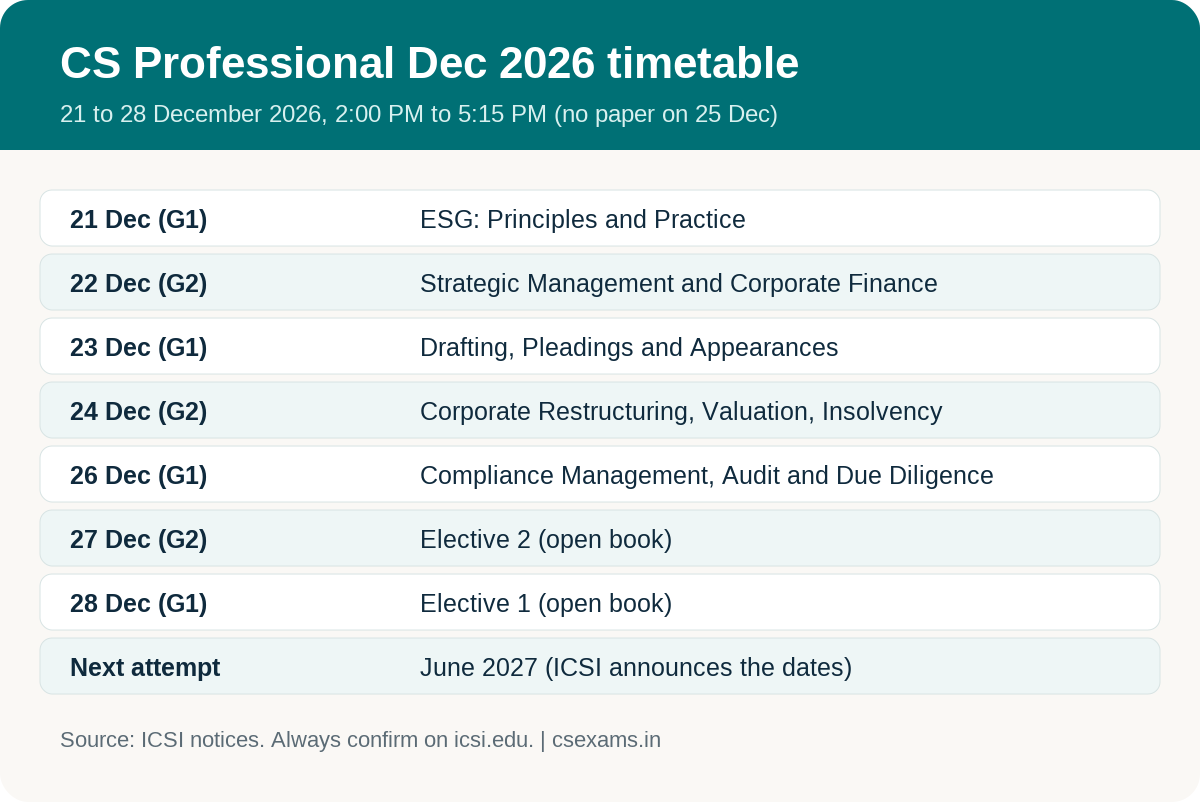
| What | Date |
|---|---|
| CS Professional Dec 2026 exams | 21 to 28 December 2026 |
| Admit card | Expected in the second week of December 2026 on icsi.edu, based on past years (the Dec 2025 cards came on 12 December 2025) |
| Dec 2026 result | Expected around 25 February 2027, based on past years (the Dec 2025 result came on 25 February 2026) |
| Next attempt | June 2027 |
Write full papers under time before the exam: our CS Professional test series has papers on the ICSI pattern, checked by Company Secretaries. See plans and prices.
Always confirm dates on the official ICSI website, icsi.edu.
This guide explains secretarial audit the way you will meet it in the exam and at work: what the law says, which companies need it, what the auditor actually checks, how the MR-3 report is built and the mistakes students make when writing answers on it.
What is secretarial audit under Section 204
Section 204 of the Companies Act, 2013 requires certain companies to annex a secretarial audit report to their Board's report. The report must be given by a Company Secretary in practice, which means a member of ICSI who holds a certificate of practice. A company secretary in employment of the same company cannot sign it.
The idea is simple. The statutory auditor checks the numbers. The secretarial auditor checks the process: were board meetings held properly, were forms filed with the Registrar on time, were related party approvals taken, were SEBI rules met for a listed company. Both reports go to shareholders, and both carry professional responsibility.
The Board has to explain in its report any qualification, observation or other remark made by the secretarial auditor. That one line in the law is why companies take this audit seriously. A bad remark sits in the annual report for every investor to read.
Which companies need a secretarial audit
Rule 9 of the Companies (Appointment and Remuneration of Managerial Personnel) Rules, 2014 lists the companies covered. Learn these four limbs exactly, because a one-word slip costs marks in a case question.
| Type of company | Threshold | Secretarial audit needed |
|---|---|---|
| Listed company | No threshold | Yes |
| Public company | Paid-up share capital of Rs 50 crore or more | Yes |
| Public company | Turnover of Rs 250 crore or more | Yes |
| Any company | Outstanding loans or borrowings from banks or public financial institutions of Rs 100 crore or more | Yes |
| Private company below the borrowing limit | Not covered by the above | No, under the Act |
Notice the last limb. It says "every company", so a private company with heavy bank borrowings is covered too. Students often write that private companies are fully outside Section 204, and that is wrong.
Listed entities also have Regulation 24A of the SEBI Listing Regulations. It requires a secretarial audit of the listed entity and its material unlisted subsidiaries incorporated in India, plus an annual secretarial compliance report. Since the December 2024 amendment, a listed entity appoints its secretarial auditor with shareholders' approval, the auditor must be peer reviewed, and the term is capped at one term of five years for an individual and two terms of five years for a firm. Always confirm the current text on the SEBI website before an attempt, because SEBI updates these rules often.
What a secretarial auditor checks
The scope comes from the format of MR-3 itself. The auditor states that records were examined under a list of laws, and the list tells you the scope.
- The Companies Act, 2013 and the rules made under it.
- The Securities Contracts (Regulation) Act, 1956 and its rules.
- The Depositories Act, 1996 and the related regulations.
- FEMA and the rules on foreign direct investment, overseas direct investment and external commercial borrowings, to the extent they apply.
- The SEBI regulations that apply, such as Listing Regulations, Takeover Regulations, Insider Trading Regulations and the ICDR Regulations.
- Other laws specifically applicable to the company's industry, such as banking, insurance or pharma rules.
- Compliance with the Secretarial Standards SS-1 and SS-2 issued by ICSI.
In practice, the work is a review of the minutes books, registers, filings on the MCA portal, stock exchange disclosures, board and committee papers, and the company's compliance reports from department heads. The auditor tests a sample, raises queries, and records the answers in working papers.
The process step by step
- Appointment by a board resolution (and shareholders' approval for listed entities under the SEBI rules), with a consent letter and eligibility confirmation from the auditor.
- An engagement letter that fixes the scope, period and fees.
- Planning: understanding the business, the applicable laws and the risk areas.
- Verification of records, filings and processes, usually on a sample basis.
- Discussion of findings with management.
- Signing the report in MR-3, with the UDIN generated on the ICSI portal.
Form MR-3: how the report is structured
MR-3 has a fixed shape, and you should be able to draft it from memory for CS Professional. It is addressed to the members of the company. It opens with the basis of the audit, then lists the laws checked, then gives the auditor's findings.
The main parts are the period covered (the financial year), the list of laws, the observation paragraph on non-compliance if any, and a paragraph on the board's composition, notice of meetings and the system for decision making. It ends with a paragraph on specific events during the year, such as a rights issue, buy-back, merger or major decision under Section 180.
Most students lose marks here because they write a general essay about audit instead of using the MR-3 headings. If a question says "draft a secretarial audit report", use the format. The examiner is checking whether you know it.
Secretarial audit in the CS Professional exam
In the current CS Professional syllabus, secretarial audit sits in the paper on Compliance Management, Audit and Due Diligence. Questions come in three forms: a direct theory question on applicability or scope, a case where you decide whether a company is covered, and a drafting question on MR-3 or a qualification paragraph.
The case questions are where the marks are. A typical one gives you a private company with Rs 40 crore paid-up capital and Rs 120 crore of bank loans, and asks if Section 204 applies. The answer turns on the borrowing limb, not on capital or turnover. Write the provision, apply it to the facts, then conclude. That three-step structure works in every case question. For a full plan for the paper, read our CMADD preparation strategy.
Practice is what turns this into marks. Write at least two MR-3 drafts and three applicability cases under time pressure, and get them checked. Our CS Professional test series has every answer checked by a Company Secretary, which shows you exactly where your drafting falls short.
Secretarial audit as a career for a new CS
Many new members start practice with secretarial audit and annual compliance work. The demand is steady because every listed company and many large unlisted ones need it each year, and SEBI's push for peer review has raised the value of a clean audit file.
To sign audit reports you need a certificate of practice from ICSI, and for listed entity work you need peer review. Before that, working in a practising firm during training is the best way to learn the real files. If you are planning the years after the course, our guide to career options after CS covers practice and employment side by side.
Common mistakes in secretarial audit answers
- Writing that private companies are never covered, forgetting the Rs 100 crore borrowing limb.
- Mixing up paid-up capital (Rs 50 crore) and turnover (Rs 250 crore) thresholds.
- Saying the company's own employed CS can sign MR-3.
- Forgetting that Secretarial Standards compliance is part of the report.
- Ignoring Regulation 24A when the facts mention a listed entity or its material subsidiary.
- Not mentioning that the Board must explain the auditor's qualifications in its report.
Keep a one-page sheet with the four thresholds, the MR-3 headings and the Regulation 24A points. Read it before every mock. It takes five minutes and saves the easy marks. For the official text, the ICSI guidance on icsi.edu is the best reference.
Frequently asked questions
Who can conduct a secretarial audit?
Only a Company Secretary in practice, that is an ICSI member holding a certificate of practice. For listed entities, SEBI also requires the auditor to be peer reviewed.
Is secretarial audit applicable to private companies?
Yes, if the private company has outstanding loans or borrowings from banks or public financial institutions of Rs 100 crore or more. Otherwise the Act does not require it.
What is Form MR-3?
MR-3 is the prescribed format of the secretarial audit report under Section 204. It is annexed to the Board's report of the company.
What is the threshold for secretarial audit in a public company?
A public company needs it if its paid-up share capital is Rs 50 crore or more, or its turnover is Rs 250 crore or more, or its borrowings from banks or public financial institutions are Rs 100 crore or more.
What is the difference between secretarial audit and statutory audit?
A statutory audit checks the financial statements. A secretarial audit checks compliance with corporate and other applicable laws, and is done by a Company Secretary in practice.
In which CS Professional paper is secretarial audit covered?
It is covered in Compliance Management, Audit and Due Diligence in the current CS Professional syllabus.
Practise what you just read