In this article (15)
- Why annual compliance matters for a CS
- Annual compliance calendar for a private limited company
- Board meetings and the director's disclosures
- AGM, financial statements and annual return
- Event-based filings that people forget
- Penalties for late filing
- Common compliance mistakes in small companies
- How this links to your CS exams
- Frequently asked questions
- What is the due date of AOC-4 for a private limited company?
- What is the due date of MGT-7A?
- By when must a private company hold its AGM?
- Is DIR-3 KYC still required every year?
- How many board meetings must a private company hold?
- Who files DPT-3?
The annual compliance of a private limited company comes down to one AGM, a set of board meetings and a handful of ROC forms, each with its own due date. Miss a date and the company pays additional fees for every day of delay. For CS students, this calendar is the first thing a firm will hand you during training, so it pays to know it cold.
Latest update (18 Nov 2026): CS Executive and CS Professional December 2026 exams run from 21 to 28 December 2026; the next attempt is June 2027. The next CSEET is on 1 to 4 February 2027, and June 2027 CSEET registration is open till 28 February 2027.
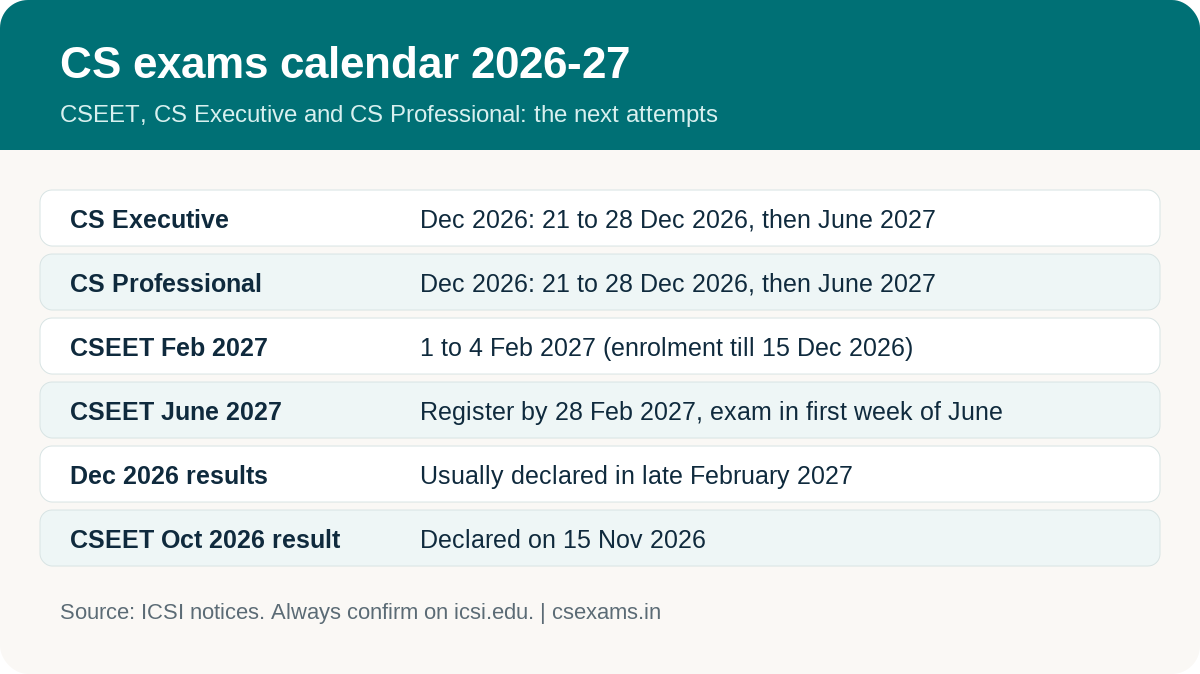
| Exam | Next dates |
|---|---|
| CS Executive | 21 to 28 Dec 2026, then June 2027 |
| CS Professional | 21 to 28 Dec 2026, then June 2027 |
| CSEET | 1 to 4 Feb 2027, then the first week of June 2027 |
| Dec 2026 results | Expected around 25 February 2027, based on past years |
Test series for every level: CSEET, CS Executive and CS Professional, checked by Company Secretaries.
Always confirm dates on the official ICSI website, icsi.edu.
This post gives the full annual compliance calendar for a private limited company under the Companies Act, 2013, the forms involved, who files them, and the small errors that cause the most trouble. Dates assume a financial year ending on 31 March.
Why annual compliance matters for a CS
A private company has fewer rules than a public company, but it is not compliance free. Every year it has to hold board meetings, get its accounts audited, hold an AGM, and file its financial statements and annual return with the Registrar. These filings are public on the MCA portal, and lenders, investors and buyers check them.
A company secretary in employment owns this calendar. A CS in practice handles it for dozens of small clients at once. Either way, the work is the same: track the dates, prepare the papers and certify the forms. If you are doing your training now, the company secretary internship guide explains what kind of work to ask for.
Annual compliance calendar for a private limited company
Here is the calendar in one table. Use it as a checklist, and confirm the current form versions on the MCA portal, because MCA revises forms and rules from time to time.
| Compliance | Form | Due date or time limit |
|---|---|---|
| Disclosure of interest by directors | MBP-1 | At the first board meeting of each financial year and on any change |
| Return of deposits and outstanding loans | DPT-3 | By 30 June every year (for 31 March data) |
| Half-yearly return on dues to MSME suppliers | MSME-1 | By 30 April (October to March) and 31 October (April to September), where such dues are outstanding beyond 45 days |
| Annual general meeting | Not a form | Within 6 months of the end of the financial year, so by 30 September; the first AGM within 9 months |
| Intimation of auditor appointment | ADT-1 | Within 15 days of the AGM at which the auditor is appointed |
| Filing of financial statements | AOC-4 | Within 30 days of the AGM |
| Filing of annual return | MGT-7A for small companies and OPCs, MGT-7 for others | Within 60 days of the AGM |
| Director KYC | DIR-3 KYC | Once every three years under the revised rules from 31 March 2026, plus updates when contact details change |
Board meetings and the director's disclosures
A private company must hold at least four board meetings in a calendar year, with no more than 120 days between two meetings. A small company or a One Person Company needs at least one meeting in each half of the calendar year, with a gap of at least 90 days between them. Notice must go to every director at least seven days in advance, as SS-1 requires.
At the first board meeting of every financial year, each director gives a disclosure of interest in Form MBP-1. Directors also give a declaration in Form DIR-8 that they are not disqualified. These are internal papers, kept in the company's records, but auditors and secretarial reviewers will ask for them.
The board meeting after year end approves the audited financial statements and the Board's report, and fixes the date of the AGM. Plan this meeting early. Most delays in AOC-4 filing start with a late audit, not a late form.
AGM, financial statements and annual return
The AGM must be held within six months of the end of the financial year, so 30 September for most companies. The first AGM can be held within nine months of the end of the first financial year. The ROC can extend the time for an AGM other than the first by up to three months, for special reasons.
After the AGM, three filings follow. ADT-1 goes within 15 days if an auditor is appointed or reappointed. AOC-4 with the audited financial statements and Board's report goes within 30 days. The annual return goes within 60 days, in MGT-7A for small companies and OPCs and in MGT-7 for other private companies.
The annual return of a company other than a small company or OPC must be signed by a director and a company secretary, or by a CS in practice where there is no company secretary. This is a direct source of work for practising CS members.
Event-based filings that people forget
- DIR-12 within 30 days of appointment or resignation of a director.
- MGT-14 within 30 days for resolutions that must be filed, such as special resolutions.
- SH-7 within 30 days of a change in authorised capital.
- PAS-3 within 30 days of an allotment of shares.
- CHG-1 for creation or modification of a charge, within the time allowed under Section 77.
- INC-22 for a change in registered office within the city, within 30 days.
Penalties for late filing
Late ROC forms attract an additional fee that grows with the delay. AOC-4 and MGT-7 or MGT-7A are the expensive ones, with an additional fee for each day of delay. Beyond the fee, continuous non-filing of financial statements or annual returns can lead to disqualification of directors under Section 164(2) and, in the worst case, the company being struck off.
The rates of additional fees are set in the Companies (Registration Offices and Fees) Rules, 2014 and revised from time to time. Check the current figures on the MCA portal before you advise a client. Never quote an old rate from memory.
Common compliance mistakes in small companies
- Counting the 30 and 60 day limits from the end of the financial year instead of from the AGM date.
- Filing MGT-7 when the company qualifies as a small company and should file MGT-7A, or the other way round.
- Missing DPT-3 because the company "has no deposits". The return also covers outstanding loans that are not deposits.
- Forgetting MSME-1 when supplier payments run past 45 days.
- Holding board meetings without proper notice or minutes, which then fails in a secretarial review.
- Not updating a director's mobile number or email, which blocks KYC.
Most students learn this only during training, and the first month is a scramble. Making your own calendar for a sample company while you are still studying puts you ahead of others in your batch.
How this links to your CS exams
Most of these filings come straight from CS Executive Company Law and Practice: meetings, accounts, annual return and charges. In CS Professional, the same calendar shows up in compliance management and due diligence questions, where you have to spot the missed filing in a case.
When you write an exam answer on a compliance date, quote the section and the form together. "Under Section 137, AOC-4 within 30 days of the AGM" scores better than just "30 days". Practising this kind of precise answer is easier with checked mock papers; our CS Executive test series and CS Professional test series mark exactly these details. For career paths that build on this work, see company secretary career scope.
Frequently asked questions
What is the due date of AOC-4 for a private limited company?
AOC-4 must be filed within 30 days of the annual general meeting at which the financial statements are adopted.
What is the due date of MGT-7A?
The annual return in MGT-7A, for small companies and One Person Companies, must be filed within 60 days of the AGM.
By when must a private company hold its AGM?
Within six months of the end of the financial year, so by 30 September for a March year end. The first AGM can be held within nine months.
Is DIR-3 KYC still required every year?
No. Under the revised rules from 31 March 2026, directors file DIR-3 KYC once every three years, and update contact details when they change.
How many board meetings must a private company hold?
At least four a year with a gap of not more than 120 days. A small company or OPC needs one meeting in each half of the calendar year.
Who files DPT-3?
Every company other than a government company files DPT-3 by 30 June for deposits and outstanding loans or money not treated as deposits.
Practise what you just read