In this article (15)
- What interviewers look for in a fresher CS
- Personal and HR questions
- Core company law questions with answer pointers
- Practical compliance questions
- Questions to prepare
- SEBI and listed company questions
- How to prepare in the last week
- Mistakes freshers make in CS interviews
- Frequently asked questions
- What questions are asked in a company secretary interview?
- How should a fresher CS prepare for an interview?
- Which companies must appoint a whole-time company secretary?
- Within how many days must a CS vacancy be filled?
- Is it fine to say I will check in an interview?
- Do CS trainees also face interviews?
Company secretary interview questions fall into four groups: questions about you, core company law, practical compliance work, and a few on SEBI and current changes. Freshers who prepare the second and third groups well usually do fine, because most candidates walk in with only theory from the study material.
Latest update (18 Nov 2026): CS Executive and CS Professional December 2026 exams run from 21 to 28 December 2026; the next attempt is June 2027. The next CSEET is on 1 to 4 February 2027, and June 2027 CSEET registration is open till 28 February 2027.
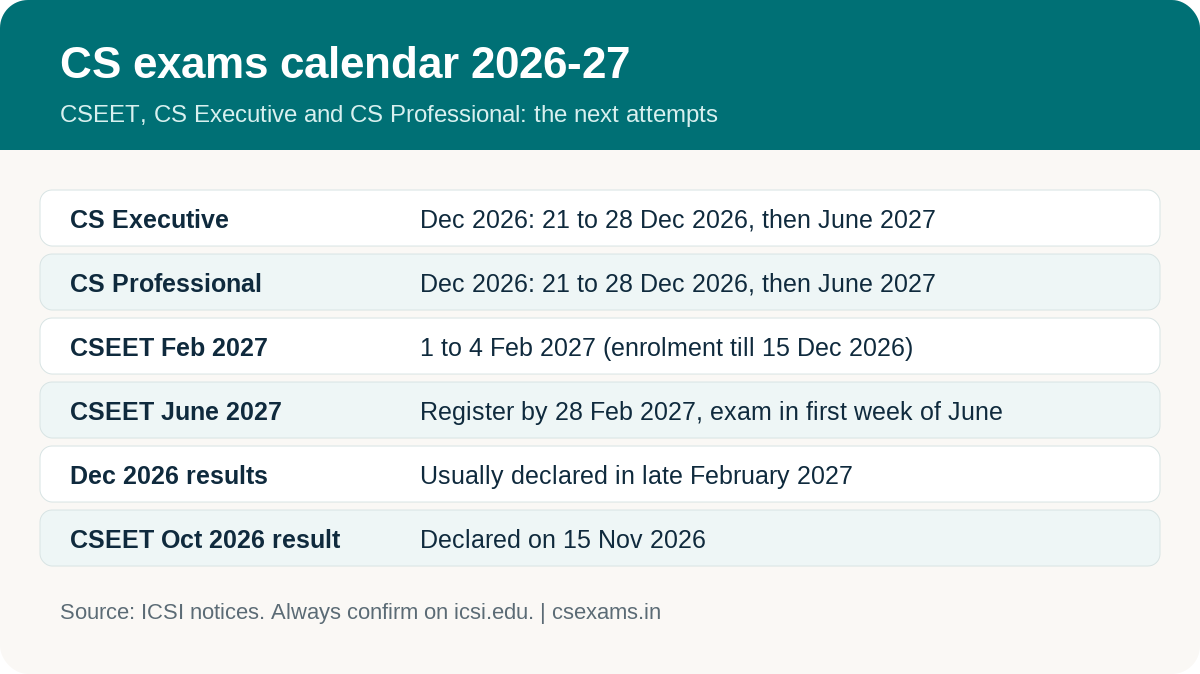
| Exam | Next dates |
|---|---|
| CS Executive | 21 to 28 Dec 2026, then June 2027 |
| CS Professional | 21 to 28 Dec 2026, then June 2027 |
| CSEET | 1 to 4 Feb 2027, then the first week of June 2027 |
| Dec 2026 results | Expected around 25 February 2027, based on past years |
Test series for every level: CSEET, CS Executive and CS Professional, checked by Company Secretaries.
Always confirm dates on the official ICSI website, icsi.edu.
This post lists the questions that come up most for newly qualified members and for CS Executive or Professional students going for training, with short answer pointers drawn from the Companies Act, 2013 and SEBI rules. Use it to prepare, not to memorise word for word.
What interviewers look for in a fresher CS
Panels for company secretary roles are usually a senior CS, a CFO or a partner of a practising firm. They know you have cleared the exams. What they want to see is whether you can be trusted with a filing deadline, whether you know where to look things up, and whether you can explain a rule in plain words to a director.
So the best answers are short, cite the section, and add one practical point. "Section 203 requires listed companies to have a whole-time company secretary, and in practice that person also signs the annual return" is a better answer than a paragraph of theory.
Personal and HR questions
- Tell us about yourself. Keep it to one minute: education, CS stage, training, one thing you are good at.
- Why company secretary and not CA or law. Give a real reason, such as an interest in governance or a training experience that stuck with you.
- What did you do during your training. Name the actual work: ROC filings, minutes drafting, board papers, a due diligence.
- Where do you see yourself in five years. Practice or employment, and a sector you like.
- Are you comfortable with deadlines and late evenings near AGM season. Be honest, and mention how you planned around exam deadlines.
If you are still deciding between employment and practice, our guide on career after CS sets out both paths.
Core company law questions with answer pointers
These come up in almost every interview, from a small private company to a listed group. Keep the answers sharp.
| Question | Answer pointer |
|---|---|
| Who is a key managerial personnel | Section 2(51): CEO or MD or manager, company secretary, whole-time director, CFO, and others as prescribed |
| Which companies must appoint a whole-time CS | Section 203 with Rule 8: every listed company and every other public company with paid-up capital of Rs 10 crore or more; Rule 8A: other companies with paid-up capital of Rs 10 crore or more |
| What are the functions of a company secretary | Section 205: report to the board on compliance, ensure compliance with secretarial standards, and other duties as prescribed |
| Minimum number of board meetings | Section 173: four a year, gap of not more than 120 days; relaxed for small companies and OPCs |
| Time limit for holding an AGM | Section 96: within 6 months of the end of the financial year, first AGM within 9 months |
| Ordinary vs special resolution | Section 114: special needs votes in favour at least three times the votes against |
| Are secretarial standards mandatory | Yes, SS-1 and SS-2 under Section 118(10) |
| What is secretarial audit | Section 204, report in Form MR-3 by a CS in practice for listed and specified companies |
Expect a follow-up on each. If you say Section 203, the next question will be what happens if the CS post falls vacant. The answer is that the board must fill it within six months. Know the next layer, not just the headline.
Practical compliance questions
This is where freshers either impress or fall flat. Interviewers ask about filings because that is what you will do on day one.
Questions to prepare
- Walk us through the annual compliance of a private limited company. Mention board meetings, AGM, ADT-1, AOC-4, MGT-7 or MGT-7A, DPT-3 and MSME-1.
- Within how many days is DIR-12 filed after a director is appointed. Within 30 days.
- How do you draft minutes of a board meeting. Mention the SS-1 timelines: draft circulated within 15 days, entered within 30 days.
- What is the process to increase authorised capital. Check the articles, board meeting, ordinary resolution at a general meeting (unless the articles need more), file SH-7 within 30 days.
- What is a resolution by circulation and when can it not be used. Mention Section 175, and the matters that need a meeting.
- How do you allot shares on a private placement. PAS-4, special resolution, separate bank account, allotment within 60 days, PAS-3 within 15 days of allotment.
Most students lose marks here because they know the form name but not the trigger or timeline. A clean answer has three parts: when it applies, what you do, and the deadline. For a full compliance list, our post on company secretary job description covers the routine duties.
SEBI and listed company questions
If the role is in a listed company or a firm with listed clients, expect these.
- What is the role of the compliance officer under the SEBI Listing Regulations. Regulation 6 requires a qualified company secretary as compliance officer.
- What is the trading window under the insider trading rules, and when is it closed. Explain the closure from the end of the quarter until 48 hours after results are made public.
- What is a related party transaction and who approves it. Mention the audit committee and, for material transactions, shareholders.
- Within how much time must a listed company disclose material events. Explain the timelines under Regulation 30, and say you would check the latest circular.
Saying "I would check the latest SEBI circular" is not weak. It is the honest answer for a fresher, and panels respect it more than a confident wrong number.
How to prepare in the last week
Revise the Companies Act sections in the table above until you can quote them without thinking. Make one page on the annual compliance calendar and one on SEBI basics. Read the latest MCA and SEBI updates from the last three months; panels like asking "any recent amendment you read about".
Do two mock interviews with a friend or senior, one in English and one mixing Hindi if that is how the office works. Record yourself once. Most freshers speak too fast and too long, and hearing it fixes it quickly.
Carry your training certificate, a printed resume and a list of three tasks you did in training with the forms involved. Being able to say "I filed 40 AOC-4 forms last season" carries more weight than any certificate.
Mistakes freshers make in CS interviews
- Reciting definitions from the study material without the section number.
- Bluffing on a deadline instead of saying you would verify it.
- Not knowing what the company does or which laws apply to its sector.
- Talking only about exams and nothing about the training work.
- Asking about salary before the panel has discussed the role.
If you are still in the exam stage, the same habit of precise, section-based answers is what scores in ICSI papers too. Our CS Professional test series has every answer sheet checked by a Company Secretary, and the feedback trains exactly this habit. You can compare options on our plans page.
Frequently asked questions
What questions are asked in a company secretary interview?
Expect questions on yourself and your training, core Companies Act provisions like KMP and board meetings, ROC filings and timelines, and SEBI basics for listed company roles.
How should a fresher CS prepare for an interview?
Revise key sections with numbers, make one page each on the compliance calendar and SEBI basics, read recent MCA and SEBI updates, and do two mock interviews.
Which companies must appoint a whole-time company secretary?
Every listed company and every other public company with paid-up capital of Rs 10 crore or more, and other companies with paid-up capital of Rs 10 crore or more under Rule 8A.
Within how many days must a CS vacancy be filled?
Under Section 203, a vacancy in the office of a whole-time KMP, including the company secretary, must be filled by the board within six months.
Is it fine to say I will check in an interview?
Yes, for a specific deadline or a recent circular. Panels prefer an honest answer and a clear way to verify it over a confident wrong number.
Do CS trainees also face interviews?
Yes. Firms and companies interview CS Executive and Professional students for training, and the company law and filing questions are much the same.
Practise what you just read