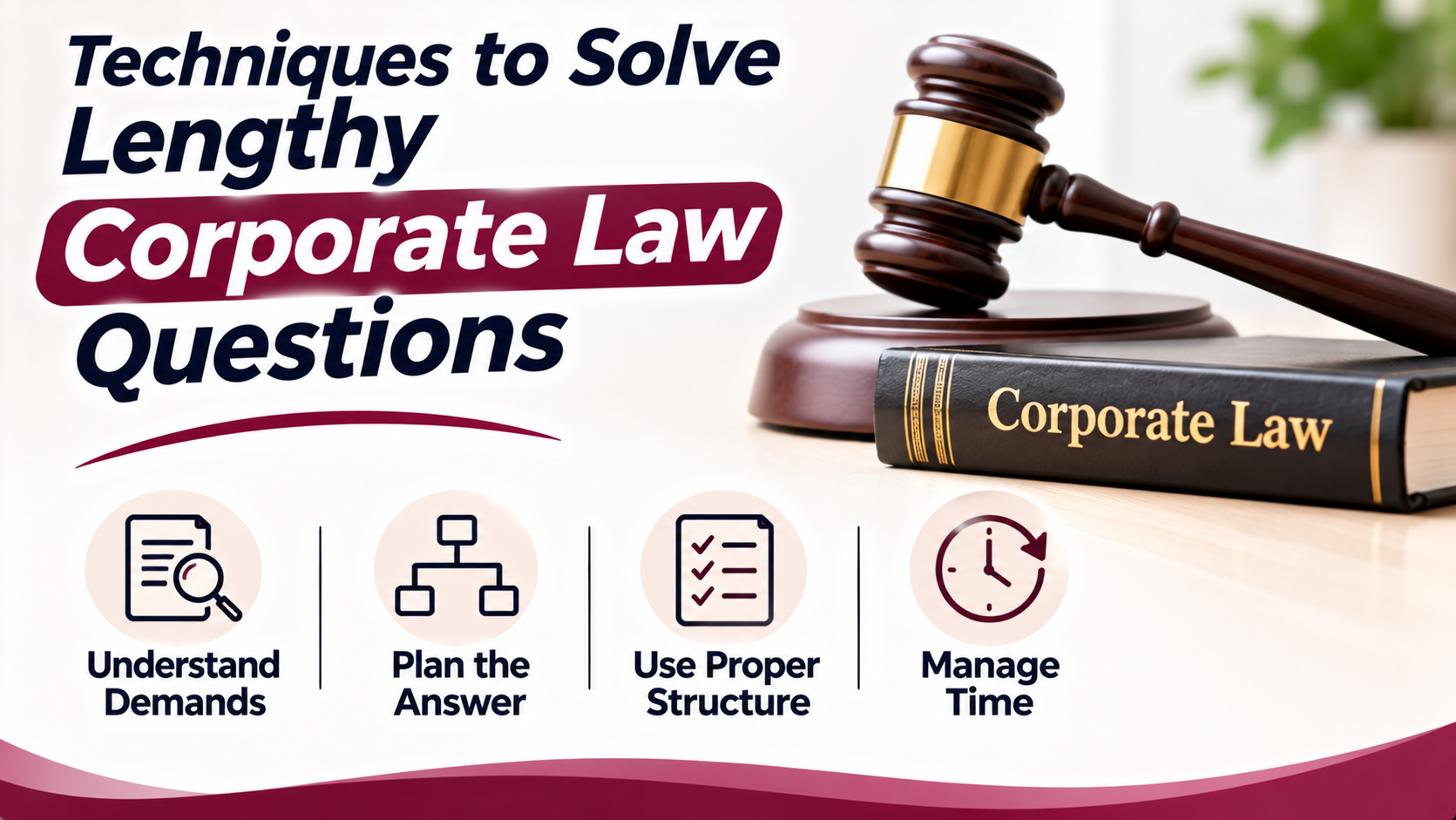
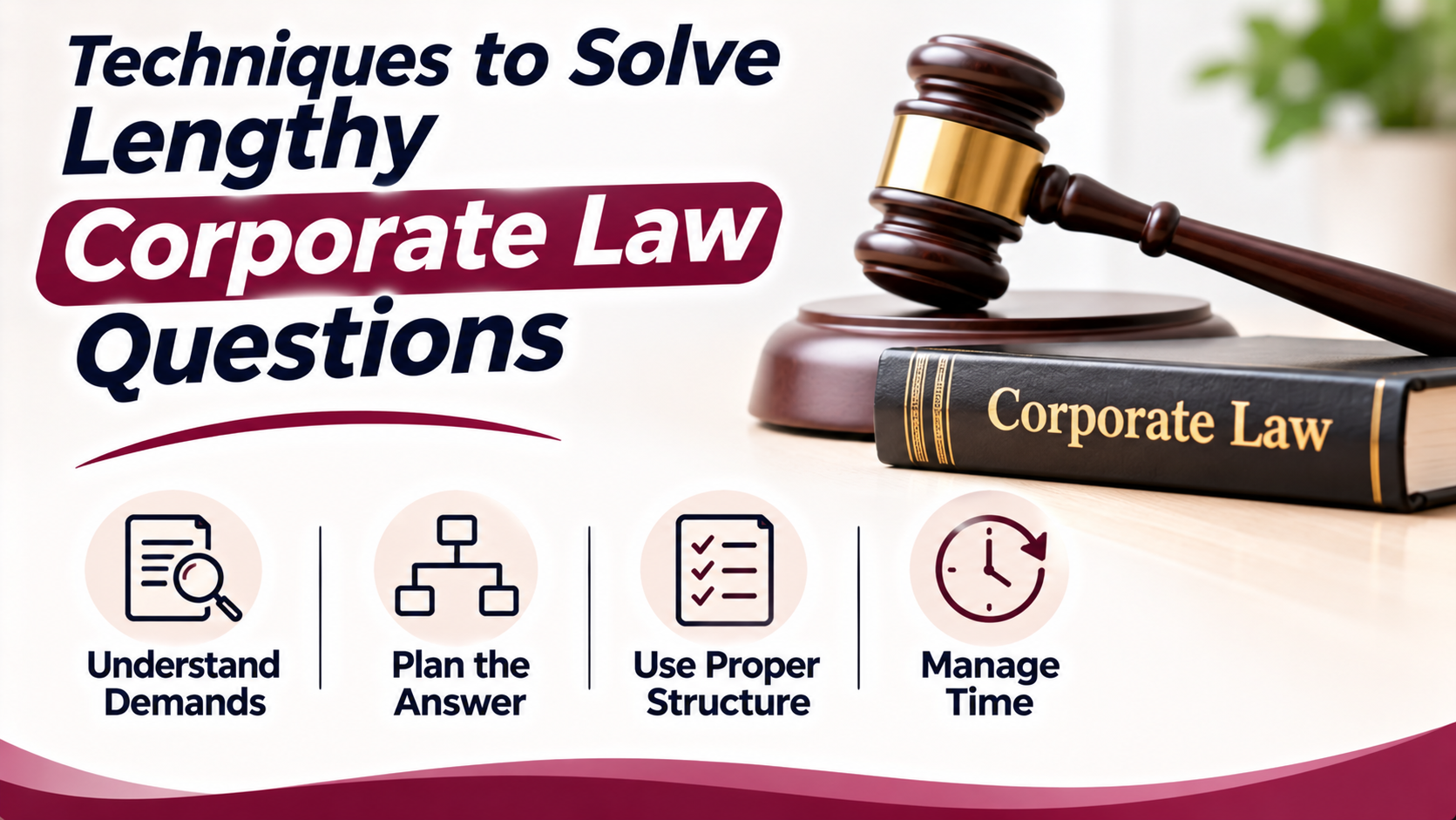
Lengthy Corporate Law questions can feel challenging because they often contain several facts, multiple parties and more than one legal issue. Students may understand the relevant provisions but still lose marks when they overlook a key fact, write unrelated theory or fail to reach a clear conclusion.
A structured approach makes these questions easier to handle. The aim is to identify what the question requires, connect the facts with the relevant legal principles and present the answer in a logical sequence within the available time.
Read the requirement before analysing every fact
Start by reading the final requirement or the specific question being asked. Identify whether you need to advise a party, determine validity, explain a consequence or analyse compliance. This gives direction to your reading of the case facts.
Then read the full question and mark the facts connected with the requirement. Avoid treating every sentence as equally important. Some details establish context, while others determine how a provision applies.
Break the case into separate legal issues
A lengthy case may contain several connected issues. Divide it into smaller questions, such as whether a decision was authorised, whether a procedure was followed or what consequence may arise from non-compliance. Write a brief outline before drafting the final response.
If the question has multiple parts, answer each part separately. This reduces the risk of discussing one issue at length while missing another. Use short headings where they make the structure easier to follow.
Identify the relevant provision accurately
Once the issue is clear, identify the applicable provision, rule or principle from the current syllabus. Check its essential conditions, exceptions and procedural requirements. Avoid relying on a vague memory of a section when the distinction between provisions matters to the outcome.
Where a section number is required or confidently known, use it accurately. If you are uncertain, do not invent a number. A correct explanation of the applicable principle is more useful than an incorrect statutory reference.
Apply the law to the facts
A strong case-based answer does not stop after reproducing a provision. Explain how the relevant facts satisfy or fail to satisfy the conditions of the rule. Connect each important fact to the legal principle and show the reasoning that leads to your answer.
Avoid writing a long general explanation that could fit any question. The examiner needs to see that you have understood the specific situation. Use the facts provided and do not add assumptions that are not supported by the question.
Use a clear answer structure
A practical structure is: issue, applicable legal principle, application to facts and conclusion. The length of each part depends on the marks and complexity of the question. This format keeps the answer focused and makes the reasoning easy to follow.
For questions with multiple issues, repeat the structure for each issue. Use relevant headings, concise paragraphs and clear conclusions. Do not use headings simply for decoration; each should help organise a separate part of the answer.
Manage lengthy answers within time
Before writing, estimate the time available based on marks and the number of issues. Avoid spending too long copying the facts or reproducing an entire provision when only a particular part is relevant. Allocate enough time for application and conclusion.
Practise with timed case studies. After each attempt, compare planned and actual completion time. If the answer was too long, identify which parts were unnecessary. If it was too short, check whether you omitted an issue or failed to apply the law.
Use technical language carefully
Corporate Law answers require accurate legal terminology. Use the terms relevant to the provision and avoid replacing them with casual expressions that may change the meaning. At the same time, keep sentences direct and readable.
When two concepts appear similar, explain the distinction that matters to the question. Avoid adding unrelated provisions or lengthy background merely to demonstrate that you have studied the chapter.
Support conclusions with reasoning
A conclusion should follow from the rule and its application. Avoid giving a one-word response such as 'valid' or 'invalid' without explaining why. State the outcome clearly and connect it to the facts already discussed.
If the facts are insufficient to reach an unconditional conclusion, explain the relevant condition or qualification. Do not introduce uncertainty unnecessarily, but do not ignore a condition that changes the legal result.
Practise with case-based questions and review mistakes
Use study-material illustrations, applicable practice questions and mock papers to develop issue-spotting skills. After solving a case, compare your answer with the suggested response and check whether you identified all issues, selected the correct principle and applied the facts adequately.
Keep a record of recurring problems, such as missing a second issue, writing excessive theory or giving unsupported conclusions. Reattempt selected questions after revision to check whether your method has improved.
Use CS Exams Test Series to strengthen answer writing
A structured CS Exams Test Series can help students practise lengthy Corporate Law questions under time limits. Use these assessments to test issue identification, legal application, answer structure and completion speed.
Review the feedback carefully and return to the relevant ICSI study material when a provision or concept is unclear. Regular practice with focused correction can help make lengthy answers more organised and relevant.
Quick Reference Table
| Answer stage | What to do | Why it matters |
|---|---|---|
| Requirement | Identify the exact task | Keeps the answer focused |
| Issue spotting | Separate legal issues | Prevents missed parts |
| Legal principle | Identify applicable rule and conditions | Establishes the legal basis |
| Application | Connect facts with the rule | Shows understanding |
| Conclusion | State a reasoned outcome | Completes the analysis |
Conclusion
Consistent preparation depends on understanding the subject, practising relevant questions and reviewing mistakes honestly. Use the applicable ICSI study material as your foundation and make each assessment part of a clear improvement plan. A structured approach with CS Exams Test Series can help you practise with discipline and identify where further revision is needed.