In this article (14)
- What is a Section 8 company
- Features of a Section 8 company
- How a Section 8 company is formed
- Privileges and exemptions
- Section 8 company vs trust vs society
- Revocation, conversion and penalties
- How to write Section 8 answers in CS Executive
- Frequently asked questions
- Can a Section 8 company pay dividend?
- Is there a minimum capital for a Section 8 company?
- Does a Section 8 company need Limited in its name?
- How many board meetings does a Section 8 company need?
- Which form is used to convert a company into a Section 8 company?
- Can a Section 8 company licence be revoked?
A Section 8 company is a company formed for a charitable or social purpose, which must use all its profits for that purpose and cannot pay dividends to its members. It is registered under Section 8 of the Companies Act, 2013 with a licence from the Central Government. For CS Executive students, it is a regular question in company law, usually as a case on formation, name or conversion.
Latest update (18 Nov 2026): the CS Executive December 2026 exams run from 21 to 28 December 2026 (2:00 PM to 5:15 PM, no paper on 25 December). The next attempt after that is June 2027; ICSI announces its dates closer to the time.
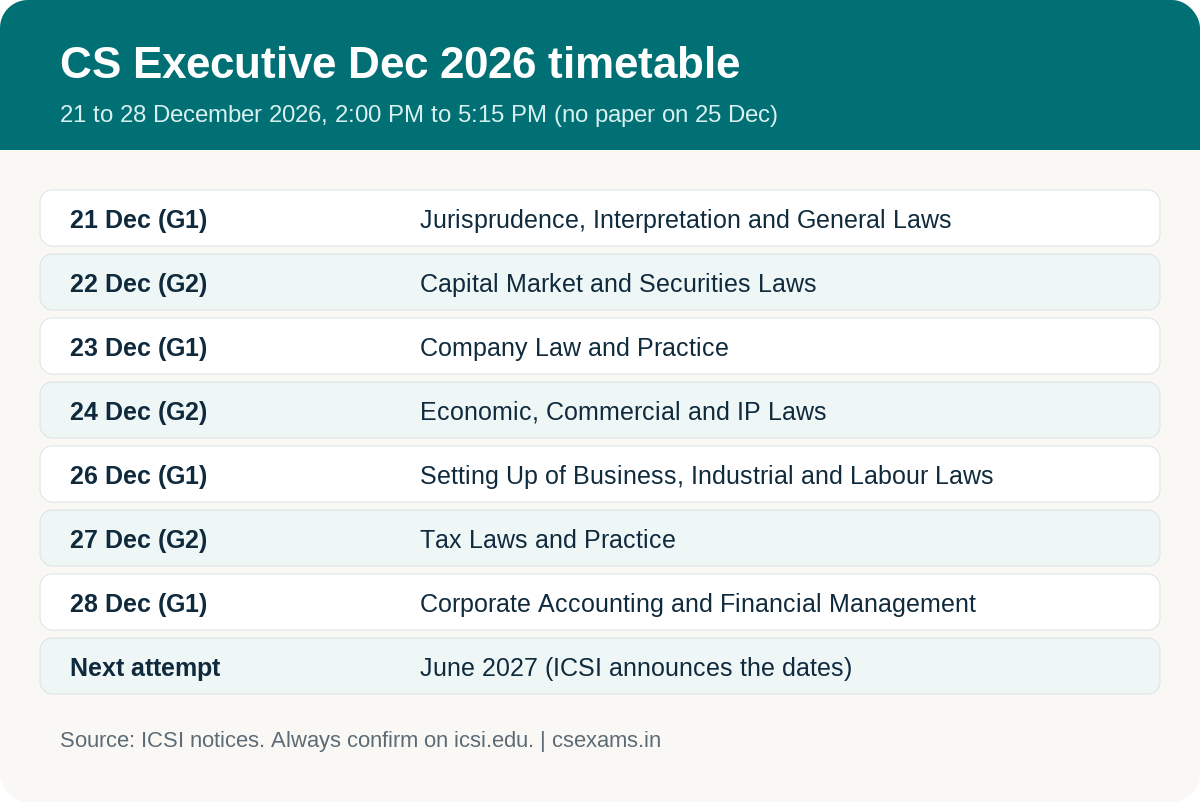
| What | Date |
|---|---|
| CS Executive Dec 2026 exams | 21 to 28 December 2026 |
| Admit card | Expected in the second week of December 2026 on icsi.edu, based on past years (the Dec 2025 cards came on 12 December 2025) |
| Dec 2026 result | Expected around 25 February 2027, based on past years (the Dec 2025 result came on 25 February 2026) |
| Next attempt | June 2027 |
Write full papers under time before the exam: our CS Executive test series has papers on the ICSI pattern, checked by Company Secretaries. See plans and prices.
Always confirm dates on the official ICSI website, icsi.edu.
This guide covers the features of a Section 8 company, how it is formed, the privileges it gets, the restrictions it lives with and how examiners test it.
What is a Section 8 company
Section 8 allows the Central Government to grant a licence to a person or an association of persons who want to register a company with objects such as commerce, art, science, sports, education, research, social welfare, religion, charity, protection of environment or any similar object. The company must intend to apply its profits or other income only to promote these objects and must prohibit payment of any dividend to its members.
That last condition is what makes a Section 8 company different from an ordinary company. Members cannot take profit out. If the company is wound up or dissolved, its surplus assets go to another Section 8 company with similar objects, or as the Tribunal decides, not to the members.
The powers of the Central Government under this section have been delegated to the Registrar of Companies, so in practice the licence comes through the ROC.
Features of a Section 8 company
- It can be a private or a public company, limited by shares or by guarantee.
- There is no minimum paid-up share capital requirement.
- It does not need to use "Limited" or "Private Limited" in its name.
- Its name usually includes words like Foundation, Forum, Association, Federation, Chambers, Confederation, Council or Electoral Trust.
- Profits and income are used only for its objects. No dividend can be paid to members.
- It enjoys all the privileges and is subject to all the obligations of a limited company, unless an exemption applies.
- It cannot change its objects or memorandum without the prior approval of the Central Government.
How a Section 8 company is formed
Formation follows the normal incorporation route on the MCA portal, with a licence step added. For a new company, the application for licence goes along with the integrated incorporation form, and the draft memorandum and articles must be in the prescribed format for Section 8 companies.
- Reserve the name, keeping in mind the words usually used by Section 8 companies.
- Prepare the memorandum and articles with the charitable objects and the clause prohibiting dividend.
- Prepare a declaration by a professional (an advocate, CA, CMA or CS in practice) that the documents meet the requirements of Section 8.
- Prepare a statement of estimated income and expenditure for the next three years.
- File the incorporation form with the licence application on the MCA portal.
- The ROC issues the licence and the certificate of incorporation.
An existing company can also convert into a Section 8 company. It applies for a licence in Form INC-12, after passing a special resolution, and then alters its memorandum and articles. Practical steps on the portal change with MCA updates, so read our company incorporation guide for CS Executive alongside this post.
Privileges and exemptions
Section 8 companies get some relaxations under MCA exemption notifications. The board meeting exemption is the one most often asked in the exam: a Section 8 company needs to hold at least one board meeting in each half of a calendar year, instead of four meetings a year with a 120 day gap.
Other relaxations relate to the number of directors who must be independent, some committee requirements and some provisions on related party transactions. The exact list sits in the exemption notification, and you should read it from the bare act or the ICSI study material rather than from memory.
Outside company law, Section 8 companies can apply for registration under the Income-tax Act for exemption of income and for donor deductions, but that is a separate process with its own conditions. Keep this as a passing line in your answer unless the question asks for it.
Section 8 company vs trust vs society
A comparison question comes up now and then, and it is also what clients ask a new CS in practice. Here is a quick view.
| Point | Section 8 company | Trust | Society |
|---|---|---|---|
| Governing law | Companies Act, 2013 | Indian Trusts Act, 1882 or state public trust laws | Societies Registration Act, 1860 or state acts |
| Registered with | Registrar of Companies, with a licence | Sub-registrar or Charity Commissioner, depending on the state | Registrar of Societies |
| Minimum members | 2 for private, 7 for public | At least 1 settlor and trustees | Usually 7 |
| Separate legal entity | Yes | No, the trustees act for the trust | Depends on the state act |
| Dividend to members | Not allowed | Not applicable | Not allowed |
| Compliance level | High: ROC filings, board meetings, audit | Low to moderate | Moderate |
For a CS in practice, Section 8 work is steady: incorporation, annual filings, board meetings every half year and help with tax registrations. Many small NGOs move from a trust to a Section 8 company once they start getting larger grants, and they need someone to handle the change.
The credibility point is why donors and foreign funders often prefer Section 8 companies. The governance is visible on the MCA portal, and the filings are public.
Revocation, conversion and penalties
The Central Government can revoke the licence if the company breaks any requirement of Section 8 or the conditions of its licence, or if its affairs are conducted fraudulently or against public interest. Before revoking, the company must get a reasonable opportunity of being heard. After revocation, the government can order the company to be wound up or amalgamated with another Section 8 company.
A Section 8 company can convert into another kind of company only by following the rules for conversion, which include a special resolution and approval of the Central Government. Conditions are attached, such as paying back the tax benefits or concessions received. Examiners like this point because it shows the trade-off: you cannot enjoy charitable status and then convert freely.
Section 8 also has a penalty provision for default, which applies to the company and its officers. Check the current amounts in the bare act, as penalty provisions were changed by the Companies (Amendment) Acts of 2019 and 2020.
How to write Section 8 answers in CS Executive
Most questions are cases. A group of doctors wants to start a company to run a free clinic and pay themselves a dividend. Can they register under Section 8? The answer is no for the dividend part, and you should explain why, then say what they can do, for example take reasonable remuneration for services as permitted.
Use the same pattern every time: provision, facts, conclusion. Quote the section number. Write the objects list correctly. Most students lose marks because they write "non-profit company" and stop there, without the prohibition on dividend and the licence.
Practise five or six such cases before the exam and get them checked. Our CS Executive test series has case questions on Section 8 and company formation, with each answer checked by a Company Secretary. For the full exam view, see our CS Executive company law strategy, and for the official text use the ICSI material on icsi.edu.
Frequently asked questions
Can a Section 8 company pay dividend?
No. A Section 8 company must apply its profits only to its objects and its memorandum must prohibit payment of dividend to members.
Is there a minimum capital for a Section 8 company?
No. The Companies Act, 2013 does not prescribe any minimum paid-up share capital for a Section 8 company.
Does a Section 8 company need Limited in its name?
No. A Section 8 company is not required to use the words Limited or Private Limited in its name.
How many board meetings does a Section 8 company need?
Under the MCA exemption, a Section 8 company must hold at least one board meeting in each half of a calendar year.
Which form is used to convert a company into a Section 8 company?
An existing company applies for a Section 8 licence in Form INC-12 after passing a special resolution.
Can a Section 8 company licence be revoked?
Yes. The Central Government can revoke it for breach of Section 8 or licence conditions, or fraudulent conduct, after giving the company a reasonable opportunity of being heard.
Practise what you just read