In this article (16)
- CS Executive Corporate Accounting and Financial Management at a glance
- What Part I Corporate Accounting covers
- The common Part I mistake
- What Part II Financial Management covers
- A 36-day practice plan
- Do not ignore the theory questions
- Speed and presentation in the exam hall
- Checked mock papers before 28 December
- The last two days
- Frequently asked questions
- When is the CS Executive Corporate Accounting and Financial Management paper in Dec 2026?
- How are marks divided in CS Executive Corporate Accounting and Financial Management?
- Which study material applies to CS Executive CAFM for December 2026?
- Is CS Executive Corporate Accounting and Financial Management a scoring paper?
- Which chapters should I practise first for CS Executive CAFM?
- Do working notes carry marks in CS Executive accounts?
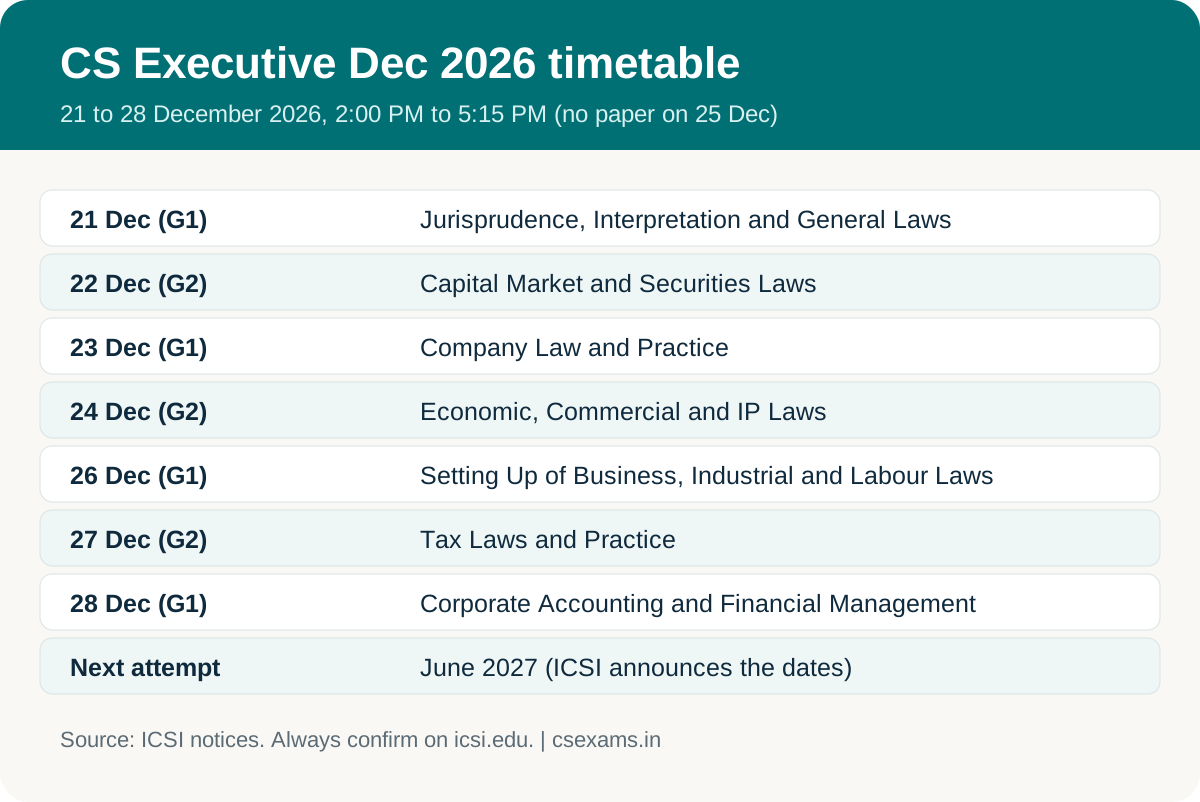
CS Executive Corporate Accounting and Financial Management is the last paper of the session, on Monday, 28 December 2026. From today that leaves about 36 days. It is also the paper that decides many Group 1 aggregates, because you can pick up marks here that are hard to get in the law papers.
Latest update (18 Nov 2026): the CS Executive December 2026 exams run from 21 to 28 December 2026 (2:00 PM to 5:15 PM, no paper on 25 December). The next attempt after that is June 2027; ICSI announces its dates closer to the time.
| What | Date |
|---|---|
| CS Executive Dec 2026 exams | 21 to 28 December 2026 |
| Admit card | Expected in the second week of December 2026 on icsi.edu, based on past years (the Dec 2025 cards came on 12 December 2025) |
| Dec 2026 result | Expected around 25 February 2027, based on past years (the Dec 2025 result came on 25 February 2026) |
| Next attempt | June 2027 |
Write full papers under time before the exam: our CS Executive test series has papers on the ICSI pattern, checked by Company Secretaries. See plans and prices.
Always confirm dates on the official ICSI website, icsi.edu.
This is a practice paper. You do not pass it by reading. You pass it by solving enough full questions that the formats come to your hand without thinking. Below is how the paper splits, which chapters give the most return, and a plan that fits around your other Group 1 papers.
CS Executive Corporate Accounting and Financial Management at a glance
Everything in this table is taken from the ICSI Syllabus 2022 document, the December 2026 time table and the ICSI list of study material for this session.
| Point | Detail for December 2026 |
|---|---|
| Paper | Corporate Accounting and Financial Management, Group 1 |
| Date and time | Monday, 28 December 2026, 2:00 PM to 5:15 PM (15 minutes reading time) |
| Part I | Corporate Accounting: 60 marks |
| Part II | Financial Management: 40 marks |
| Study material | Updated till 30 November 2025, with the December 2026 supplement |
| Passing rule | 40 in the paper and 50 percent aggregate in the group |
You can confirm the dates on the official ICSI time table for December 2026. Since this paper comes after Setting Up of Business on 26 December, you get one clear day before it. Use it well, because it is the only full day you will have just for accounts in the exam week.
What Part I Corporate Accounting covers
Part I is 60 marks and has a wide spread. It starts with the basics of accounting and corporate accounting, then moves to accounting standards, accounting for share capital, accounting for debentures, related aspects of company accounts, consolidation of accounts, financial statement analysis, cash flows and forecasting financial statements.
For practice value, put share capital and debentures first. These chapters have long, format-driven questions, and once your journal entries and ledger formats are steady, they become reliable marks. Consolidation and cash flow statements come next. Both look heavy, but they follow a fixed sequence of steps, so regular practice makes them faster.
The common Part I mistake
Most students lose marks in consolidation because they skip working notes and try to do the whole thing in the final statement. When one figure goes wrong, there is nothing for the examiner to give step marks on. Write each working note separately, number it, and refer to it in the main answer.
What Part II Financial Management covers
Part II is 40 marks. The chapters are an introduction to financial management, time value of money, capital budgeting, cost of capital, capital structure, dividend decisions, working capital management, security analysis and the operational approach to financial decisions.
Financial management questions are usually shorter than corporate accounting ones, but students drop marks on presentation. Write the formula first, then the values, then the answer, and finish with one line of interpretation, for example whether the project should be accepted. Many students do the maths right and forget the conclusion. That last line is often where the marks sit.
A 36-day practice plan
This plan assumes you have studied the syllabus once and are revising all Group 1 papers. It gives accounts about two hours on most days, more in the last ten days.
| Days | Focus | Daily target |
|---|---|---|
| 1 to 7 | Share capital and debentures | 3 full questions with entries and ledgers |
| 8 to 13 | Related aspects of company accounts and accounting standards | 2 questions plus short theory notes |
| 14 to 19 | Consolidation and cash flows | 2 long questions with working notes |
| 20 to 24 | Financial statement analysis and forecasting | Ratio questions and one forecast |
| 25 to 30 | Financial Management full revision | 4 to 5 short questions daily |
| 31 to 34 | Two full timed papers and checking | 3 hours each, then corrections |
| 35 and 36 | Formula sheet and mistake list | Light revision only |
If you are also planning the other papers, our CS Executive Dec 2026 last month revision plan shows how to fit them together. For a quick view of which chapters matter more, read CS Executive chapter-wise weightage.
Do not ignore the theory questions
Students often treat this paper as purely numerical and leave theory for the last night. That is a mistake. Accounting standards, the basics of corporate accounting and the introduction to financial management all produce short theory questions, and these are some of the quickest marks in the paper if you have a clean answer ready.
Keep a small theory notebook for this paper. For each accounting standard in your study material, write its objective, scope and two or three main points in your own words. For financial management, write short notes on the goals of financial management, the factors that decide capital structure, the factors that affect dividend policy and the sources of working capital finance. Read this notebook for 15 minutes every alternate day. By the exam, these answers will come out quickly, which leaves more time for the long practical questions.
When you write theory in the exam, keep it in points with a one-line heading for each point. A theory answer in this paper does not need to be long. It needs to be clear and correct.
Speed and presentation in the exam hall
Three hours feels long until you meet a consolidation question that takes 50 minutes. Speed comes from two things. First, knowing your formats so well that you do not stop to think about where a line goes. Second, deciding in the reading time which questions you will attempt and in what order.
- Draw ruled formats with a pencil and scale. Neat tables are easier to check and easier to give marks to.
- Show every formula before you put the numbers in.
- Round consistently and state your rounding once.
- Give each answer a clear final line: the figure, the decision or the interpretation.
- Keep 10 minutes at the end to check totals and see that no part is left blank.
A blank part of a question gets zero. A neat attempt with correct working notes gets step marks even if the final answer is off.
Checked mock papers before 28 December
Self-checking an accounts paper is hard, because you tend to see what you meant to write. A checked mock shows you where your format is costing marks and where your time went. Our CS Executive test series includes full Corporate Accounting and Financial Management papers checked by company secretaries, with comments on working notes and presentation. Two or three checked papers in the next month can make a real difference to your Group 1 aggregate. See the options on our plans page.
The last two days
On 27 December, revise your formula sheet and your mistake list, and solve one short question from each Part II chapter to keep your hand moving. Do not start a new chapter. On the morning of 28 December, look at your formats once and then stop. Carry a simple calculator that ICSI allows, and check its battery the night before.
This is the last paper of the session. Many students arrive tired and rush it. If you keep one full day of energy for it, you give yourself the best chance of finishing Group 1 strongly.
Frequently asked questions
When is the CS Executive Corporate Accounting and Financial Management paper in Dec 2026?
It is on Monday, 28 December 2026, from 2:00 PM to 5:15 PM, with the first 15 minutes as reading time. It is the last Group 1 paper of the session.
How are marks divided in CS Executive Corporate Accounting and Financial Management?
Under Syllabus 2022, Part I Corporate Accounting carries 60 marks and Part II Financial Management carries 40 marks.
Which study material applies to CS Executive CAFM for December 2026?
ICSI lists the study material updated till 30 November 2025 for this paper, to be read along with the December 2026 supplement on the ICSI academic portal.
Is CS Executive Corporate Accounting and Financial Management a scoring paper?
It can be, because practical questions have a right answer. Students who practise full questions with working notes usually score better here than in the theory papers.
Which chapters should I practise first for CS Executive CAFM?
In Part I, start with share capital, debentures, consolidation and cash flows. In Part II, time value of money, capital budgeting, cost of capital and working capital give the most practice value.
Do working notes carry marks in CS Executive accounts?
Working notes show how you reached a figure, so an examiner can give step marks even if the final number is wrong. Always write them neatly and number them.
Practise what you just read