In this article (15)
- Arbitration, Mediation and Conciliation at a glance
- How the ICSI model paper is set
- Provisions the model paper keeps testing
- How to prepare the drafting questions
- Answering case studies in an open book paper
- Arbitration, conciliation and mediation: keep them apart
- A three week plan for the elective
- Practise drafts and get feedback
- Frequently asked questions
- Is Arbitration, Mediation and Conciliation an open book paper?
- When is the AMC elective exam in December 2026?
- What is the weightage of arbitration and mediation in this elective?
- Are drafting questions asked in the AMC elective?
- Which Act governs arbitration in India for this paper?
- How many questions are compulsory in the AMC model paper?
The CS Professional Arbitration, Mediation and Conciliation elective, Paper 7.1 in Group 2, is an open book paper on Sunday, 27 December 2026. It suits students who like law that is close to practice: disputes between business partners, challenges to awards, enforcement of foreign awards and settlement by mediation. It is also the only elective where ICSI asks you to draft documents such as an arbitral award.
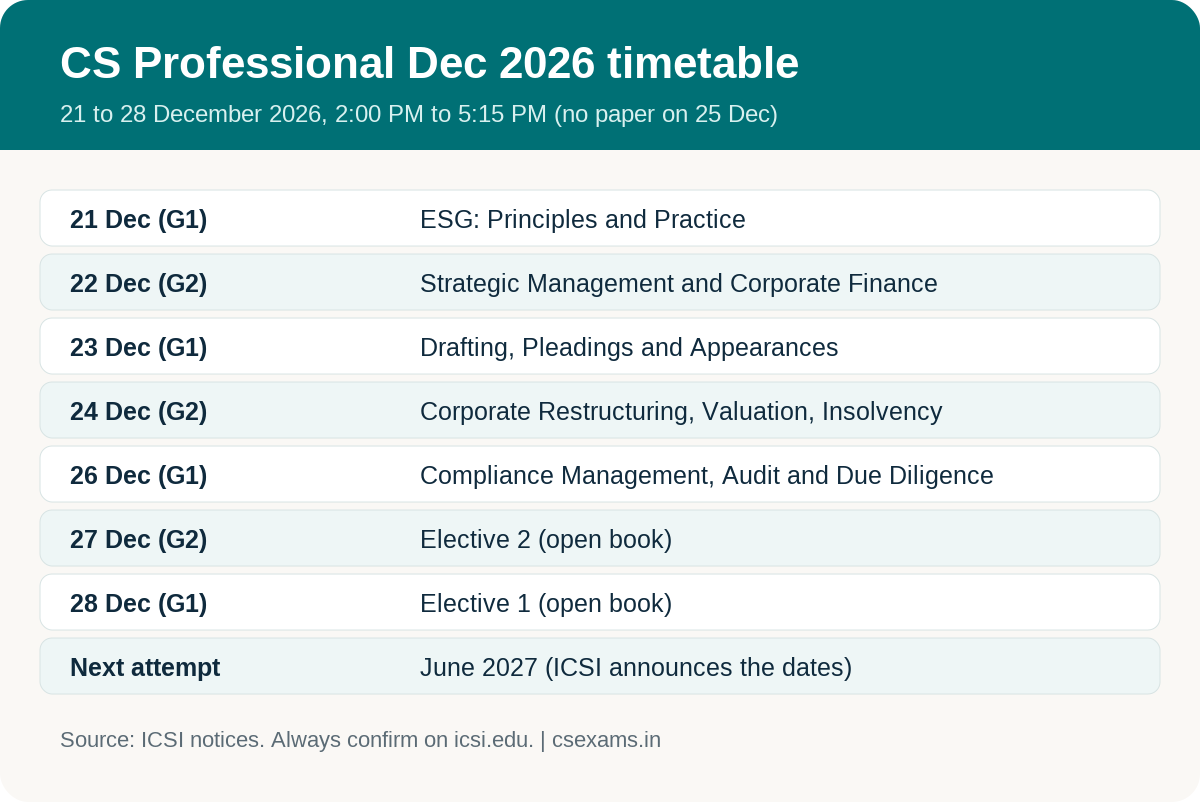
Latest update (18 Nov 2026): the CS Professional December 2026 exams run from 21 to 28 December 2026 (2:00 PM to 5:15 PM, no paper on 25 December). The next attempt after that is June 2027; ICSI announces its dates closer to the time.
| What | Date |
|---|---|
| CS Professional Dec 2026 exams | 21 to 28 December 2026 |
| Admit card | Expected in the second week of December 2026 on icsi.edu, based on past years (the Dec 2025 cards came on 12 December 2025) |
| Dec 2026 result | Expected around 25 February 2027, based on past years (the Dec 2025 result came on 25 February 2026) |
| Next attempt | June 2027 |
Write full papers under time before the exam: our CS Professional test series has papers on the ICSI pattern, checked by Company Secretaries. See plans and prices.
Always confirm dates on the official ICSI website, icsi.edu.
Here is how the paper is split, how the model paper is set and how to prepare it well in the time left.
Arbitration, Mediation and Conciliation at a glance
| Point | Details |
|---|---|
| Paper | Group 2, Elective Paper 7.1: Arbitration, Mediation and Conciliation |
| Exam date | Sunday, 27 December 2026 (Elective 2 papers) |
| Time | 2:00 PM to 5:15 PM, with the first 15 minutes for reading |
| Mode | Open book, written answers |
| Part I: Arbitration and Conciliation | 70 marks |
| Part II: Mediation | 30 marks |
| Material for December 2026 | Study material updated to 31 May 2026, plus applicable supplements |
Part I units in the syllabus run from an introduction to arbitration and commercial transactions to arbitration agreements and clauses, arbitral institutions, procedure, appointment of arbitrators, pleadings, and arbitral proceedings and evidence, and continue to awards, challenges and enforcement. Part II deals with mediation, including the framework under the Mediation Act, 2023.
How the ICSI model paper is set
| Part | Question | Type | Marks |
|---|---|---|---|
| I | Q1 | Compulsory case study (15 + 10) | 25 |
| I | Q2 | Compulsory case based sub-parts | 15 |
| I | Q3 | Compulsory drafting: an award (8) and an arbitration agreement (7) | 15 |
| I | Q4 or Q4A | Choice, case based | 15 |
| II | Q5 | Compulsory case study with a drafted mediated settlement agreement | 15 |
| II | Q6 or Q6A | Choice, case based | 15 |
That means 22 of the 100 marks in the model paper come from drafting alone: an award, an arbitration agreement and a mediated settlement agreement. Students who have never written a draft before the exam lose most of those marks, open book or not.
Provisions the model paper keeps testing
The model paper's questions point to the areas you should know without searching:
- Whether an award from a foreign seated international commercial arbitration can be challenged under Section 34 of the Arbitration and Conciliation Act, 1996, and the effect of Section 2(2) when the seat is outside India.
- Documents needed to enforce a foreign award before an Indian court.
- Qualifications of arbitrators under the Eighth Schedule and how the law on them changed.
- The meaning of "court" under the Act and which court has jurisdiction.
- Arbitration in capital market disputes and share pledge disputes, and conciliated settlements.
- Empanelment of mediators, types of mediation, institutional mediation rules and pre-litigation mediation.
Make a one page table with each topic, the section and the leading case law from your study material. Tab it in the book, and add the institution rules your material covers, since questions on institutional arbitration and mediation rules appear in both parts. In a case study, the right section in the first line tells the examiner you know where the answer lies.
How to prepare the drafting questions
Drafting is where you gain or lose the most. Prepare three drafts in your own handwriting before the exam:
- Arbitral award: parties, arbitration agreement, appointment of the tribunal, procedural history, pleadings, issues, findings, the award with costs and interest, seat, date and signature.
- Arbitration agreement or clause: scope of disputes, seat, number and appointment of arbitrators, institution or ad hoc, governing law, language and confidentiality.
- Mediated settlement agreement: parties, background, terms agreed, implementation, confidentiality, signatures of parties and the mediator.
Most students lose marks here because their draft has no structure. Use clear headings and numbered clauses, and fill in the facts given in the question instead of leaving blanks. Even a simple draft with every standard part scores better than a long but jumbled one.
Write each draft at least twice before the exam: once with the book open, once without, timed at about 12 to 15 minutes. The second attempt shows you which clauses you forget under pressure. Keep the final versions with your index so you can glance at the structure in the exam hall. Open book allows you to carry this preparation, and it saves real time when the draft carries 8 marks.
Answering case studies in an open book paper
For case based questions, follow one order: the issue, the provision, the leading case if there is one, the application to the facts and a conclusion. Keep a 5 mark answer to about 150 words. Open book means you can check a section number, not that you can copy a whole page. Use the reading time to choose between Q4 and Q4A and between Q6 and Q6A, and start with the drafting question if drafting is your strength, so those marks are safe early. Our post on open book exam preparation for CS Professional covers tabbing and indexing, and our guide on case study solving techniques helps with long fact patterns.
Arbitration, conciliation and mediation: keep them apart
Many answers lose marks because the student uses the three words as if they mean the same thing. They do not, and the examiner checks whether you know the difference. In arbitration, a neutral tribunal decides the dispute and its award binds the parties, subject to the limited grounds of challenge in the Act. In conciliation under Part III of the 1996 Act, the conciliator helps the parties reach their own settlement, and a signed settlement agreement has the same effect as an arbitral award on agreed terms. In mediation, the mediator also helps the parties settle, and the Mediation Act, 2023 now gives a framework for the process and for the settlement that follows.
Keep a comparison table in your notes with rows for the role of the neutral, whether the outcome binds, how it is enforced, confidentiality and the governing law. When a case study asks which method suits a dispute, such as a long joint venture where the parties want to keep working together, the comparison gives you the reasons in seconds. Mediation usually fits when the relationship matters; arbitration fits when the parties want a binding decision from an expert.
One more habit helps in this paper: cite the section. "Under Section 34" or "under Section 48" for a foreign award is worth more than a paragraph of general explanation. The open book lets you confirm the number, so there is no reason to leave it out.
A three week plan for the elective
| Week | Focus |
|---|---|
| Week 1 | Arbitration agreement, tribunal, procedure and evidence, with your section table |
| Week 2 | Awards, challenges, enforcement of foreign awards, conciliation and mediation |
| Week 3 | Three practice drafts, then two timed papers with the book open |
Elective 2 falls on 27 December, a day after Compliance Management, Audit and Due Diligence and a day before Elective 1, so keep short daily sessions for it in the weeks before. See our CS Professional last month revision plan for the full schedule.
Practise drafts and get feedback
You cannot judge your own drafts easily. Our CS Professional test series includes elective papers checked by Company Secretaries, who comment on structure, missing clauses and case study application. You can compare options on the plans page.
Frequently asked questions
Is Arbitration, Mediation and Conciliation an open book paper?
Yes. The ICSI time table marks the elective papers of CS Professional as open book examinations.
When is the AMC elective exam in December 2026?
Elective 2 papers, including Arbitration, Mediation and Conciliation, are on Sunday, 27 December 2026, from 2:00 PM to 5:15 PM.
What is the weightage of arbitration and mediation in this elective?
Part I, Arbitration and Conciliation, carries 70 marks and Part II, Mediation, carries 30 marks.
Are drafting questions asked in the AMC elective?
Yes. ICSI's model paper asks you to draft an arbitral award, an arbitration agreement and a mediated settlement agreement.
Which Act governs arbitration in India for this paper?
The Arbitration and Conciliation Act, 1996 governs arbitration and conciliation, and the Mediation Act, 2023 is the main law for mediation.
How many questions are compulsory in the AMC model paper?
Four of the six questions are compulsory, and you choose one option each in Question 4 and Question 6.
Practise what you just read