In this article (14)
- Where the IFSCA elective fits in CS Professional
- What IFSCA is, in plain words
- The ten lessons of Paper 4.6
- What the December 2026 supplement adds
- Who should pick the IFSCA elective
- How to prepare it as an open book paper
- Common mistakes to avoid
- Frequently asked questions
- What is Paper 4.6 in CS Professional?
- Is the IFSCA elective an open book exam?
- When is the IFSCA elective paper in December 2026?
- How many lessons are there in the IFSCA elective?
- Is there a supplement for the IFSCA elective for December 2026?
- Is the IFSCA elective easier than other CS Professional electives?
The IFSCA elective is the newest option in CS Professional. ICSI added "IFSCA: Regulations, Listing and Compliances" as Paper 4.6 under Elective 1 in its syllabus 2022, applicable from the June 2026 session. For the December 2026 attempt it sits with the other Elective 1 papers on Monday 28 December, as an open book exam.
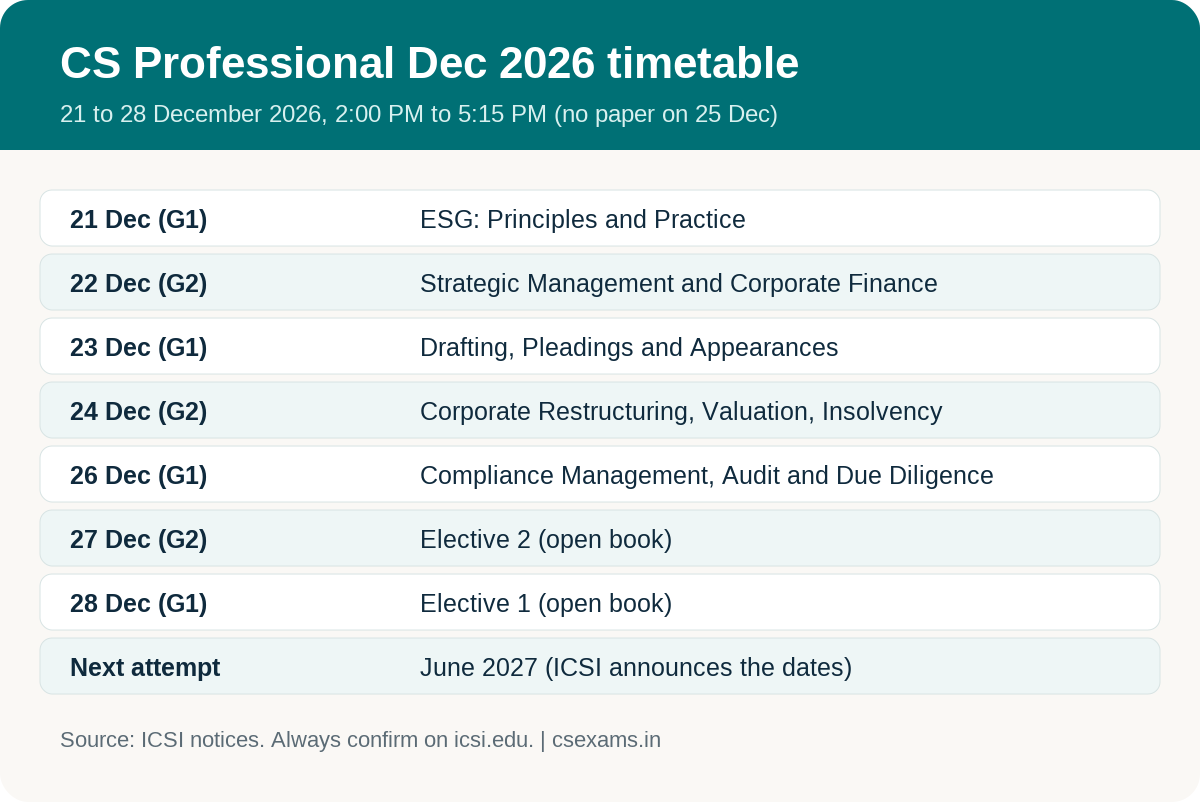
Latest update (18 Nov 2026): the CS Professional December 2026 exams run from 21 to 28 December 2026 (2:00 PM to 5:15 PM, no paper on 25 December). The next attempt after that is June 2027; ICSI announces its dates closer to the time.
| What | Date |
|---|---|
| CS Professional Dec 2026 exams | 21 to 28 December 2026 |
| Admit card | Expected in the second week of December 2026 on icsi.edu, based on past years (the Dec 2025 cards came on 12 December 2025) |
| Dec 2026 result | Expected around 25 February 2027, based on past years (the Dec 2025 result came on 25 February 2026) |
| Next attempt | June 2027 |
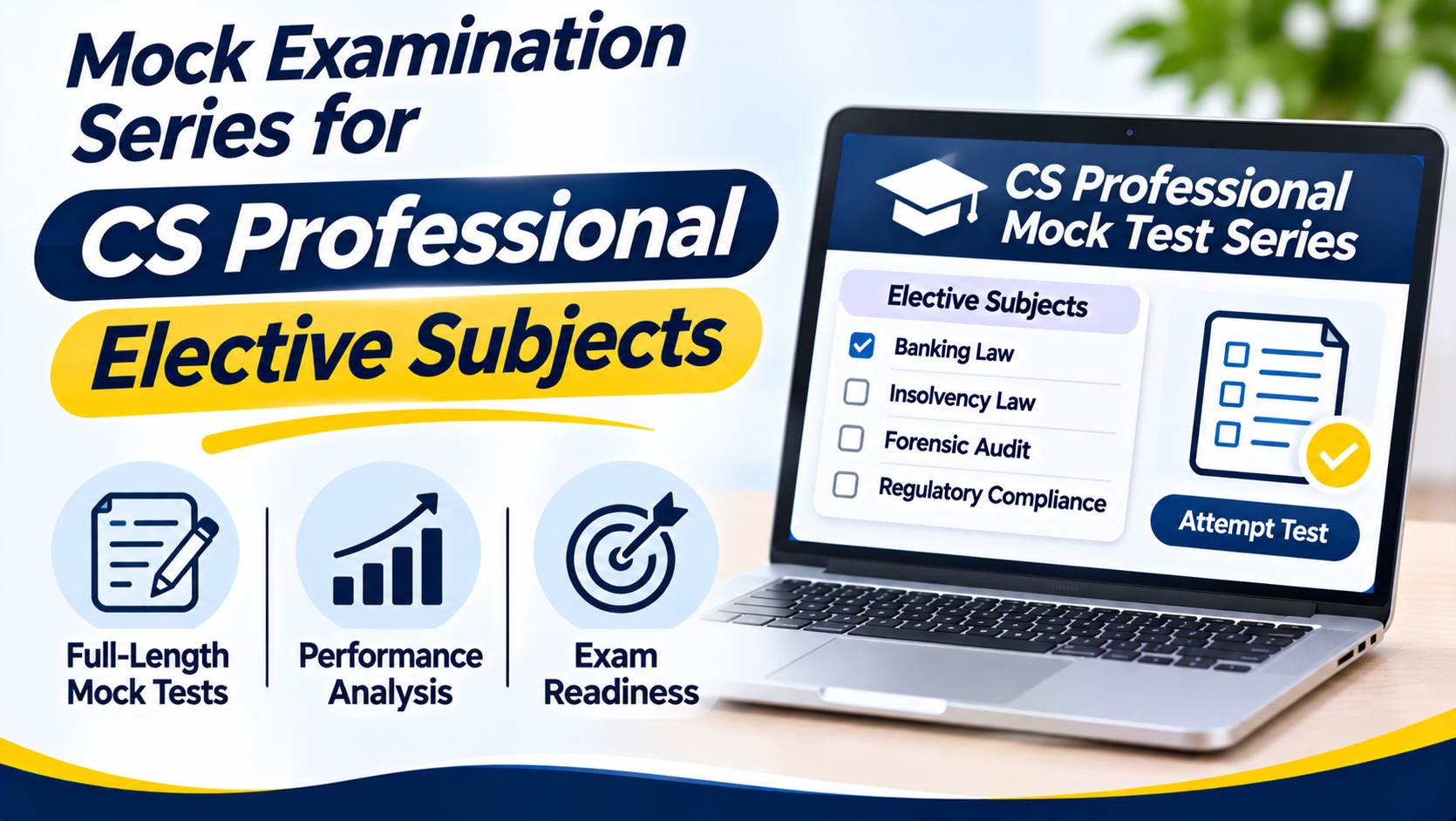
Write full papers under time before the exam: our CS Professional test series has papers on the ICSI pattern, checked by Company Secretaries. See plans and prices.
Always confirm dates on the official ICSI website, icsi.edu.
Because it is new, there are few past papers and almost no guidance on it. This post explains what the paper covers, who it suits, and how to prepare it if you choose it now or for June 2027.
Where the IFSCA elective fits in CS Professional
CS Professional under syllabus 2022 has seven papers in two groups. Each group has one elective, and you choose one paper from each elective list. Paper 4 (Elective 1) is in Group 1 and Paper 7 (Elective 2) is in Group 2.
| Elective 1 (Paper 4, Group 1) | Elective 2 (Paper 7, Group 2) |
|---|---|
| 4.1 CSR and Social Governance | 7.1 Arbitration, Mediation and Conciliation |
| 4.2 Internal and Forensic Audit | 7.2 GST and Corporate Tax Planning |
| 4.3 Intellectual Property Rights: Law and Practice | 7.3 Labour Laws and Practice |
| 4.4 Artificial Intelligence, Data Analytics and Cyber Security: Laws and Practice | 7.4 Banking and Insurance: Laws and Practice |
| 4.5 Advanced Direct Tax Laws and Practice | 7.5 Insolvency and Bankruptcy: Law and Practice |
| 4.6 IFSCA: Regulations, Listing and Compliances (from June 2026) |
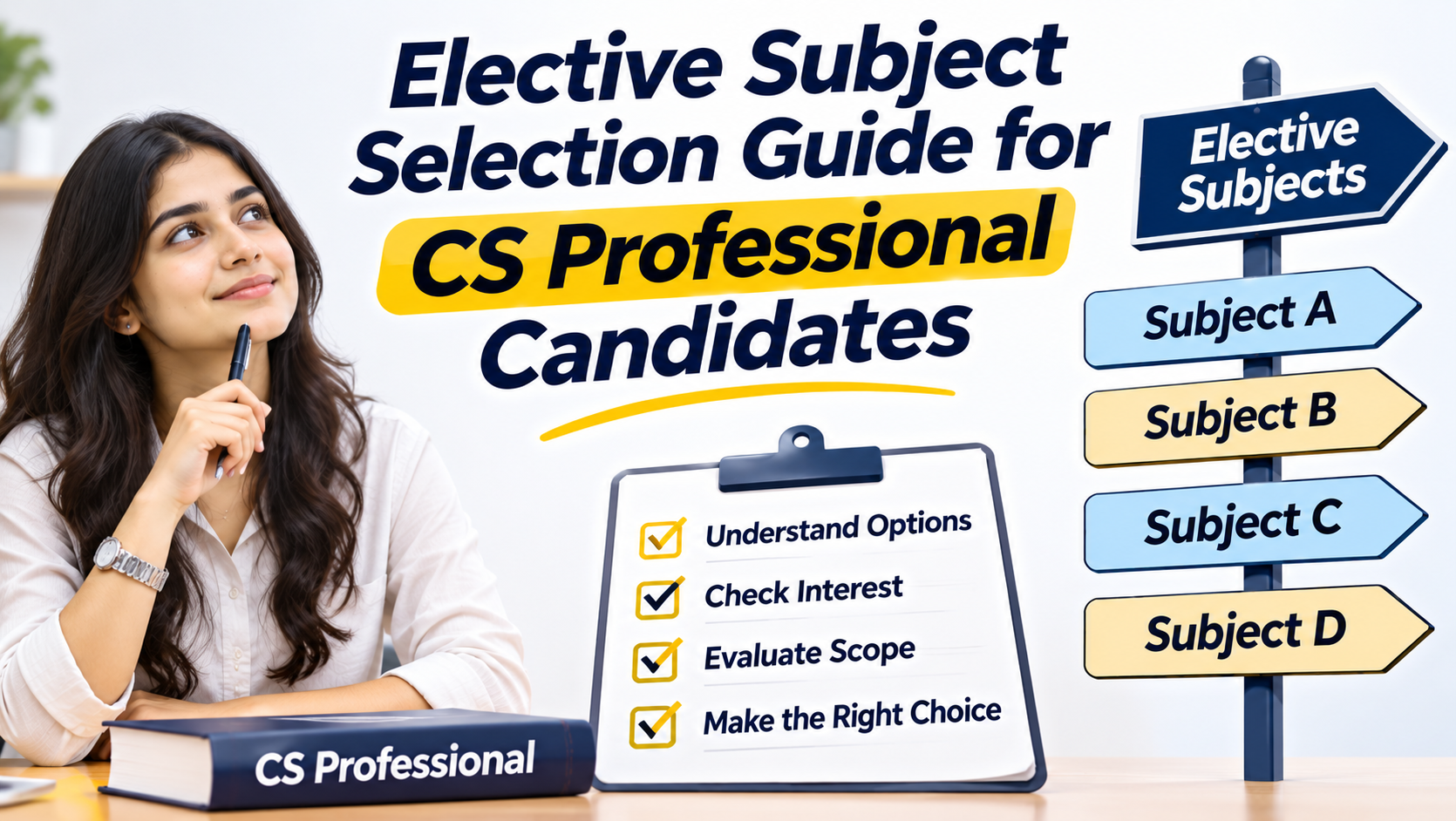
In the ICSI time table for December 2026, Elective 2 papers are on Sunday 27 December and Elective 1 papers on Monday 28 December, both marked as open book exams. If you are still weighing all the options, our elective selection guide covers the older papers in more detail.
What IFSCA is, in plain words
IFSCA is the International Financial Services Centres Authority, the single regulator for India's international financial services centre at GIFT City in Gujarat. Funds, banks, insurers, exchanges, bullion trading and fintech firms that operate from the IFSC follow IFSCA's regulations rather than the separate rules of SEBI, RBI or IRDAI that apply in the domestic market.
For a Company Secretary, that means a new set of registration, listing, governance and reporting rules to handle. ICSI has also been building courses for people working with IFSC entities, which is part of why this elective was added.
The ten lessons of Paper 4.6
The ICSI study material for this paper has ten lessons, matching the ten topics in the syllabus. The paper carries 100 marks. The stated aim is to build a full understanding of the main parts of the IFSC.
| Lesson | Title | What to focus on |
|---|---|---|
| 1 | International Financial Services Centres: An Introduction | Why IFSCs exist, the GIFT City set up, basic terms |
| 2 | IFSCA Ecosystem and Regulatory Framework | Powers of IFSCA, how it replaces several domestic regulators |
| 3 | Fund Management Services | Fund management entities, schemes, key managerial personnel rules |
| 4 | Listing and Issuance of Securities | Listing on IFSC exchanges, debt and equity issues |
| 5 | Insurance and Reinsurance | Insurance offices in the IFSC and their registration |
| 6 | Banking Services and Finance Companies in IFSC | IFSC banking units and finance companies |
| 7 | Book-keeping, Accounting, Taxation and Financial Crime Compliance Services and TAS | Service providers and their obligations |
| 8 | India International Bullion Exchange (IIBX) | How bullion trading works in the IFSC |
| 9 | Overview of FinTech and Service Providers in IFSC | Fintech frameworks and the regulatory sandbox |
| 10 | Capital Market Intermediaries | Broker, custodian and other intermediary registration |
What the December 2026 supplement adds
ICSI's list of study material for December 2026 shows the IFSCA paper material updated till 31 May 2026, and there is a separate supplement for this paper covering changes from 1 December 2025 to 31 May 2026. It touches lessons 3, 4, 7, 8, 9 and 10. Some of the updates it lists:
- Fund management: changes to key managerial personnel eligibility and experience, placement memorandum and winding up conditions, and custodian appointment timelines.
- Listing: new frameworks for preferential issues and QIPs, and a separate one for rights issues, both from April 2026.
- Finance companies and TechFin: May 2026 amendments, including a framework for trust and company service providers.
- IIBX: January 2026 changes on eligibility for SEZ units and advance authorisation holders.
- FinTech: a March 2026 framework for the regulatory sandbox, and December 2025 regulations for global in-house centres.
- Capital market intermediaries: January 2026 amendments on unified registration and officer qualifications.
Most students lose marks here because they study the base material and skip the supplement. In a new, regulation heavy paper, the examiner is likely to test recent changes, so read the supplement twice.
Who should pick the IFSCA elective
This paper suits you if you are comfortable with securities law and like regulatory detail. Much of it builds on ideas from CS Executive Capital Market and Securities Laws, such as listing, intermediaries and fund structures, but applied to a different regulator.
- Good fit: you enjoyed CMSL, you want to work in fund, listing or compliance roles, or you plan to work with GIFT City entities.
- Think twice: you prefer papers with a long bank of past questions, or you find regulation heavy papers hard to retain.
- Practical point: as a new paper it has very few past papers and guideline answers, so you will rely on the ICSI study material, the supplement and practice questions.
One more point to weigh: this paper sits in Group 1 with ESG, Drafting, Pleadings and Appearances, and Compliance Management, Audit and Due Diligence. Those are long writing papers. An elective that you find interesting is easier to keep up with alongside them than one you picked only because a friend did.
Choose your elective for your own interest and comfort, not because someone says one is easier. Every elective is 100 marks and counts the same toward your Group 1 aggregate.
How to prepare it as an open book paper
Open book does not mean easy. You will not have time to search the book for every answer. What helps is knowing exactly where each topic sits in your material. Our post on open book exam preparation in CS Professional goes deeper, but here is a short plan for this paper.
- Read all ten lessons once, then make a one page index: lesson, key regulation, page numbers.
- Add the supplement changes to the index with a different colour, so you see what is new.
- Use the Test Yourself questions at the end of each lesson and the test paper at the end of the study material.
- Write answers in the regulatory format: name the regulation, state the rule, apply it to the facts, conclude.
- In the last week, write at least one full 3 hour paper with your book beside you, to practise finding pages quickly.
Common mistakes to avoid
- Writing domestic SEBI or RBI rules when the question is about an IFSC entity. Read the question for words like IFSC, GIFT City or IFSCA.
- Copying long passages from the book. Open book papers reward application, not reproduction.
- Leaving the supplement for the last two days.
- Ignoring the introductory lessons. Questions on the IFSCA framework and its powers are easy marks.
Whatever elective you pick, the other Group 1 papers carry most of your aggregate, so practise them in full. Our CS Professional test series has ICSI pattern papers checked by Company Secretaries, and you can compare plans on the plans page. For the official syllabus, see the ICSI syllabus 2022 document.
Frequently asked questions
What is Paper 4.6 in CS Professional?
Paper 4.6 is IFSCA: Regulations, Listing and Compliances, an option under Elective 1 in the CS Professional syllabus 2022. ICSI added it from the June 2026 session.
Is the IFSCA elective an open book exam?
Yes. In ICSI's December 2026 time table, all Elective 1 and Elective 2 papers are marked as open book exams.
When is the IFSCA elective paper in December 2026?
Elective 1 papers, including Paper 4.6, are scheduled for Monday 28 December 2026 as per the ICSI time table.
How many lessons are there in the IFSCA elective?
The ICSI study material has ten lessons, from an introduction to IFSCs through to capital market intermediaries, and the paper carries 100 marks.
Is there a supplement for the IFSCA elective for December 2026?
Yes. ICSI has a December 2026 supplement for this paper covering IFSCA changes from 1 December 2025 to 31 May 2026.
Is the IFSCA elective easier than other CS Professional electives?
No elective is officially easier. IFSCA suits students who like securities and regulatory law, but it has very few past papers because it is new.
Practise what you just read