In this article (15)
- Internal and Forensic Audit at a glance
- How the ICSI model paper is set
- Part I: internal audit (60 marks)
- Part II: forensic audit (40 marks)
- How to prepare an open book audit paper
- Writing audit case study answers
- A three week plan for the elective
- Get your case study answers checked
- Frequently asked questions
- Is Internal and Forensic Audit an open book paper in CS Professional?
- When is the Internal and Forensic Audit exam in December 2026?
- What is the weightage of internal audit and forensic audit?
- What does the December 2026 supplement for this elective cover?
- Are Standards on Internal Audit mandatory?
- How should I answer forensic audit case studies?
The CS Professional Internal and Forensic Audit elective, Paper 4.2 in Group 1, is an open book paper on Monday, 28 December 2026. Almost every question is a situation from a real office: a cash shortage nobody admits to, GST charged at the wrong rate on a thousand invoices, travel claims without boarding passes. If you enjoy finding what went wrong and explaining what to do next, this elective suits you.
Latest update (18 Nov 2026): the CS Professional December 2026 exams run from 21 to 28 December 2026 (2:00 PM to 5:15 PM, no paper on 25 December). The next attempt after that is June 2027; ICSI announces its dates closer to the time.
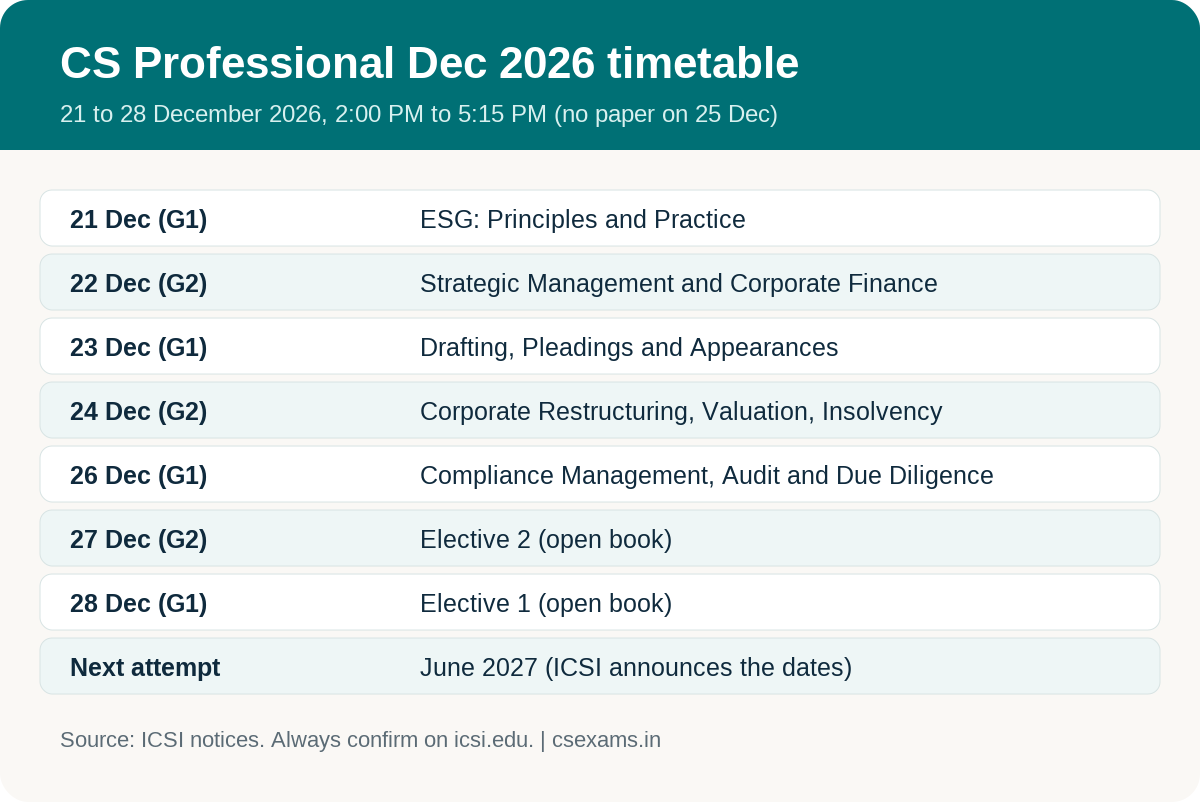
| What | Date |
|---|---|
| CS Professional Dec 2026 exams | 21 to 28 December 2026 |
| Admit card | Expected in the second week of December 2026 on icsi.edu, based on past years (the Dec 2025 cards came on 12 December 2025) |
| Dec 2026 result | Expected around 25 February 2027, based on past years (the Dec 2025 result came on 25 February 2026) |
| Next attempt | June 2027 |
Write full papers under time before the exam: our CS Professional test series has papers on the ICSI pattern, checked by Company Secretaries. See plans and prices.
Always confirm dates on the official ICSI website, icsi.edu.
This guide covers how the paper is split, how ICSI sets the model paper, what is new for December 2026 and how to prepare.
Internal and Forensic Audit at a glance
| Point | Details |
|---|---|
| Paper | Group 1, Elective Paper 4.2: Internal and Forensic Audit |
| Exam date | Monday, 28 December 2026 (Elective 1 papers) |
| Time | 2:00 PM to 5:15 PM, with the first 15 minutes for reading |
| Mode | Open book, written answers |
| Part I: Internal Audit | 60 marks |
| Part II: Forensic Audit | 40 marks |
| Material for December 2026 | Study material updated to 31 May 2026, plus the ICSI supplement with updates up to 31 May 2026 |
Elective 1 is the last paper of Group 1, so many students reach it tired after a week of exams. Prepare it early, and keep your tabbed book and index ready a few days before, so the night of 27 December is only for a calm read of your notes. For choosing between electives for a later attempt, see our elective selection guide.
How the ICSI model paper is set
ICSI's model question paper for this elective has six main questions, with choices in two of them.
| Part | Question | Type | Marks |
|---|---|---|---|
| I | Q1 | Compulsory scenarios, sub-parts of 8 and 7 marks | 15 |
| I | Q2 | Compulsory scenarios, 8 and 7 marks | 15 |
| I | Q3 | Compulsory, three sub-parts of 5 marks | 15 |
| I | Q4 or Q4A | Choice, sub-parts of 5 marks | 15 |
| II | Q5 | Compulsory forensic case study, four sub-parts of 5 marks | 20 |
| II | Q6 or Q6A | Choice, sub-parts of 5 to 10 marks | 20 |
The model paper's questions show the style: what an internal auditor should do after staff deny a cash fraud, how to handle wrong GST rates on about 1,000 transactions, gaps in travel expense claims, internal controls where one office manager controls every key financial function, and red flags, green flags and the fraud triangle. Question 5 is a full forensic case on an NBFC where you plan the method, report findings, state limitations and suggest legal steps.
Part I: internal audit (60 marks)
Part I is about how internal audit is planned, done and reported. The December 2026 supplement adds a summary of the Standards on Internal Audit issued by ICAI, from the quality standards to SIA 110 to SIA 330, grouped into core concepts, audit execution and reporting. It notes that these standards are recommendatory, and become binding on a company only when its board or audit committee adopts them, since no internal audit standard is required by law in India. It also compares them with the IIA's international standards.
Learn SIA 110, the basic principles of internal audit, well. The supplement lists twelve principles, including independence, integrity, due professional care, confidentiality, risk based audit and the use of technology and data analytics without giving up professional judgement. A scenario answer that names the right principle reads as an expert answer.
Most students lose marks here because they describe what an auditor is, instead of what this auditor should do now. In the cash fraud scenario, the examiner wants steps: secure records, check the cash book against bank and vouchers, interview people separately, document everything and report to the audit committee.
Part II: forensic audit (40 marks)
Part II covers fraud, investigation methods, evidence, reporting and the laws around it. The supplement adds a clear summary of fraud reporting by auditors under the Companies Act, 2013:
- Section 143(12): frauds of Rs 1 crore or more are reported to the Central Government; smaller frauds to the audit committee or board.
- Section 143(13): reporting in good faith is not a breach of the auditor's duty.
- Section 143(14): the same duty applies to cost auditors and secretarial auditors, which matters for you as a future CS.
- Section 143(15): failure to report attracts a fine from Rs 1 lakh to Rs 25 lakh.
- Rule 13 of the Companies (Audit and Auditors) Rules: report to the board or audit committee within 2 days, seek a reply within 45 days, and forward to the Central Government within 15 days of the reply in Form ADT-4.
Put these numbers on one page and tab it in your book. The forensic case study almost always has a reporting angle, and the timelines are easy marks.
Beyond reporting, learn the steps of a forensic investigation in order: understand the allegation, plan the scope, collect and preserve evidence, analyse data and documents, interview people, and report findings with limitations. The model paper's NBFC case asks for exactly this sequence.
How to prepare an open book audit paper
Open book helps only if you know where things are. A practical method:
- Read the study material once fully, then the supplement.
- Tab every lesson and mark the SIAs, the fraud reporting rules, the fraud triangle and the steps of a forensic investigation.
- Make your own index of 2 to 3 pages: topic, page number, one line summary.
- Solve the ICSI model paper and past papers with the book open and a timer running.
Our post on open book exam preparation for CS Professional explains tabbing and indexing in more detail.
Writing audit case study answers
Use a four step shape for every scenario: the issue in one line, the standard or provision that applies, the steps the auditor should take, and the conclusion or report. For an 8 mark sub-part, aim for about 250 words; for 5 marks, about 150. A short table works well for red flags and green flags or for listing control weaknesses with the fix beside each.
Do not copy paragraphs from the book. Examiners see the same copied text in hundreds of scripts. Write in your own words, quote one standard or section, and apply it to the facts of the question.
Also watch the verbs in the question. "Advise" means the steps you would take; "comment" means your view with a reason; "evaluate the internal controls" means list the weaknesses and the fix for each. Students who answer a different verb from the one asked often score half marks on answers that are otherwise correct. A two column table of weakness and recommended control is the cleanest way to answer evaluation questions, and examiners can mark it quickly.
A three week plan for the elective
| Week | Focus |
|---|---|
| Week 1 | Part I lessons and the SIAs in the supplement, with your index |
| Week 2 | Part II: fraud, investigation, evidence and the Section 143(12) framework |
| Week 3 | Two timed papers with the book open, then fix weak lessons |
See how this fits with your other papers in our CS Professional last month revision plan.
Get your case study answers checked
The difference between 50 and 65 in this elective is usually answer structure, not knowledge. Our CS Professional test series includes elective papers checked by Company Secretaries, who mark where your answer missed a step or a provision. You can see all options on the plans page.
Frequently asked questions
Is Internal and Forensic Audit an open book paper in CS Professional?
Yes. The ICSI time table marks the elective papers as open book examinations.
When is the Internal and Forensic Audit exam in December 2026?
Elective 1 papers, including Internal and Forensic Audit, are on Monday, 28 December 2026, from 2:00 PM to 5:15 PM.
What is the weightage of internal audit and forensic audit?
Part I, Internal Audit, carries 60 marks and Part II, Forensic Audit, carries 40 marks.
What does the December 2026 supplement for this elective cover?
It covers updates up to 31 May 2026, including a summary of ICAI's Standards on Internal Audit and the fraud reporting rules under Section 143(12) of the Companies Act, 2013.
Are Standards on Internal Audit mandatory?
As the ICSI supplement explains, they are recommendatory and become binding on a company only when its board or audit committee adopts them.
How should I answer forensic audit case studies?
State the issue, name the standard or provision, list the investigation or reporting steps, and end with a clear conclusion applied to the facts.
Practise what you just read