In this article (17)
- What secretarial standards are and why they matter
- SS-1: key rules on board meetings
- Notice and agenda
- Frequency and quorum
- Minutes
- Resolutions by circulation
- SS-2: key rules on general meetings
- SS-1 vs SS-2: numbers to remember
- How secretarial standards come up in CS exams
- Common mistakes students make
- Frequently asked questions
- Are secretarial standards mandatory?
- What is the notice period for a board meeting under SS-1?
- What is the quorum for a board meeting?
- Within how many days must minutes be entered?
- What is the notice period for a general meeting under SS-2?
- When did SS-1 and SS-2 come into force?
Secretarial standards SS-1 and SS-2 are the ICSI rules on how board meetings and general meetings must be called, held and recorded. Section 118(10) of the Companies Act, 2013 makes them mandatory, so a company that ignores them is breaking the law, not just a guideline.
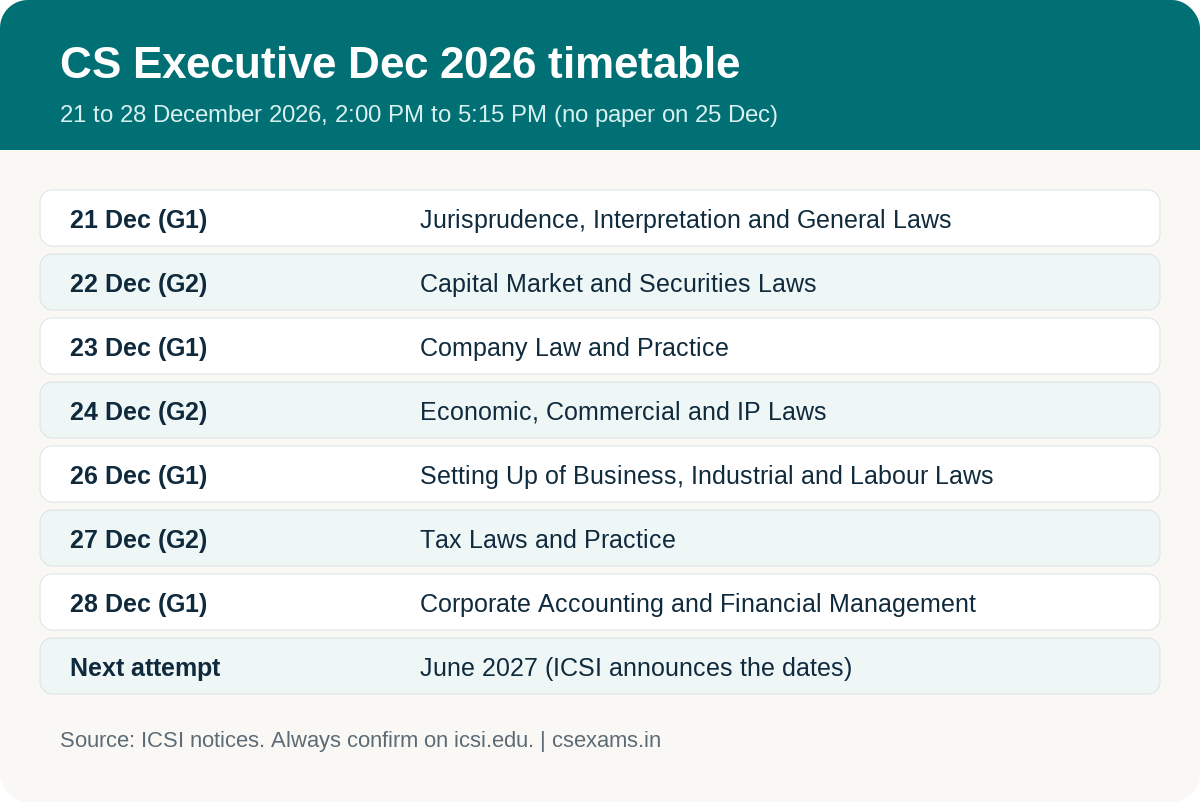
Latest update (18 Nov 2026): the CS Executive December 2026 exams run from 21 to 28 December 2026 (2:00 PM to 5:15 PM, no paper on 25 December). The next attempt after that is June 2027; ICSI announces its dates closer to the time.
| What | Date |
|---|---|
| CS Executive Dec 2026 exams | 21 to 28 December 2026 |
| Admit card | Expected in the second week of December 2026 on icsi.edu, based on past years (the Dec 2025 cards came on 12 December 2025) |
| Dec 2026 result | Expected around 25 February 2027, based on past years (the Dec 2025 result came on 25 February 2026) |
| Next attempt | June 2027 |
Write full papers under time before the exam: our CS Executive test series has papers on the ICSI pattern, checked by Company Secretaries. See plans and prices.
Always confirm dates on the official ICSI website, icsi.edu.
For CS Executive students, these two standards decide many marks in company law questions on meetings. For CS Professional, they come back in audit and due diligence. This post lays out the secretarial standards in plain language, with a comparison table of the numbers you must remember.
What secretarial standards are and why they matter
The Companies Act tells you what a company must do: hold an AGM, keep minutes, give notice of meetings. It often leaves out the detail of how. The secretarial standards fill that gap. ICSI issues them, and the Central Government approves them. Once approved, Section 118(10) requires every company to observe the standards on board and general meetings.
Two standards carry this legal force:
- SS-1: Meetings of the Board of Directors, which covers board meetings and committee meetings.
- SS-2: General Meetings, which covers AGMs, EGMs, postal ballots and e-voting.
Both first came into force on 1 July 2015. Revised versions apply from 1 October 2017. ICSI reviews them from time to time, so check the current versions on the ICSI secretarial standards page before your exam. SS-2 does not apply to a One Person Company, and SS-1 does not apply to a One Person Company that has only one director. Section 8 companies also get some relaxations, so read the scope paragraph of each standard before you answer a case.
SS-1: key rules on board meetings
SS-1 is mostly about notice, quorum, attendance and minutes. These are the points examiners ask about again and again.
Notice and agenda
Notice of a board meeting must be given in writing to every director at least seven days before the meeting. The agenda and notes on agenda go with it. A meeting can be called at shorter notice to transact urgent business, but then at least one independent director, if the company has one, must be present. If no independent director attends, decisions taken must be circulated and ratified by at least one independent director.
Frequency and quorum
A company must hold at least four board meetings in a calendar year, with a gap of not more than 120 days between two meetings. The first board meeting must be held within 30 days of incorporation. Quorum is one third of the total strength of the board or two directors, whichever is higher. Directors joining through video conferencing count for quorum.
Minutes
Draft minutes go to all directors within 15 days of the meeting. Directors send comments within seven days of receiving them. Minutes must be entered in the minutes book within 30 days and signed by the chairman of that meeting, or of the next meeting. Each page is initialled and the last page signed and dated.
Resolutions by circulation
A resolution can be passed by circulation when the draft and papers are sent to all directors. It is passed when a majority of directors entitled to vote approve it. If at least one third of the directors ask for the matter to be decided at a meeting, the chairman must put it to a meeting.
SS-2: key rules on general meetings
SS-2 deals with shareholders. The numbers are different from SS-1, and students mix them up under pressure.
- Notice of a general meeting must be given at least 21 clear days before the meeting.
- An AGM can be held at shorter notice with the consent of a majority in number of members entitled to vote, holding at least 95% of the paid-up share capital or voting power.
- Quorum follows Section 103 of the Act, based on the number of members of a public company, and two members for a private company unless the articles say more.
- Proxies must be lodged at least 48 hours before the meeting.
- Minutes must be entered within 30 days of the meeting and signed by the chairman within that time.
- Where e-voting applies, the scrutiniser's report and the results follow the time limits in the Act and the rules.
SS-2 also covers the order of business at an AGM, voting by show of hands and poll, adjournment, and the disclosures in the explanatory statement for special business. If you remember that SS-2 adds procedure on top of Sections 96 to 122 of the Act, the topics fall into place.
SS-1 vs SS-2: numbers to remember
Put this table on a single sheet and revise it until you can write it without looking. Most questions on meetings test one of these figures.
| Point | SS-1 (Board meetings) | SS-2 (General meetings) |
|---|---|---|
| Notice period | At least 7 days | At least 21 clear days |
| Shorter notice | Allowed for urgent business, with an independent director present | AGM: consent of majority in number holding 95% of capital or voting power |
| Quorum | One third of total strength or 2 directors, whichever is higher | As per Section 103 of the Act |
| Frequency | At least 4 meetings a year, gap of not more than 120 days | AGM every year, within the time limit of Section 96 |
| Minutes entry | Within 30 days | Within 30 days |
| Draft minutes | Circulated within 15 days, comments within 7 days | Not required to be circulated in the same way |
| Legal basis | Section 118(10), Companies Act, 2013 | Section 118(10), Companies Act, 2013 |
How secretarial standards come up in CS exams
In CS Executive, meetings are part of Company Law and Practice. Questions usually give a set of facts and ask whether a meeting was valid. The notice was sent six days before. The quorum was two out of nine directors. Minutes were signed after 45 days. You have to spot each defect and cite the rule. Read our CS Executive company law guide for the wider paper.
In CS Professional, the same rules appear in compliance audit questions. You may be asked what a secretarial auditor should check on board meetings, or to draft an observation on non-compliance with SS-1. The facts stay the same; only the angle changes.
A short tip: when you write the answer, quote the standard and the paragraph topic, for example "As per SS-1 on notice of meetings". Examiners give credit for the right source. Quoting only the Act when the question is about the standard loses easy marks.
One more habit helps. When a case gives you dates, draw a quick timeline in the margin: notice date, meeting date, minutes date. Defects jump out in seconds, and you will not miss the 120 day gap.
Common mistakes students make
- Writing 21 days for board meeting notice, or 7 days for general meetings.
- Saying quorum for a board meeting is one third, and forgetting "or 2 directors, whichever is higher".
- Forgetting the 120 day gap rule when the facts give meeting dates.
- Treating secretarial standards as recommendatory. SS-1 and SS-2 are mandatory under Section 118(10).
- Mixing the 15 day draft minutes rule with the 30 day entry rule.
The way to fix these is timed practice with real feedback. Solve meeting-based case questions under exam conditions and have them checked. Our CS Executive test series includes chapter tests on meetings, and every sheet is checked by a Company Secretary who marks the exact missing rule. If you are still building your study plan, our guide on remembering legal provisions shows how to revise numbers like these without cramming.
Frequently asked questions
Are secretarial standards mandatory?
Yes. SS-1 on board meetings and SS-2 on general meetings are mandatory under Section 118(10) of the Companies Act, 2013.
What is the notice period for a board meeting under SS-1?
At least seven days' notice in writing must be given to every director, with the agenda and notes on agenda.
What is the quorum for a board meeting?
One third of the total strength of the board or two directors, whichever is higher. Directors attending by video conferencing count for quorum.
Within how many days must minutes be entered?
Under both SS-1 and SS-2, minutes must be entered in the minutes book within 30 days of the meeting.
What is the notice period for a general meeting under SS-2?
At least 21 clear days. An AGM can be held at shorter notice with consent of a majority in number of members holding at least 95% of the paid-up capital or voting power.
When did SS-1 and SS-2 come into force?
They first came into force on 1 July 2015, and the revised versions apply from 1 October 2017.
Practise what you just read