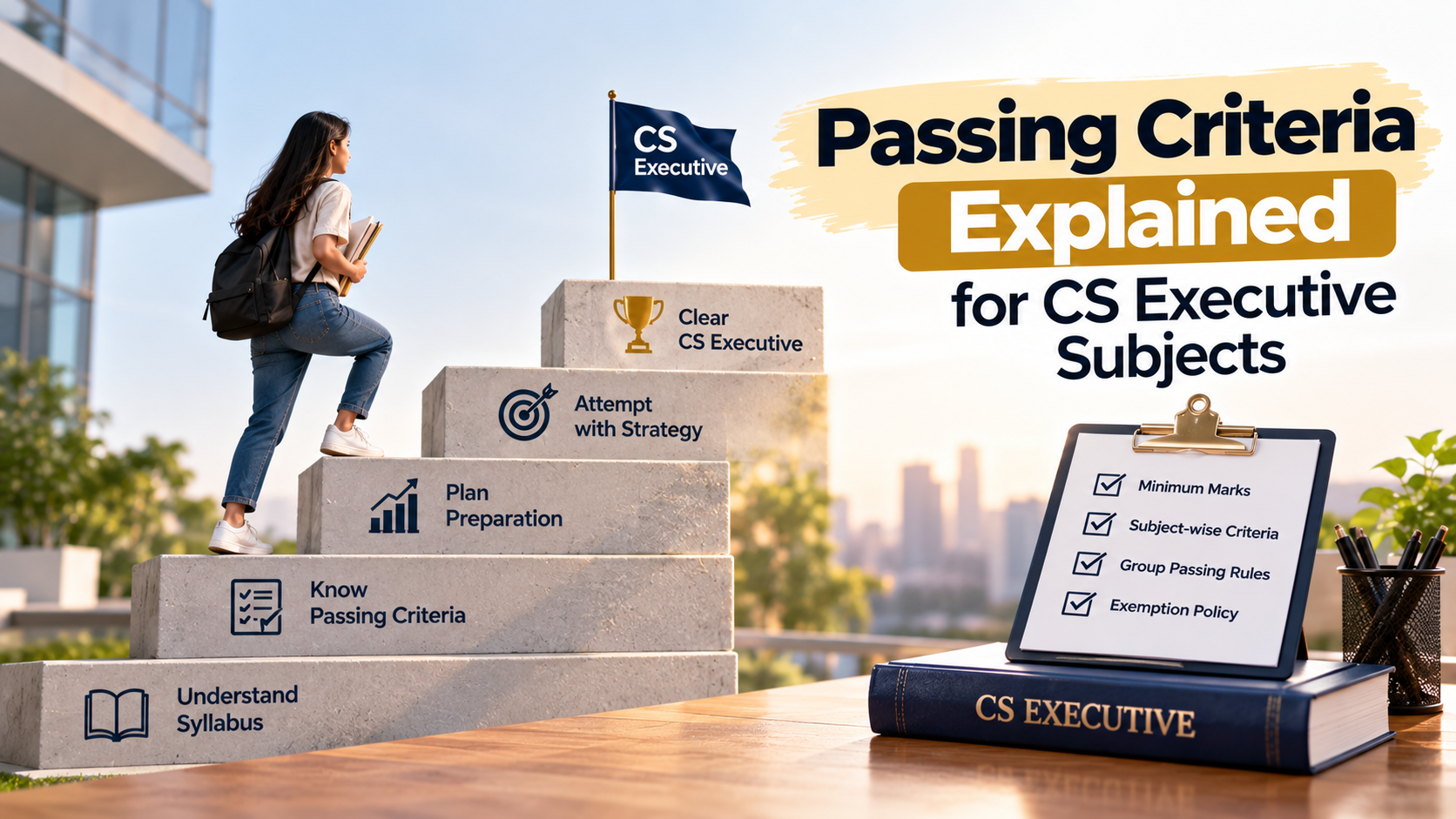
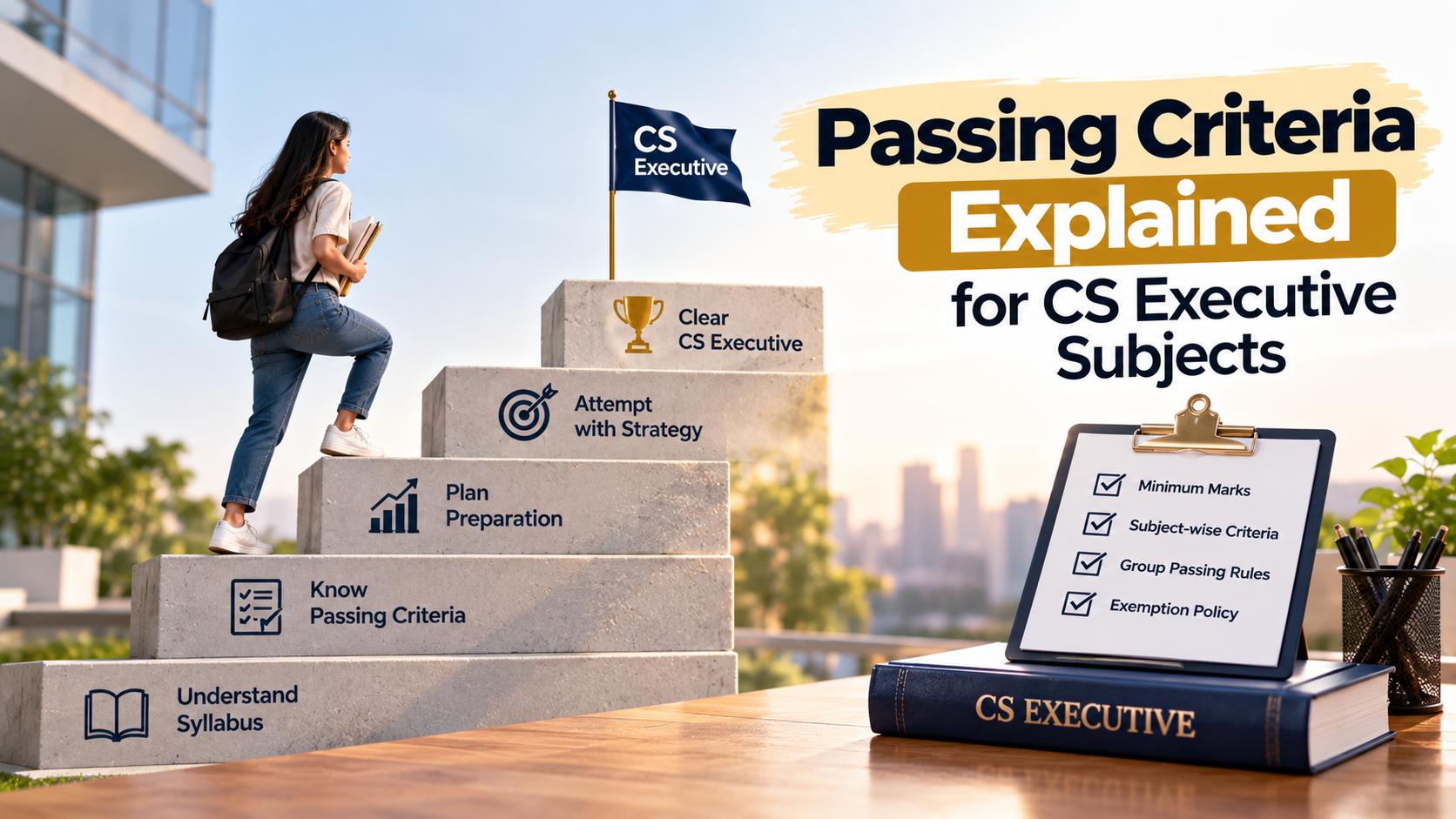
Understanding the passing criteria for the CS Executive Programme helps students plan preparation realistically. It clarifies the difference between meeting the minimum requirement in an individual paper and achieving the required aggregate. Knowing the rules early also helps you divide revision time across subjects.
ICSI guidance has generally described a requirement of at least 40% in each paper and 50% in aggregate at one sitting. Candidates should verify the latest official qualifying-marks notice and any syllabus-specific rules before making an exam plan.
Understand both parts of the passing rule
CS Executive passing criteria are generally explained through two requirements: a minimum mark in each relevant paper and a minimum aggregate across the set of papers defined by the rules. Meeting only one condition may not be enough. A strong score in one paper does not necessarily compensate for a paper below the required minimum.
ICSI has commonly published a qualifying requirement of at least 40% in each paper and 50% in aggregate at one sitting. However, candidates should verify the latest official qualifying-marks notification and the rules that apply to their syllabus, module and examination session before planning around those figures.
What does a 40% paper-wise minimum mean?
If the applicable rule requires 40% in each paper, the student must reach that threshold separately in every paper covered by the rule. For example, 40% of a hypothetical 100-mark paper is 40 marks. This illustrates the calculation only; use the actual marks structure and regulations for your session.
This is why focusing only on strong subjects can be risky. A candidate may score well in several papers but still fall short if one paper is below the individual minimum. Give every subject enough attention and use mock tests to identify weak areas before the examination.
Understand the aggregate requirement
An aggregate requirement is calculated by adding the marks included under the applicable rule and comparing the total with the prescribed percentage. For example, if a defined set of papers carries 400 marks and the rule requires 50% aggregate across that exact set, the illustrative threshold would be 200 marks. The papers included must be confirmed from the regulations.
Do not assume that aggregate marks always mean the total across every paper in the entire programme. The applicable rule may define the requirement by module or another set of papers. Check the official wording, especially if you are appearing in one module or have an exemption.
Confirm your syllabus and paper structure
CS Executive subjects and paper arrangements depend on the syllabus under which you are registered. ICSI publishes current examination information and subject lists, while older syllabus versions may use different paper names or arrangements. Confirm your syllabus year and the papers relevant to your attempt before setting targets.
Make a tracker with each paper, its maximum marks, your latest mock score and your target. This shows which subjects are near the minimum and where you need a stronger margin. Do not calculate targets using a paper list copied from an older syllabus without checking it.
Set a target above the minimum
A formal passing threshold is a minimum, not necessarily a sensible preparation target. Aim for a margin above the threshold because exam-day pressure, unfamiliar questions or careless mistakes can affect performance. Set targets based on your mock scores, remaining time and the topics still to be covered.
Break each subject into chapters and mark whether you have studied, revised and practised each one. For law-focused papers, include concept understanding and structured answer writing. For numerical or application-based papers, schedule regular question solving instead of relying on reading alone.
Use mock tests to measure readiness
Attempt mock tests under realistic time limits. One score is not a complete picture, so look for patterns across several attempts. A stable improvement is more informative than a single unusually high or low result.
After each mock, classify mistakes as knowledge gaps, poor presentation, time management or careless errors. Each category needs a different response. Relearn a weak concept, practise writing a clearer answer, use timed sections to improve speed or slow down when reading questions.
Check exemptions and special provisions
Exemptions, carry-forward provisions and other special situations can affect how results are evaluated. A general summary may not cover your individual case. Check the current ICSI regulations, examination guidelines and official notices that apply to your exemption or previous result.
Keep official marks statements and exemption confirmations available when planning a later attempt. If a rule is unclear, contact ICSI through its official support channel. Do not treat a coaching note or a friend’s experience as a binding interpretation of examination regulations.
Balance subjects throughout revision
Students sometimes spend too much time on familiar subjects because these provide confidence, while avoiding a difficult paper. A balanced timetable reduces that risk. Schedule regular sessions for weaker subjects and use shorter recall sessions to keep stronger subjects fresh.
Alternate demanding topics with lighter revision where practical. After a difficult chapter, complete a short recall exercise or a set of objective questions. Review progress every week and adjust the next week’s plan based on your actual test performance.
Track progress with a test series
CS Exams Test Series can be an additional practice resource for checking subject knowledge, timing and answer presentation, provided its content matches your syllabus. Compare performance paper by paper rather than focusing only on a combined score.
Keep a tracker showing the test date, marks, topics where marks were lost and the next corrective action. If a subject remains below target, revise the underlying chapters and attempt a fresh test. Use official ICSI material to resolve doubts about syllabus coverage or qualifying rules.
Verify the official rule before making decisions
Passing criteria should be confirmed through official ICSI publications, especially when syllabus or regulations change. Check the official examination site for the latest qualifying-marks notice and read the rules for the session under which you are appearing.
Use this article as a study-planning guide, not as an official ruling. If your case involves an exemption, module-specific requirement, syllabus transition or another special condition, rely on the applicable ICSI regulation and written clarification from the Institute.
How CS Exams Test Series Can Support Your Preparation
CS Exams Test Series can be used as an additional practice resource to test understanding, identify weak areas and build a regular preparation routine. Choose resources that match your applicable syllabus and session. For syllabus details, examination instructions and official rules, refer to the Institute of Company Secretaries of India (ICSI).