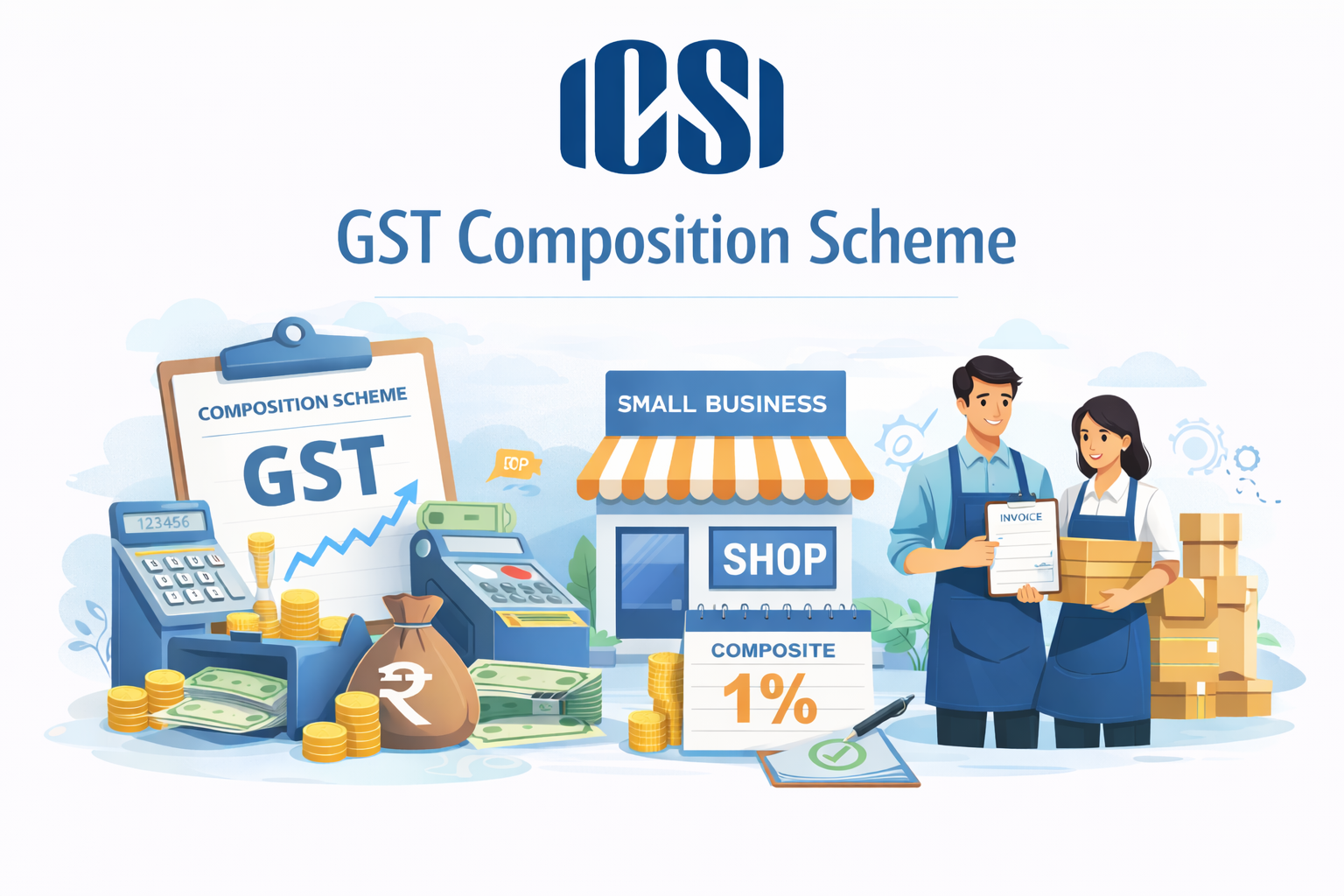
The composition scheme under GST is a simple and easy plan for taxpayers. Small taxpayers can get rid of tedious GST formalities and pay GST at a certain rate of turnover. This scheme can be selected by any taxpayer whose turnover is less than Rs. 1.5 crore.
Under this scheme, an eligible business pays tax at a certain rate on its turnover, rather than a detailed tax calculation for every sale. This means low compliance and simple tax payment, which is a great help for the owners of small businesses, who cannot have a strong accounting team.
What is the GST Composition Scheme?
The GST composition scheme provides an easy tax payment method for small taxpayers. Instead of paying tax on each sale and submitting various returns, individuals in this program send a fixed percentage of their gross income as tax.
It is a voluntary program that aims to reduce compliance load for small businesses. For example, if a manufacturer's annual revenue becomes Rs 1 crore, GST will be charged at a standard rate of 1% instead of computing each sales transaction.
What are the Conditions for Availing the Compositions Scheme?
Before choosing the GST composition scheme, it is important to understand the basic requirements that determine who can choose the option of the composition scheme:
- Turnover limit: This scheme is available only to businesses that have annual sales within a specific limit, which is up to Rs 15 lakhs or up to Rs 18.75 lakh for specialized category states.
- Nature of Business: It is open to suppliers of goods and some services, but not for people engaged in interstate sales or the supply of non-taxable goods or those that fall under reverse charge provisions.
- No input tax credit: Businesses participating in this scheme will not be able to claim input tax credit on their procurement or operational expenses.
- Simply simplifies compliance: participants benefit from low paperwork, low return filing, and easy records.
- Tax rate: Instead of normal GST rates, the total turnover is applied as a certain, low percentage rate tax.
- Quarterly Payments: Taxes are fixed every quarter, which helps to manage cash flow more efficiently.
- Voluntary Opt-in: Businesses can voluntarily choose this scheme if they meet eligibility criteria and follow the necessary procedure.
Who is Eligible?
To qualify for the GST composition scheme, businesses have to meet turnover and business-type norms:
- Annual turnover up to ₹ 1.5 crore (in special category states, up to 75 lakhs)
- Goods or simple services should be dealt with (inter-state supply or e-commerce not included)
- Should not engage in the supply of goods through e-commerce.
- Services should not be supplied except for those notifications (e.g., supply of food/beverages in restaurants without air conditioning)
These conditions ensure that only very small enterprises benefit from simplified compliance.
Check How to Apply for the GST Compositions Scheme
Businesses can apply online through the GST portal by following these steps:
Step 1: Go to the official GST portal and log in with your username and password.
Step 2: Navigate to services> Registration > Application to choose the option of composition levy.
Step 3: Read the terms and conditions carefully, check the declaration box, and proceed.
Step 4: Fill in all the required details, such as business information, turnover, and the location of the business.
Step 5: Review the details recorded and submit the form using e-Hastkshak, Electronic Verification Code (EVC), or Digital Signature Certificate (DSC).
Step 6: After submission, you will receive an acknowledgment reference number to track the application.
Who can opt for the Compositions Scheme?
The following people cannot choose the option of the scheme:
- Ice cream, pan masala, or the manufacturer of tobacco.
- A person who supplies interstate or gives a discount on the supply.
- A casual taxable person or a non-resident taxable person.
- A person supplying services through an e-commerce operator needs to collect TCS under CGST Section 52.
- On the recommendations of the GST Council, a manufacturer of such items or a supplier of such services notified by the government
Applicable GST Rate Under the Compositions Scheme
| Business category | GST % |
| Manufacturers (except ice cream, pan masala, tobacco products, etc.) | 1% (0.5% CGST + 0.5% SGST/UTGST) |
| Restaurant (not serving alcohol) | 5% (2.5% CGST + 2.5% SGST/UTGST) |
| Eligible service providers (or goods and service suppliers) | 6% (3% CGST + 3% SGST / UTGST) |
| Traders or any other supplier eligible for the composition levy | 1% (0.5% CGST + 0.5% SGST/UTGST) |
Objective of Various Composition Scheme (GST) Forms
Under the current GST rules and regulations, it is necessary to present various forms for diverse purposes to the taxpayers/businesses registered under the composition scheme. Form Name/No., Its purpose and due date are mentioned in the table below:
| Sr. No. | Form no. | Purpose | Due date |
| 1 | Form GST CMP 01 | Tax payment under composition (provisional registration) | Within 30 days of GST registration |
| 2 | Form GST CMP 02 | To furnish information related to stock and inward supplies from unregistered individuals | Before the start of the financial year |
| 3 | Form GST CMP 03 | To opt out of the composition scheme | Within 60 days of the exercise of an option |
| 4 | Form GST CMP 04 | Show-cause notice on contravention of the Act or rules by the proper officer | Within seven days of the occurrence of the event |
| 5 | Form GST CMP 05 | To reply to the show-cause notice | On contravention |
| 6 | Form GST CMP 06 | An issue of order | Within 15 days |
| 7 | Form GST CMP 07 | Registration under the Composition Scheme | Within 30 days |
| 8 | Form GST REG 01 | To furnish information related to inputs in the stocks of finished or semi-finished goods | Before the appointed date |
| 9 | Form GST ITC 01 | Intimation of ITC available | Within 30 days of the option being withdrawn |
| 10 | Form GST ITC 13 | Intimation of willingness to opt for the scheme | Within 60 days of starting a new financial year |
Benefits of the GST Compositions Scheme
The composition plan gives many advantages to small businesses:
- Simplified compliance: A quarterly return (GSTR-4) and an annual return.
- Reduced tax rates: The composition rate is much lower than regular GST rates.
- Low record-keeping: There is no need to track each tax invoice in detail.
- Better cash flow: Flat rates help in planning outflow.
Filing Returns Under the GST Compositions Scheme
Taxpayers must file under this scheme:
- GSTR-4: quarterly return
- GSTR-9A: Annual return
The GST composition scheme offers a simple, budget-friendly, and effective tax option for small enterprises. GST Rachna Yojana enables businesses to make informed decisions informed by understanding the rate of GST tax for the Turnover limit, and the eligibility criteria for the GST composition scheme. By understanding GST composition rules and situations, the owners of small businesses can conserve time and focus on expanding their business.
Why Choose CS Exam Test Series for CS Preparation
When it comes to preparing for the hard CS exams, choosing the right test series can make all the difference. csexams.in has emerged as a trusted and result-oriented platform for CSEET, Executive, and Professional-level aspirants. Here's why it should be your first choice:
- Trusted by Thousands of CS Aspirants: The CS Exam has built a strong reputation among CS students for its consistent quality and excellent student feedback.
- ICSI Pattern-Based Question Papers: All tests are strictly based on the latest ICSI exam pattern and syllabus, ensuring real exam-like practice.
- Timely Evaluation with Expert Feedback: Get your answers evaluated within 48–72 hours along with detailed feedback, a marking scheme, and improvement tips.
- Personalized Mentorship & Study Planner: Get personalized mentorship, performance tracking, and a daily study plan customized to your syllabus completion pace.