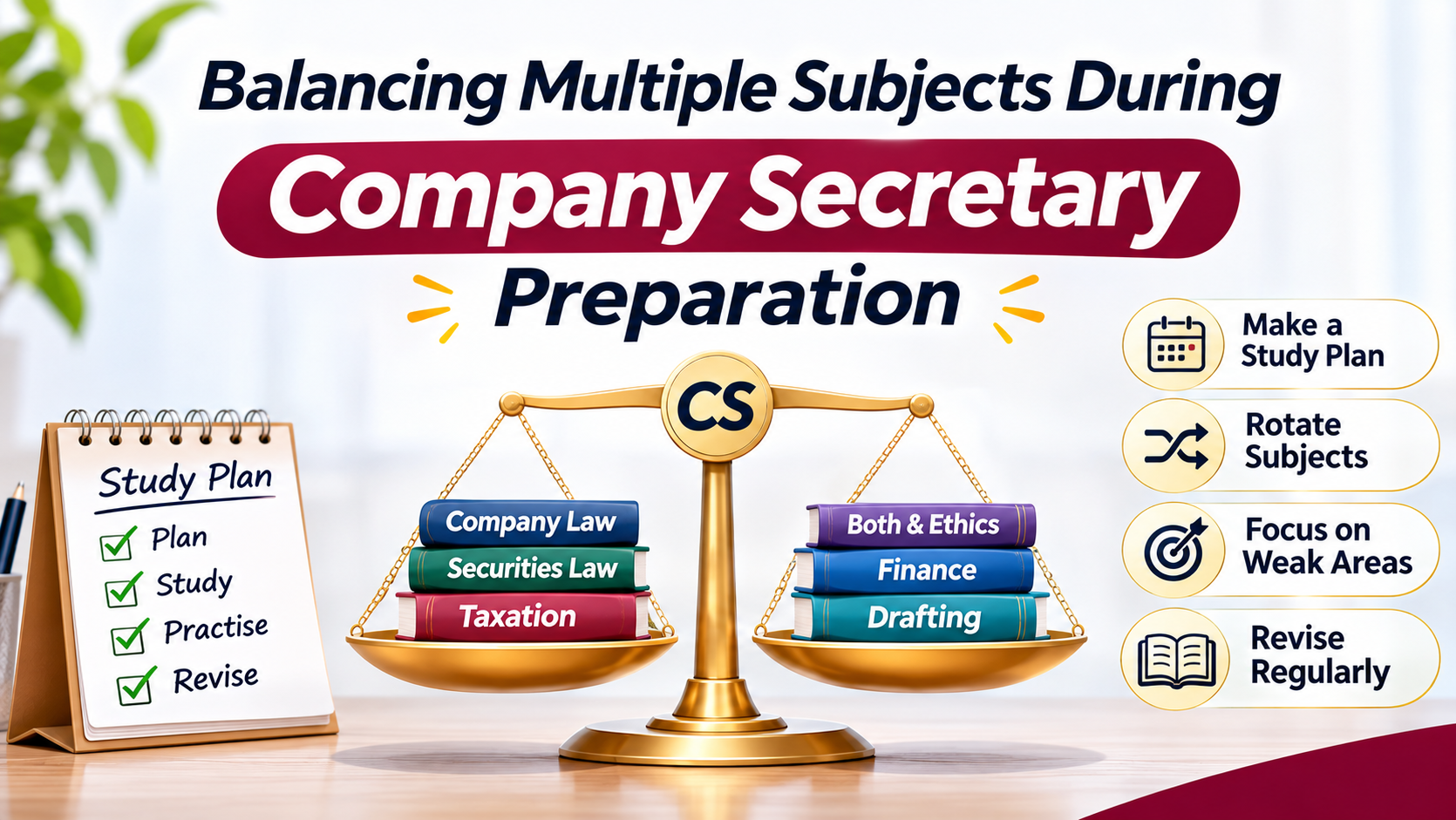
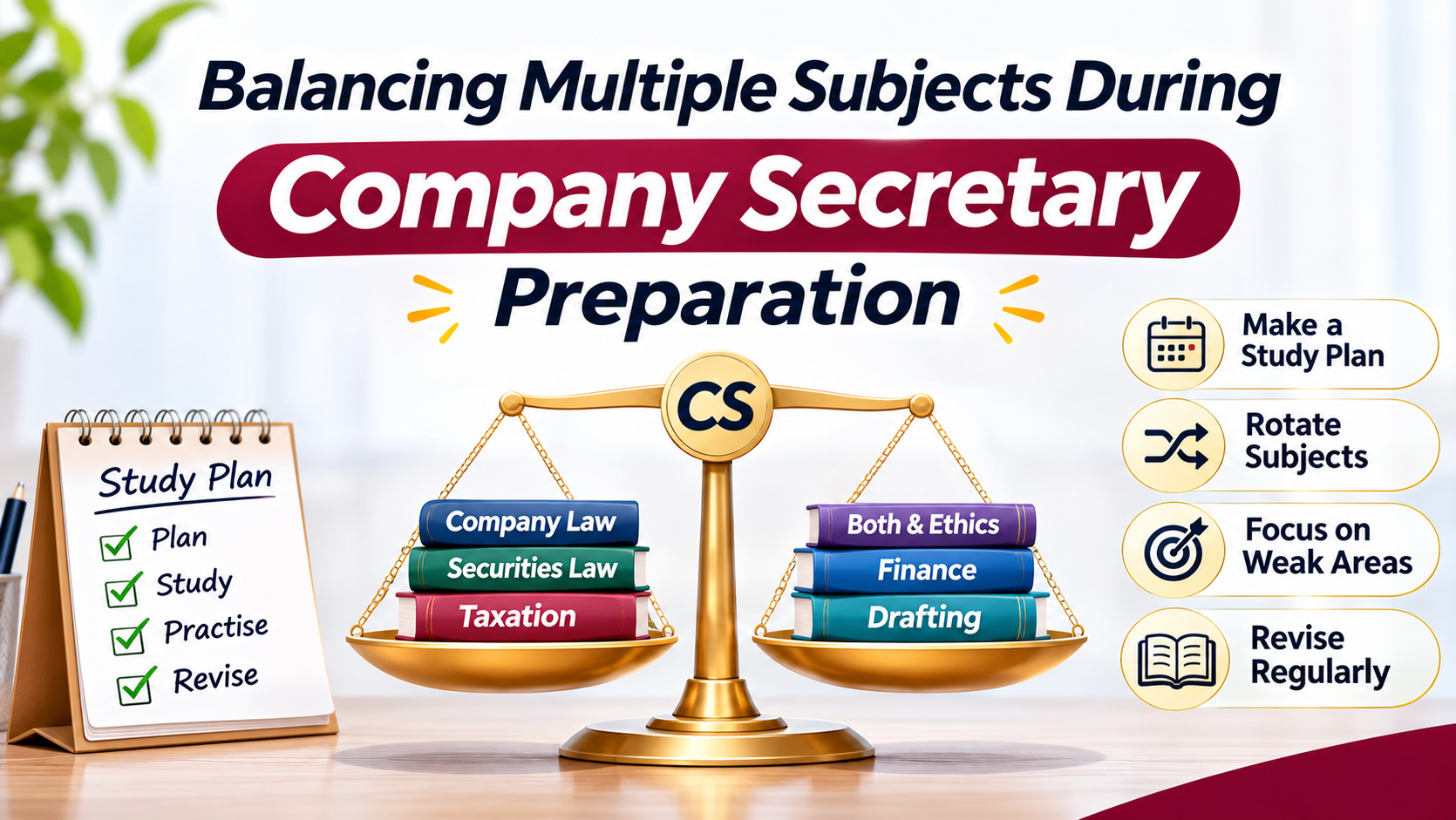
Preparing for Company Secretary examinations requires more than completing chapters. Students must understand concepts, remember important details and apply them accurately under time limits. A clear routine makes that work manageable.
A structured plan that combines learning, revision and practice helps students see where they are progressing and where they need to improve. CS Exams Test Series can support this process through planned examination-style practice and performance review.
Balance does not mean equal hours
Different subjects demand different kinds of work. A difficult paper may need repeated concept sessions, while a stronger subject may need only revision and timed practice. Equal hours can therefore create an artificial balance. Allocate effort according to syllabus size, difficulty, current understanding and the work still required.
Assess every subject first
Create a subject-wise status sheet and list the chapters, completion level, confidence, pending practice and revision needs. Separate familiarity from genuine ability: a topic read once may still be weak if you cannot explain it or apply it. Review this assessment every one or two weeks because your priorities will change as preparation improves.
Choose a rotation pattern you can maintain
You may study two main subjects each day and add a short revision task from another subject, or assign different combinations to alternate days. The key is to avoid long gaps. Keep the pattern stable long enough to judge it, and give any repeatedly missed subject a fixed slot instead of continually redesigning the timetable.
Give difficult papers focused attention
Identify the reason a subject feels difficult. It may be weak fundamentals, lengthy provisions, unfamiliar terminology, calculation errors or difficulty applying concepts to cases. More reading will not solve every problem. Schedule difficult topics during productive hours, divide chapters into smaller tasks and follow learning with closed-book questions.
Maintain stronger subjects
A subject should not disappear from the timetable once its first reading is complete. Use shorter maintenance sessions for recall, selected questions and periodic timed practice. In law, practise identifying issues and applying provisions; in practical papers, reproduce workings accurately. Maintenance keeps knowledge available without taking the same time as a weak subject.
Combine learning with practice
After completing a topic, attempt questions while the concepts are fresh. Revisit it later through active recall and include it in a sectional test. Keep an error record by subject and identify whether mistakes arise from misunderstanding, forgetting, misreading, calculation or presentation. This creates a useful cycle of learning and correction.
Plan weekly subject outcomes
Set a clear weekly outcome for each paper. One may need a new chapter completed, another two rounds of questions and another a revision session. Leave a flexible slot for spillover work. At the weekly review, move unfinished tasks deliberately rather than copying the entire backlog into the next week.
Let test performance guide allocation
One test score should not dictate your whole plan, but repeated patterns matter. If a subject remains weak across several attempts, increase focused practice. If another is consistently strong, maintain it through revision and timed questions. The CS Exams Test Series can provide checkpoints across papers; review accuracy, completion rate and answer quality before changing your timetable.
Avoid common rotation mistakes
Switching subjects every few minutes can interrupt concentration, while studying only one subject for several days creates long gaps elsewhere. Students may also over-study favourite topics because they feel comfortable. Use planned sessions and a weekly tracker, and do not copy another student's allocation without considering your own strengths and commitments.
Make the plan flexible
Keep a normal routine and a reduced version for busy weeks. Protect short revision sessions and essential practice when time is limited, then move longer learning blocks to a suitable slot. A clear rotation helps you restart quickly because the next subject and task are already decided.
Quick Reference Table
| Preparation need | Time allocation | Useful activity |
|---|---|---|
| Weak subject | Frequent focused sessions | Concept review followed by questions |
| Strong subject | Short regular maintenance | Active recall and timed practice |
| New chapter | Longer uninterrupted block | Concept learning and summary notes |
| Completed chapter | Spaced revision slots | Closed-book recall and sectional questions |