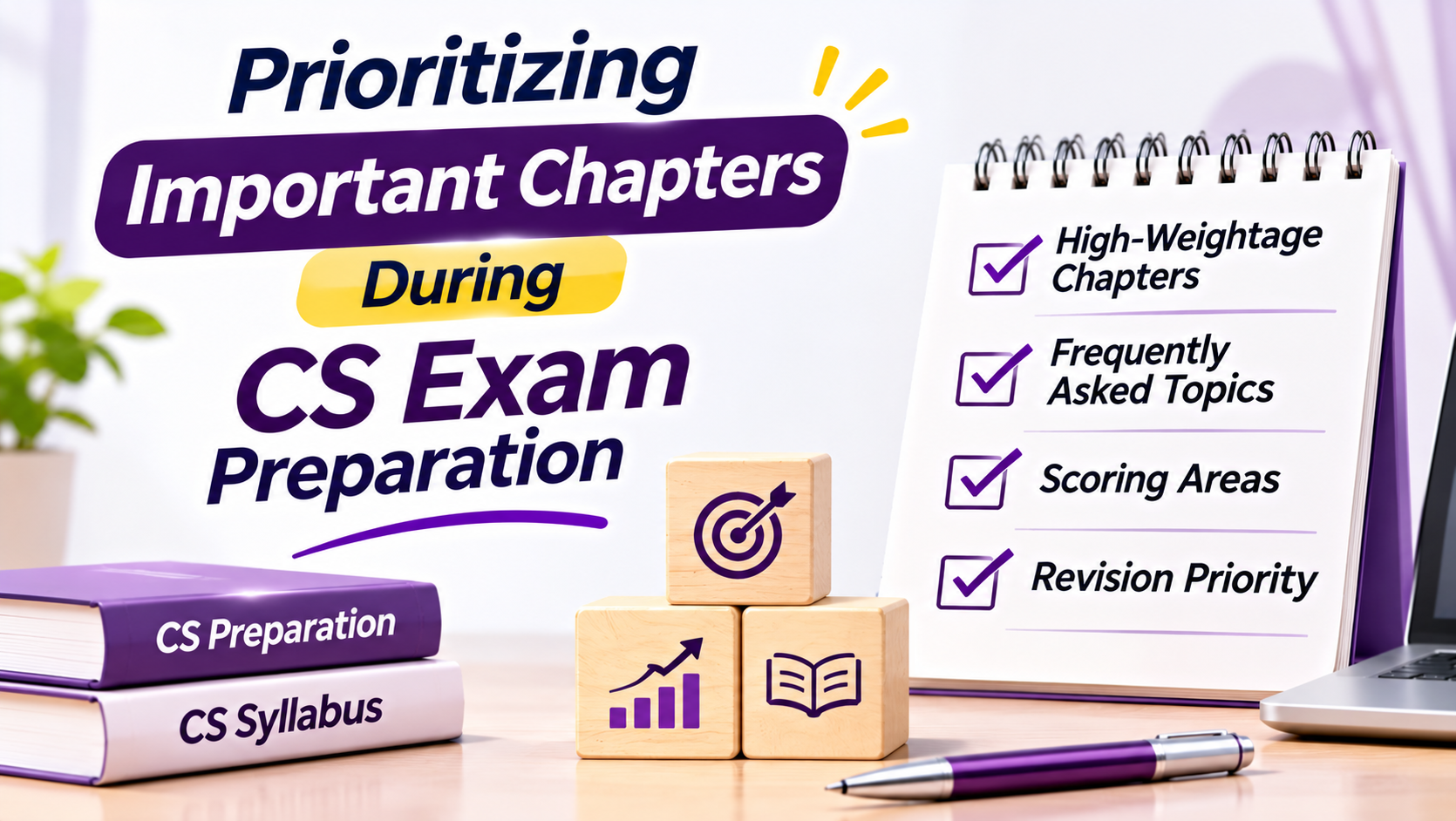
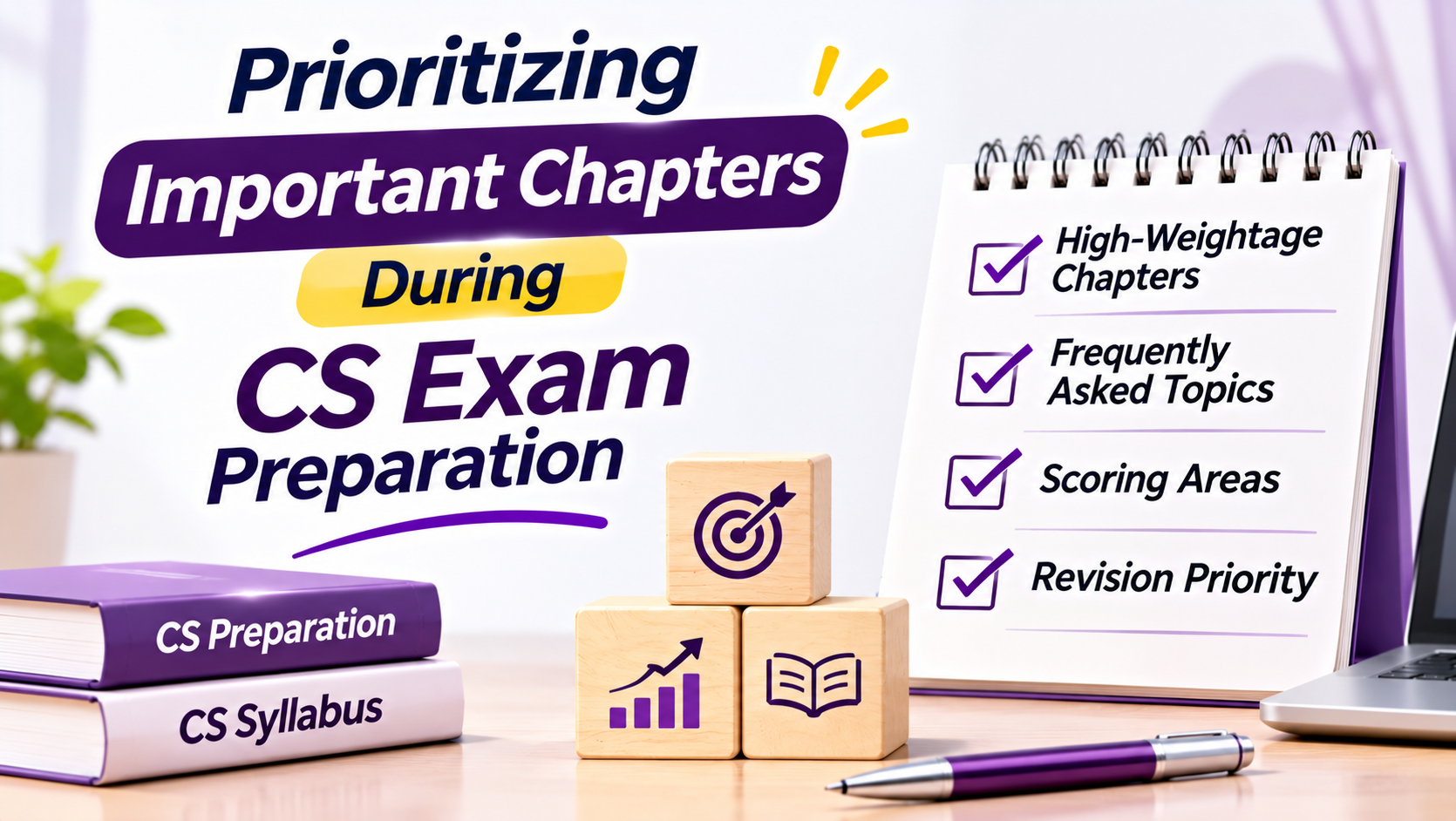
Preparing for a Company Secretary examination involves more than completing every chapter once. Students often have limited time, several papers to manage and different levels of confidence across subjects. The challenge is deciding what deserves attention first without ignoring the rest of the syllabus.
A practical priority system helps you use study hours more effectively. Instead of studying only the chapters you enjoy or relying entirely on predicted questions, combine the official syllabus, learning objectives, past examination papers, your preparation level and mock-test performance. This guide explains how to build that system.
Why chapter prioritisation matters
Every chapter does not demand the same amount of time from every student. A topic that is straightforward for one candidate may require several practice sessions for another. Prioritisation recognises this difference and prevents a fixed timetable from becoming unrealistic.
It also reduces the risk of spending too long polishing a familiar chapter while leaving an unfamiliar area untouched. The purpose is not to predict the examination paper. It is to create a sensible order for learning, practice and revision while keeping the complete prescribed syllabus in view.
Start with the official syllabus
Begin with the latest applicable ICSI syllabus, study material, amendments and examination guidelines for your session. Divide each paper into modules, chapters and smaller topics. Mark the topics you have completed, partly understood or not yet started.
Use the official learning outcomes and study material to understand the expected depth. Previous papers can reveal how concepts have been tested, but they should not replace the syllabus. A chapter that has appeared less frequently is not automatically unimportant, and an amendment may change what needs attention.
Create one master checklist for all papers. This gives you a realistic view of the workload and makes it easier to distribute time across subjects.
Use a practical priority matrix
Rate each chapter using four factors: your current understanding, the time needed to learn it, its importance within the syllabus and your ability to answer questions accurately. Keep the ratings simple—high, medium or low—rather than trying to calculate a perfect score.
High-priority chapters generally include topics you do not understand, areas that require repeated practice, and concepts that connect with several other parts of the paper. Medium-priority chapters may be familiar but still need structured revision. Lower-priority chapters are those you can already explain and apply reliably; they still need periodic recall.
Review the matrix every week. A chapter can move from high to medium priority after you demonstrate consistent accuracy, while a previously comfortable topic may move up if a mock test exposes a gap.
Analyse past papers carefully
Review previous examination papers to understand question formats, the way provisions or concepts are applied, and the depth of answers expected. Group questions by chapter and note whether they test definitions, explanations, comparisons, case-based application or practical problem-solving.
Look for recurring themes, but avoid treating frequency as a guarantee. Examination patterns can change, and questions may combine multiple concepts. The useful lesson from past papers is how to practise the syllabus—not which chapters can safely be skipped.
After solving a paper, compare your answer with the suggested answer or marking guidance where available. Identify whether marks were lost because of weak concepts, missing legal provisions, incomplete analysis, poor structure or time pressure.
Balance difficult and scoring chapters
Do not leave every difficult chapter until the final weeks. Break demanding topics into smaller learning blocks: first understand the concept, then make a short outline, solve a basic question and finally attempt an exam-style question without help.
At the same time, retain chapters where you can build confidence through accurate practice. A balanced study day may include one demanding topic, one moderate topic and a short revision session for a familiar chapter. This prevents fatigue and keeps earlier learning active.
Be careful with the phrase 'scoring chapter'. A topic becomes useful when you can understand the requirement, select the relevant concept and present a complete answer. No chapter guarantees marks simply because it seems short or popular.
Build a weekly chapter plan
Plan in weekly cycles rather than filling every hour of a month-long timetable. Select a manageable number of chapters based on their size and your available study time. For each chapter, schedule learning, question practice and a later revision slot.
Reserve time for all papers. If one subject is particularly weak, give it additional sessions without allowing the other papers to disappear from your routine. Include buffer periods for unexpected delays and keep one review session at the end of the week.
At the weekly review, record what was completed, what remains and why a task was delayed. Adjust the next week based on evidence rather than simply copying the old timetable.
Track progress and revise
Completion should mean more than reading a chapter. Use a small checklist: Can you recall the main concepts without looking? Can you explain the relevant provisions or principles? Can you solve a representative question? Can you complete it within a reasonable time?
Use active recall by closing the book and writing a short outline from memory. Revisit the same topic after increasing intervals, for example the next day, later in the week and during the next revision cycle. The exact intervals can be adjusted to your retention.
Keep an error log with the chapter, type of mistake and corrective action. This turns revision into targeted work instead of repeated reading.
How mock tests improve priorities
Mock tests show whether your chapter plan is producing usable knowledge. Analyse the paper after attempting it under timed conditions. Separate errors into concept gaps, recall gaps, misinterpretation, weak application and time-management problems.
Use the results to update your priority matrix. If you know a provision but cannot apply it to a case, schedule application practice. If you understand the topic but forget key points, add short recall sessions. If you repeatedly run out of time, practise answer planning and timed writing.
CS Exams Test Series can be used as a structured practice option for attempting papers, reviewing performance and identifying topics that need more attention. Use feedback as a guide for your next study cycle, not as a substitute for the official syllabus.
Common prioritisation mistakes
A frequent mistake is studying only chapters believed to be important. This creates avoidable risk because the examination can test any prescribed area. Another mistake is spending excessive time making elaborate notes instead of practising answers and checking retention.
Students also sometimes rank chapters once and never update the list. Preparation changes every week, so priorities should change with it. Finally, avoid comparing your chapter order with another student's timetable. Their strengths, available hours and learning pace may be different.
Quick Reference Table
| Priority level | Typical chapter status | Suggested action |
| High | Weak understanding, major gaps or repeated errors | Break into smaller topics; learn and practise early |
| Medium | Partly understood; needs application or recall | Schedule question practice and spaced revision |
| Maintenance | Reliable understanding and consistent answers | Use short revision and periodic mixed questions |
How CS Exams Test Series Can Support Your Practice
Consistent practice helps you check whether your preparation is translating into exam-ready performance. CS Exams Test Series can be considered as a structured practice option for attempting questions under timed conditions and reviewing performance. Check the current paper coverage and use any feedback alongside the latest official ICSI syllabus and study material. A test series supports preparation; it does not replace concept learning, independent revision or official resources.