In this article (16)
- Minutes of board meeting: what the law says
- Timelines under SS-1
- What to include in board minutes
- Heading and attendance
- Business transacted
- A simple format you can follow
- Signing, page numbering and keeping the minutes book
- Mistakes that cost marks and cause trouble
- Where this shows up in the CS exams
- Frequently asked questions
- Within how many days must draft minutes be circulated?
- How long do directors get to comment on draft minutes?
- When must minutes be entered in the minutes book?
- Who signs the minutes of a board meeting?
- Can signed minutes be changed?
- How long are board minutes preserved?
Minutes of board meeting are the official written record of what the directors discussed and decided. Section 118 of the Companies Act, 2013 makes them compulsory, and Secretarial Standard 1 (SS-1) issued by ICSI sets out exactly how to draft, circulate, sign and keep them. If you are a CS Executive student or a young member writing your first set of minutes, this guide gives you the timelines, the contents and a simple format you can follow.
Latest update (18 Nov 2026): the CS Executive December 2026 exams run from 21 to 28 December 2026 (2:00 PM to 5:15 PM, no paper on 25 December). The next attempt after that is June 2027; ICSI announces its dates closer to the time.
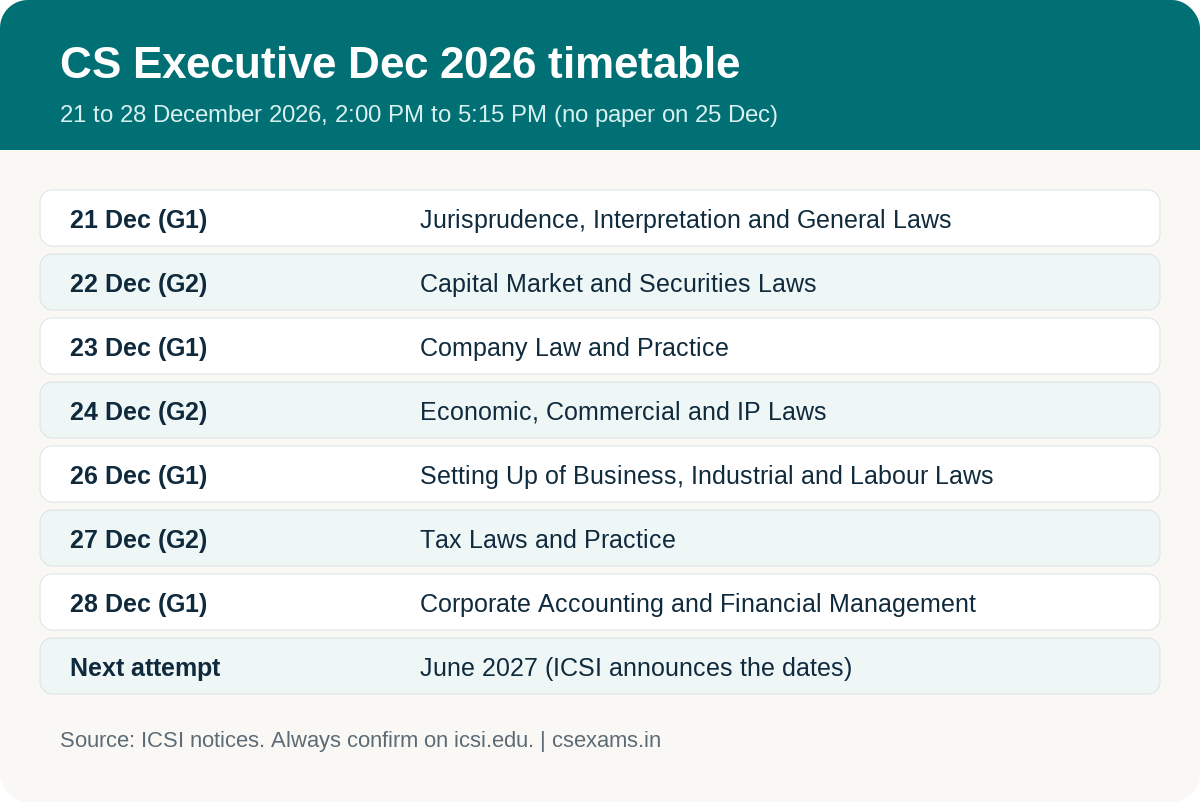
| What | Date |
|---|---|
| CS Executive Dec 2026 exams | 21 to 28 December 2026 |
| Admit card | Expected in the second week of December 2026 on icsi.edu, based on past years (the Dec 2025 cards came on 12 December 2025) |
| Dec 2026 result | Expected around 25 February 2027, based on past years (the Dec 2025 result came on 25 February 2026) |
| Next attempt | June 2027 |
Write full papers under time before the exam: our CS Executive test series has papers on the ICSI pattern, checked by Company Secretaries. See plans and prices.
Always confirm dates on the official ICSI website, icsi.edu.
Minutes look like a clerical job until something goes wrong. In a dispute, the minutes are evidence of what happened at the meeting. That is why the law is strict about how they are written and changed.
Minutes of board meeting: what the law says
Section 118 requires every company to prepare, sign and keep minutes of every meeting of its board and its committees. Rule 25 of the Companies (Management and Administration) Rules, 2014 adds detail on the minutes book. SS-1, the Secretarial Standard on Meetings of the Board of Directors, then lays down the practice in much more detail. SS-1 is mandatory for companies, because Section 118(10) requires companies to observe the secretarial standards on meetings.
Two principles run through all of it. First, minutes must contain a fair and correct summary of the proceedings. Second, the chairman decides what goes in, but he cannot leave out a dissent or record something that did not happen. You can read the official text of SS-1 on icsi.edu. Our earlier post on secretarial standards SS-1 and SS-2 covers the wider standard.
Timelines under SS-1
This table is the part students and new company secretaries most often get wrong. Learn it as a sequence, from the end of the meeting to the final signed copy.
| Step | Time limit under SS-1 |
|---|---|
| Circulate draft minutes to all directors | Within 15 days from the end of the meeting |
| Directors send comments on the draft | Within 7 days from the date of receiving it |
| Enter minutes in the minutes book | Within 30 days from the end of the meeting |
| Sign minutes | By the chairman of the same meeting or the chairman of the next meeting |
| Send signed copy to directors | Within 15 days after signing |
| Preservation | Permanently |
Draft minutes may be sent by hand, email or any other recognised electronic means.
What to include in board minutes
SS-1 lists the general contents of minutes. Think of it in three blocks: the heading, the attendance and the business.
Heading and attendance
- Name of the company and the serial number of the meeting (for example, 45th meeting of the Board).
- Day, date, venue and time the meeting started and ended.
- Names of directors present physically and those who joined through video conferencing, with the place they joined from.
- Name of the company secretary who recorded the minutes, and invitees in attendance.
- Directors who sought and were granted leave of absence.
- Name of the chairman and a record that quorum was present.
Business transacted
- Noting of the minutes of the previous meeting.
- Each item of business in the order taken up, with a short summary of the discussion where it matters.
- The full text of each resolution passed, with the manner of passing it.
- Names of directors who dissented or abstained on a decision.
- Disclosures of interest made by directors and the fact that interested directors did not take part.
- Resolutions passed by circulation since the last meeting, which must be noted at the next meeting.
A simple format you can follow
Here is a skeleton that matches SS-1. Adapt the wording to your company, but keep the order.
| Section of the minutes | Sample wording |
|---|---|
| Heading | Minutes of the 45th Meeting of the Board of Directors of ABC Private Limited held on Monday, 7 December 2026 at the registered office, from 11:00 a.m. To 1:15 p.m. |
| Present | Names of directors, with a note for each director who attended through video conferencing and his location |
| In attendance | Company secretary, CFO, statutory auditor (if invited) |
| Chairman and quorum | Mr. X took the chair. The requisite quorum was present throughout the meeting. |
| Item 1 | Leave of absence granted to Ms. Y, who had informed the company in advance |
| Item 2 | The minutes of the previous Board meeting held on (date) were noted and signed |
| Item 3 | "RESOLVED THAT..." full text of the resolution, followed by any director's dissent by name |
| Close | The meeting concluded with a vote of thanks to the chair |
Write minutes in the third person and in the past tense. "The Board approved", not "We approve". Avoid personal remarks about anyone, and keep the language neutral.
Signing, page numbering and keeping the minutes book
SS-1 says each page of the minutes book must be consecutively numbered. The chairman initials each page of the minutes, and signs and dates the last page. If the minutes are kept in electronic form, they are signed with a digital signature.
Once signed, minutes cannot be changed. If a mistake is found later, the correction is made in the minutes of a later meeting, not by altering the signed page. Section 118 treats tampering with minutes as a serious offence. Section 118(11) also provides a penalty on the company and on every officer in default when minutes are not kept as the law requires.
The minutes book is kept at the registered office or at any other place approved by the board. Directors have the right to inspect board minutes. Members can inspect general meeting minutes, but not board minutes, which is a common confusion in exam answers.
The same rules apply to minutes of committee meetings, such as the audit committee or the nomination and remuneration committee. Keep a separate minutes book for each committee, numbered in its own series, and place the signed committee minutes before the board at its next meeting so the board can note them.
Meetings held through video conferencing need a little extra care. Record the names of directors who joined that way, confirm that the chairman checked their identity and that they could see and hear the proceedings, and note any director who dropped out midway. If quorum was lost for even part of the meeting, the minutes must say so, because decisions taken without quorum are open to challenge.
Mistakes that cost marks and cause trouble
Most students lose marks in the meetings chapter because they write the timeline loosely ("within a month") instead of the exact days. Examiners look for 15, 7 and 30 days in the right places.
- Writing the resolution as a summary instead of its full text.
- Forgetting to record a director's dissent by name.
- Recording discussion word for word. Minutes are a summary, not a transcript.
- Leaving out how a director joined through video conferencing and from where.
- Pasting loose sheets in the minutes book instead of numbered pages.
- Changing a signed page to fix a spelling or a figure.
Where this shows up in the CS exams
Meetings are part of company law at the Executive level and come up again in governance and compliance papers at Professional. Expect short notes on the contents of minutes, practical questions asking you to draft a resolution, and case questions where a director claims his dissent was not recorded.
The fastest way to get these answers right is to practise drafting under time pressure and get feedback on format. Our CS Executive test series includes company law papers checked by company secretaries, so you learn what an examiner expects. Pair that with a careful read of the CS Executive company law chapter list, and you will handle minutes questions with confidence.
If you are already working, keep a template of your company's minutes and update it after every meeting. A good company secretary is known by clean minutes that never need correction.
Frequently asked questions
Within how many days must draft minutes be circulated?
Under SS-1, draft minutes of a board meeting must be circulated to all directors within 15 days from the end of the meeting.
How long do directors get to comment on draft minutes?
Directors must send their comments within 7 days from the date they receive the draft minutes.
When must minutes be entered in the minutes book?
Minutes must be entered in the minutes book within 30 days from the conclusion of the meeting.
Who signs the minutes of a board meeting?
The chairman of the same meeting or the chairman of the next meeting signs the minutes. He initials each page and signs and dates the last page.
Can signed minutes be changed?
No. Once signed, minutes cannot be altered. Any correction is recorded in the minutes of a later meeting.
How long are board minutes preserved?
SS-1 requires minutes of board meetings to be preserved permanently.
Practise what you just read