In this article (15)
- Who must appoint an independent director
- Qualifications under section 149(6)
- Databank registration and the proficiency test
- Tenure, reappointment and cooling-off
- Remuneration and liability
- Schedule IV: the code for independent directors
- Extra rules for listed companies under SEBI
- How to answer independent director questions
- Frequently asked questions
- Which companies must appoint independent directors?
- What is the tenure of an independent director?
- What is the cooling-off period for an independent director?
- Can an independent director get stock options?
- Do independent directors retire by rotation?
- How often must independent directors meet separately?

An independent director under Companies Act 2013 is a non-executive director with no material link to the company, its promoters or its management, appointed to bring an outside view to the board. Section 149 says who must appoint one, who qualifies, how long they can serve and what protects them. Schedule IV adds a code of conduct, and SEBI rules add more for listed companies.
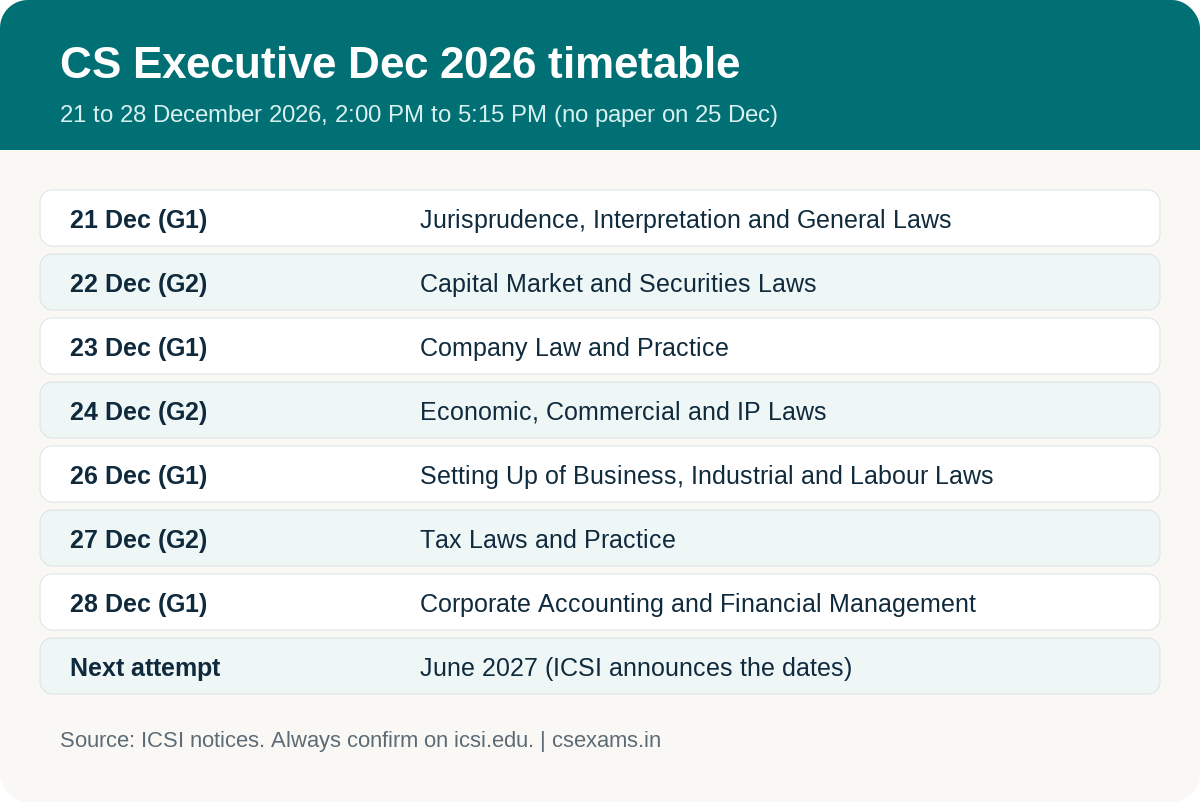
Latest update (18 Nov 2026): the CS Executive December 2026 exams run from 21 to 28 December 2026 (2:00 PM to 5:15 PM, no paper on 25 December). The next attempt after that is June 2027; ICSI announces its dates closer to the time.
| What | Date |
|---|---|
| CS Executive Dec 2026 exams | 21 to 28 December 2026 |
| Admit card | Expected in the second week of December 2026 on icsi.edu, based on past years (the Dec 2025 cards came on 12 December 2025) |
| Dec 2026 result | Expected around 25 February 2027, based on past years (the Dec 2025 result came on 25 February 2026) |
| Next attempt | June 2027 |
Write full papers under time before the exam: our CS Executive test series has papers on the ICSI pattern, checked by Company Secretaries. See plans and prices.
Always confirm dates on the official ICSI website, icsi.edu.
This is a high-scoring topic in CS Executive company law and comes back in CS Professional governance questions. It also matters on the job: as a young company secretary, you will often prepare the appointment papers and track the tenure of independent directors. Here is the full picture, section by section.
Who must appoint an independent director
Section 149(4) requires every listed public company to have at least one third of its total directors as independent directors. Any fraction is rounded off to one.
Rule 4 of the Companies (Appointment and Qualification of Directors) Rules, 2014 extends this to some unlisted public companies. They must have at least two independent directors if they meet any one of these tests on the date of the last audited financial statements:
| Class of public company | Minimum independent directors |
|---|---|
| Listed public company | One third of total directors |
| Paid-up share capital of Rs. 10 crore or more | Two |
| Turnover of Rs. 100 crore or more | Two |
| Outstanding loans, debentures and deposits together above Rs. 50 crore | Two |
The rule exempts unlisted public companies that are joint ventures, wholly owned subsidiaries or dormant companies. Private companies are not required to appoint independent directors under these provisions.
Qualifications under section 149(6)
Section 149(6) is the heart of the topic. An independent director must be a person of integrity with relevant expertise and experience in the opinion of the board, and must not fall into any of the disqualifying relationships. The main ones are:
- He is not, and was not, a promoter of the company or its holding, subsidiary or associate company.
- He is not related to the promoters or directors of these companies.
- He has no pecuniary relationship with these companies, their promoters or directors beyond the limits allowed in the section, during the two immediately preceding financial years or the current year.
- None of his relatives has a pecuniary relationship or transaction above the limits set in the section.
- He or his relative has not been a key managerial personnel or employee of the company in any of the three financial years before the appointment.
- He or his relative has not been a partner or employee of the company's audit firm, or of a firm of company secretaries in practice or cost auditors of the company, in the same three year window.
- He and his relatives together do not hold 2% or more of the total voting power.
- He is not a chief executive or director of a non-profit organisation that receives 25% or more of its receipts from the company or its group, or that holds 2% or more of the company's voting power.
Section 149(7) requires every independent director to give a declaration that he meets these criteria at the first board meeting he attends as a director, and after that at the first board meeting of every financial year, or whenever there is a change in circumstances.
Databank registration and the proficiency test
Rule 6 of the same rules requires every independent director to register with the databank maintained by the Indian Institute of Corporate Affairs. Unless exempted under the rule, the person must also pass an online proficiency self-assessment test conducted by the institute. People with long experience as directors or key managerial personnel of listed companies or larger unlisted companies are exempt, subject to the conditions in the rule.
As a company secretary, check the databank registration before the board meeting that approves the appointment. Missing it is a common compliance gap.
Tenure, reappointment and cooling-off
Section 149(10) allows an independent director to hold office for a term of up to five consecutive years. He is eligible for reappointment for one more term by a special resolution of the company, with disclosure in the board's report.
Section 149(11) says no independent director can hold office for more than two consecutive terms. After two terms, he becomes eligible again only after a cooling-off period of three years. During those three years he cannot be appointed in, or be associated with, the company in any other capacity, directly or indirectly.
| Point | Rule under section 149 |
|---|---|
| One term | Up to 5 consecutive years |
| Reappointment | One more term, by special resolution |
| Maximum continuous service | Two consecutive terms |
| Cooling-off period | 3 years, with no association in any capacity |
| Retirement by rotation | Not applicable to independent directors (Section 149(13)) |
Remuneration and liability
Section 149(9) says an independent director is not entitled to any stock option. He may receive sitting fees, reimbursement of expenses for attending board and other meetings, and profit-related commission approved by members. The sitting fee cannot go beyond the ceiling laid down in the rules on managerial remuneration.
Section 149(12) limits the liability of an independent director. He is liable only for acts of omission or commission by the company that happened with his knowledge, attributable through board processes, and with his consent or connivance, or where he did not act diligently. This protects outside directors from being blamed for things they could not have known.
Schedule IV: the code for independent directors
Schedule IV, introduced by Section 149(8), sets out the professional conduct, role, functions and duties of independent directors. It also lays down the manner of appointment, reappointment, resignation, removal and evaluation. One point that comes up often in exams: the independent directors must hold at least one separate meeting in a financial year without the non-independent directors and members of management present.
At that meeting, they review the performance of non-independent directors and the board as a whole, review the performance of the chairperson, and assess the quality and timeliness of the flow of information from management to the board.
Extra rules for listed companies under SEBI
Listed entities follow the SEBI Listing Regulations on top of the Companies Act. Regulation 17 requires at least half of the board to be independent where the chairperson is an executive director, and at least one third where the chairperson is a non-executive director. Regulation 17A limits how many listed entities a person can serve as an independent director. When the Act and SEBI rules differ, a listed company applies the stricter one. You can find the ICSI study material on corporate governance at icsi.edu.
How to answer independent director questions
Most students lose marks here because they mix up Section 149(4) with Rule 4, or forget that unlisted public companies are covered only when they cross a threshold. Start every case answer by stating the class of company, then the requirement, then the conclusion.
- For "is X eligible" questions, run through the Section 149(6) list and name the clause that disqualifies him.
- For tenure questions, count terms, not years, and check the cooling-off condition.
- For listed companies, add the SEBI requirement in one line.
Practise these under exam conditions with a checked answer sheet. Our CS Executive test series covers company law with evaluation by company secretaries, and you can see all options on the plans page. For another topic often asked in the same paper, see our post on Section 8 companies, and keep CS Executive company law handy as your chapter map.
Frequently asked questions
Which companies must appoint independent directors?
Every listed public company must have at least one third independent directors. Unlisted public companies with paid-up capital of Rs. 10 crore or more, turnover of Rs. 100 crore or more, or loans, debentures and deposits above Rs. 50 crore need at least two.
What is the tenure of an independent director?
An independent director can hold office for up to five consecutive years and can be reappointed for one more term by special resolution.
What is the cooling-off period for an independent director?
After two consecutive terms, a person can be appointed again only after three years, during which he cannot be associated with the company in any capacity.
Can an independent director get stock options?
No. Section 149(9) bars stock options. He can receive sitting fees, expense reimbursement and profit-related commission approved by members.
Do independent directors retire by rotation?
No. Section 149(13) says the retirement by rotation provisions do not apply to independent directors.
How often must independent directors meet separately?
Schedule IV requires independent directors to hold at least one meeting in a financial year without non-independent directors and management.
Practise what you just read