In this article (19)
- What section 188 of Companies Act covers
- Who is a related party
- Thresholds that need shareholders' approval
- Approval process step by step
- Audit committee
- Board meeting
- General meeting
- Disclosure
- The arm's length and ordinary course exemption
- What happens if approval is missed
- Listed companies: SEBI rules on top
- How to study section 188 for the exam
- Frequently asked questions
- What does Section 188 of the Companies Act deal with?
- Is a special resolution needed under Section 188?
- Can board approval under Section 188 be given by circulation?
- Which transactions are exempt from Section 188?
- In which form are related party transactions disclosed?
- What happens if a related party transaction is done without approval?
Section 188 of Companies Act, 2013 controls related party transactions: deals between a company and people or entities close to its directors and promoters. Some of these deals need board approval at a meeting, and larger ones need an ordinary resolution of shareholders, with the related parties kept out of the vote. Deals in the ordinary course of business and at arm's length are outside the section altogether. That is the whole idea in three sentences.
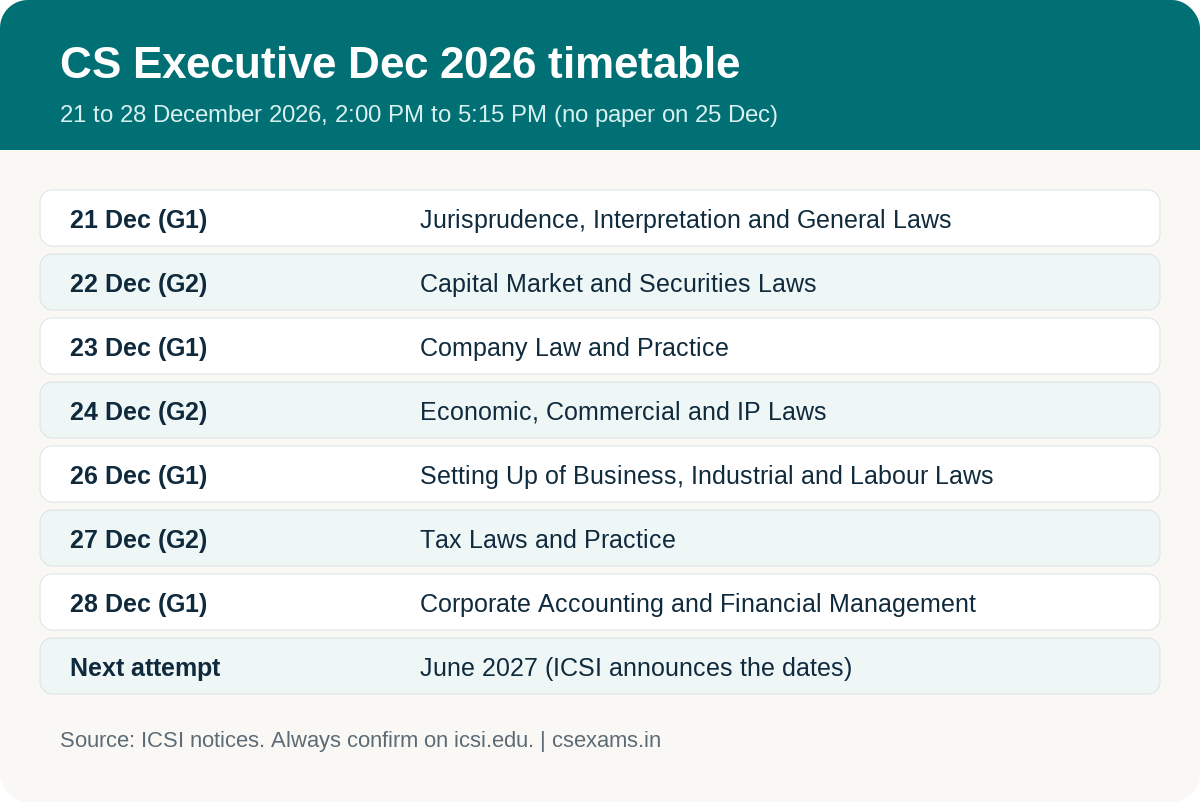
Latest update (18 Nov 2026): the CS Executive December 2026 exams run from 21 to 28 December 2026 (2:00 PM to 5:15 PM, no paper on 25 December). The next attempt after that is June 2027; ICSI announces its dates closer to the time.
| What | Date |
|---|---|
| CS Executive Dec 2026 exams | 21 to 28 December 2026 |
| Admit card | Expected in the second week of December 2026 on icsi.edu, based on past years (the Dec 2025 cards came on 12 December 2025) |
| Dec 2026 result | Expected around 25 February 2027, based on past years (the Dec 2025 result came on 25 February 2026) |
| Next attempt | June 2027 |
Write full papers under time before the exam: our CS Executive test series has papers on the ICSI pattern, checked by Company Secretaries. See plans and prices.
Always confirm dates on the official ICSI website, icsi.edu.
For CS Executive students, this section sits inside the company law paper and returns at Professional in governance and due diligence questions. For young company secretaries, it is one of the first places where a small mistake leads to a void contract and penalties. Let us go through it the way you would apply it at work.
What section 188 of Companies Act covers
Section 188(1) lists seven kinds of contracts or arrangements with a related party:
- Sale, purchase or supply of any goods or materials.
- Selling or otherwise disposing of, or buying, property of any kind.
- Leasing of property of any kind.
- Availing or rendering of any services.
- Appointment of any agent for purchase or sale of goods, materials, services or property.
- A related party's appointment to any office or place of profit in the company, its subsidiary or associate company.
- Underwriting the subscription of any securities or derivatives of the company.
Any of these with a related party needs the consent of the board, given by a resolution at a board meeting. It cannot be passed by circulation. Where the value crosses the limits in Rule 15 of the Companies (Meetings of Board and its Powers) Rules, 2014, the company also needs prior approval of shareholders by ordinary resolution.
Who is a related party
The definition is in Section 2(76). In simple terms, it covers a director or key managerial personnel and their relatives, firms and private companies where a director or manager or his relative is a partner, member or director, public companies where a director is a director and holds (with relatives) more than 2% of paid-up capital, bodies corporate whose board acts on the advice of a director, holding, subsidiary and associate companies and fellow subsidiaries, and a few more categories set out in the rules.
Students often skip "relative". Section 2(77) and the rules define it narrowly: spouse, father, mother, son, son's wife, daughter, daughter's husband, brother and sister, plus members of a Hindu Undivided Family. A cousin is not a relative under the Act, which is a favourite trick in MCQs.
Thresholds that need shareholders' approval
Rule 15(3) sets the limits. Above these, the board cannot approve alone. The limits are tested against the turnover or net worth in the audited financial statements of the preceding financial year.
| Type of transaction | Shareholder approval needed if the value |
|---|---|
| Sale, purchase or supply of goods or materials | Is 10% or more of turnover |
| Selling, disposing of or buying property | Is 10% or more of net worth |
| Leasing of property | Is 10% or more of turnover |
| Availing or rendering of services | Is 10% or more of turnover |
| Office or place of profit | Monthly remuneration exceeds Rs. 2.5 lakh |
| Underwriting of securities or derivatives | Remuneration exceeds 1% of net worth |
The value counts either for one transaction or for all transactions taken together during a financial year. Many students miss the "taken together" part and lose marks in case questions where the company signs several small contracts with the same party.
Approval process step by step
Audit committee
Where a company has an audit committee, Section 177 requires its approval for related party transactions as well. The committee may give omnibus approval for repetitive transactions, within the conditions laid down in the rules.
Board meeting
The agenda must disclose the name of the related party, the nature of the relationship, the nature, duration and particulars of the contract, the material terms including value, and any advance paid. A director who is interested in the contract must not be present during the discussion on that item.
General meeting
If the thresholds are crossed, the company passes an ordinary resolution before entering into the transaction. The explanatory statement repeats the key particulars. Members who are related parties to that particular contract cannot vote on it. There is a relief for transactions between a holding company and its wholly owned subsidiary whose accounts are consolidated and placed before shareholders: no shareholder resolution is needed for those.
Disclosure
The board's report must give particulars of contracts referred to in Section 188(1) in Form AOC-2, along with the justification for entering into them. The company also keeps a register of contracts in which directors are interested under Section 189.
The arm's length and ordinary course exemption
A proviso to Section 188(1) takes out transactions entered into in the ordinary course of business and on an arm's length basis. Both conditions must be satisfied. A transaction at market price that the company does not normally do is not exempt. A routine purchase at a special discount for a director's firm is not exempt either.
"Arm's length" means the deal is on the same terms the company would give an unrelated party. In practice, company secretaries keep evidence: price quotes from unrelated vendors, a transfer pricing study, or the company's own rate card. In an exam answer, say clearly which condition is met and why. Writing "the transaction is exempt" without testing both limbs gets partial marks at best.
What happens if approval is missed
Section 188(3) says that if a contract is entered into without the required consent, and it is not ratified by the board or shareholders within three months, the contract is voidable at the option of the board or the shareholders. If the contract was with a related party to a director, or was authorised by a director, the company can recover any loss from that director.
Section 188(5) also prescribes penalties on directors and employees who enter into or authorise such a contract in breach of the section. The exact amounts were revised by later amendments, so quote the current section if a question asks for figures.
| Situation | Result |
|---|---|
| Ordinary course and arm's length | Section 188 does not apply |
| Below Rule 15 limits, not exempt | Board approval at a meeting is enough |
| Above Rule 15 limits, not exempt | Board approval plus ordinary resolution of members |
| No approval, not ratified in 3 months | Voidable at the option of board or members |
Listed companies: SEBI rules on top
A listed entity must also follow Regulation 23 of the SEBI Listing Regulations. This brings in prior audit committee approval for all related party transactions and shareholder approval for material ones, with its own materiality threshold. Where the Companies Act and SEBI rules differ, a listed company follows the stricter of the two. This overlap is tested at Professional, so keep a side by side note.
How to study section 188 for the exam
Learn the seven clauses in order, then the Rule 15 table, then the exemption, then the consequences. Practise two kinds of questions: a case where you must decide whether approval is needed, and a short note asking for the procedure. Most students lose marks here because they write a general essay on related parties instead of applying the limits to the figures given.
Written practice with a checked answer sheet shows you fast where your structure fails. Our CS Executive test series has company law papers evaluated by company secretaries, and the CS Professional test series covers the governance side. For the wider paper, read our CS Executive company law guide.
Frequently asked questions
What does Section 188 of the Companies Act deal with?
Section 188 deals with contracts or arrangements between a company and its related parties, such as sale of goods, leasing, services and appointment to an office or place of profit.
Is a special resolution needed under Section 188?
No. After the amendments, shareholder approval for related party transactions above the Rule 15 limits is by ordinary resolution, and related parties to that contract cannot vote.
Can board approval under Section 188 be given by circulation?
No. Section 188 requires the consent of the board given by a resolution at a meeting of the board.
Which transactions are exempt from Section 188?
Transactions in the ordinary course of business that are also on an arm's length basis are outside Section 188. Both conditions must be met.
In which form are related party transactions disclosed?
Particulars of contracts under Section 188(1) are disclosed in the board's report in Form AOC-2.
What happens if a related party transaction is done without approval?
If it is not ratified within three months, the contract becomes voidable at the option of the board or shareholders, and the company can recover losses from the director concerned.
Practise what you just read