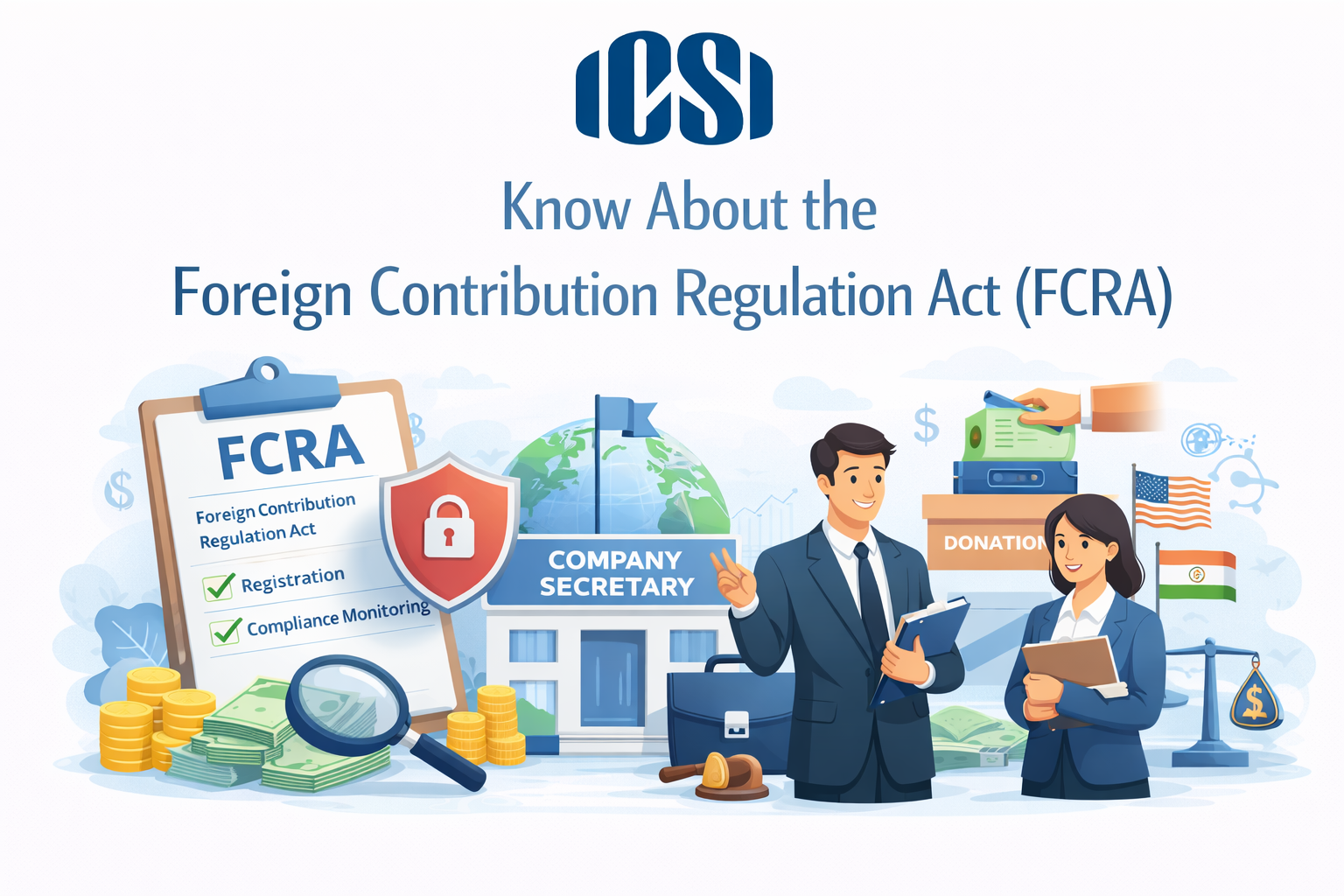
The inflow and utilization of foreign wealth by Indian individuals, associations, and organizations are governed by the Foreign Contribution Regulation Act (FCRA). FCRA makes sure that contributions from outside sources don't interfere with the democratic processes or the institutions' ability to function. This article provides a thorough understanding of the FCRA, including its history, key provisions, effects on civil society and NGOs, and current worldwide issues.
An important law in India that regulates the acceptance and use of foreign funds by people, associations, and non-governmental organizations (NGOs) is the Foreign Contribution Regulation Act (FCRA), 2010. This law was passed to make sure that foreign contributions wouldn't jeopardize economic interests, political stability, or national security. The FCRA is a set of regulations that govern how Section 8 companies, trusts, societies, and NGOs can receive and use foreign funds.
This law's main goal is to prevent foreign contributions from interfering with political stability, economic interests, or national security. Before obtaining 12A and 80G registration for exemption, any group that plans to accept donations from overseas must first complete its NGO registration. Only after fulfilling these requirements may an NGO apply for approval from the FCRA.
Objective of FCRA
- Regulation of foreign donations: Ensures that money received from abroad is used only for valid purposes.
- Prevention of Misuse: Prevention of foreign funds that can be used for harmful activities for the sovereignty and integrity of India.
- Transparency and accountability: Encourage NGOs to maintain proper records and financial transparency.
- Promoting Public Trust: Donors and stakeholders guarantee the efficient use of funds.
Highlights of FCRA
| Aspect | Key Details |
| Enacted | 2010, effective from May 2011 |
| Purpose | To regulate the acceptance and use of foreign contributions and hospitality |
| Covers | Individuals, associations, and companies across India and abroad |
| Restrictions | Political parties, journalists, judges, and government servants cannot receive foreign funds |
| Compliance | Registration, separate bank account, audited returns, annual reports |
| Amendments | 2020 (Aadhaar, stricter rules), 2022 (annual reporting) |
| Criticism | Over-regulation, reduced space for NGOs |
Why Was FCRA Introduced?
The Act was introduced to maintain transparency and prevent foreign influence in India's democratic and social systems. Many times, foreign money has been seen as a way to indirectly influence political or social decisions within the country. By regulating such contributions, the government ensures that they are used only for legal and beneficial purposes.
The main reasons for starting FCRA include:
- To prevent foreign sources from influencing Indian politics and policies.
- To regulate foreign funds so that they are used only for developmental or charitable purposes.
- Organizations need to explain accountability to ensure how they use foreign contributions.
Who Needs FCRA Registration?
Any non-governmental organization (NGO), Trust, Society, or Section 8 company that plans to get financial contributions from foreign sources will have to get FCRA registration from the Ministry of Home Affairs (MHA). This legal requirement ensures that foreign donations are used especially for social, charitable, or developmental activities and do not compromise national interests. Organizations usually require FCRA registrations, including:
- Charitable Trust—Registered under the Trusts of India Act, 1882, these organizations mainly work in areas such as education, healthcare, social welfare, and religious activities. Trusts work based on a trust deed that defines their objectives and the responsibilities of trustees.
- Societies—The Society Registration Act, 1860, serves as a member-based organization that promotes cultural, educational, and human causes. Unlike trusts, societies require a minimum of seven members and are ruled by a managing committee.
- Section 8 Companies—Company Act, 2013, Section 8 company registration is ideal for non-governmental organizations that prefer a structured, corporate-style rule model while working as non-profit organizations. These companies are bound to legally use all their profits for charitable purposes and cannot distribute dividends to their members.
Before applying for FCRA approval, NGOs also have to ensure that they complete the following legal formalities:
- NGO registration—To establish legal recognition and operational validity.
- 12A Registration—To avail income tax exemption for NGOs.
- 80G Registration—To provide tax benefits to donors and encourage financial contributions.
By securing these registrations, NGOs can increase their credibility and get access to both domestic and international funding while remaining in line with government rules.
Features of the Foreign Contribution Regulation Act 2010
The provisions of FCRA 2010 are as follows.
- If the Ministry of Home Affairs believes that the organization is not neutral, it will cancel the registration of NGOs.
- Saying this, a provision was made that the person whose property has been separated needs to be disposed of in such a way that the government will inform the state.
- The organization must maintain a separate account to get foreign contributions, and no other money that accepts foreign contributions will be deposited in that account.
- Each bank will be obliged to report the amount of foreign contribution received by the prescribed authority and other related details.
- The registration certificate given to NGOs under the 2010 Act will be valid for 5 years.
International Prospects and Concerns
Many global human rights organizations and international supervisors have expressed concern about the restrictive nature of FCRA regulations.
- Criticism from international bodies: The United Nations special synergy has highlighted that FCRA provisions can potentially restrict the union and freedom of expression. He has emphasized that the purpose of the law to ensure transparency should not be a tool to discourage civil advocacy.
- Calls for a balanced approach: While the need for strong financial regulation is undisputed, stakeholders emphasize the importance of ensuring that regulatory measures do not obstruct real development or human efforts. Many believe that a balanced approach that combines oversight with enabling support is essential for a healthy citizen society.
Why Choose CS Exam Test Series for CS Preparation
When it comes to preparing for the hard CS exams, choosing the right test series can make all the difference. csexams.in has emerged as a trusted and result-oriented platform for CSEET, Executive, and Professional-level aspirants. Here's why it should be your first choice:
- Trusted by Thousands of CS Aspirants: The CS Exam has built a strong reputation among CS students for its consistent quality and excellent student feedback.
- ICSI Pattern-Based Question Papers: All tests are strictly based on the latest ICSI exam pattern and syllabus, ensuring real exam-like practice.
- Timely Evaluation with Expert Feedback: Get your answers evaluated within 48–72 hours along with detailed feedback, a marking scheme, and improvement tips.
- Personalized Mentorship & Study Planner: Get personalized mentorship, performance tracking, and a daily study plan customized to your syllabus completion pace.