In this article (16)
- CS Executive Capital Market and Securities Laws: key facts
- What Part I Capital Market covers
- What Part II Securities Laws covers
- The most common Part II mistake
- Study material, supplement and SEBI changes
- A 30-day revision plan for CMSL
- A simple method to remember regulations
- Writing answers in the exam
- Practise with checked papers
- Frequently asked questions
- When is the CS Executive Capital Market and Securities Laws paper in Dec 2026?
- How are marks split in CS Executive Capital Market and Securities Laws?
- Which study material applies to CS Executive CMSL for December 2026?
- How do I remember SEBI regulation timelines for CS Executive?
- Is CMSL a tough paper in CS Executive?
- Does CS Executive CMSL include IFSCA?
CS Executive Capital Market and Securities Laws is on Tuesday, 22 December 2026, the first Group 2 paper of the session. From today you have about 30 days. If you are writing both groups, it sits between Jurisprudence on 21 December and Company Law on 23 December, so it will get squeezed unless you finish most of the revision early.
Latest update (18 Nov 2026): the CS Executive December 2026 exams run from 21 to 28 December 2026 (2:00 PM to 5:15 PM, no paper on 25 December). The next attempt after that is June 2027; ICSI announces its dates closer to the time.
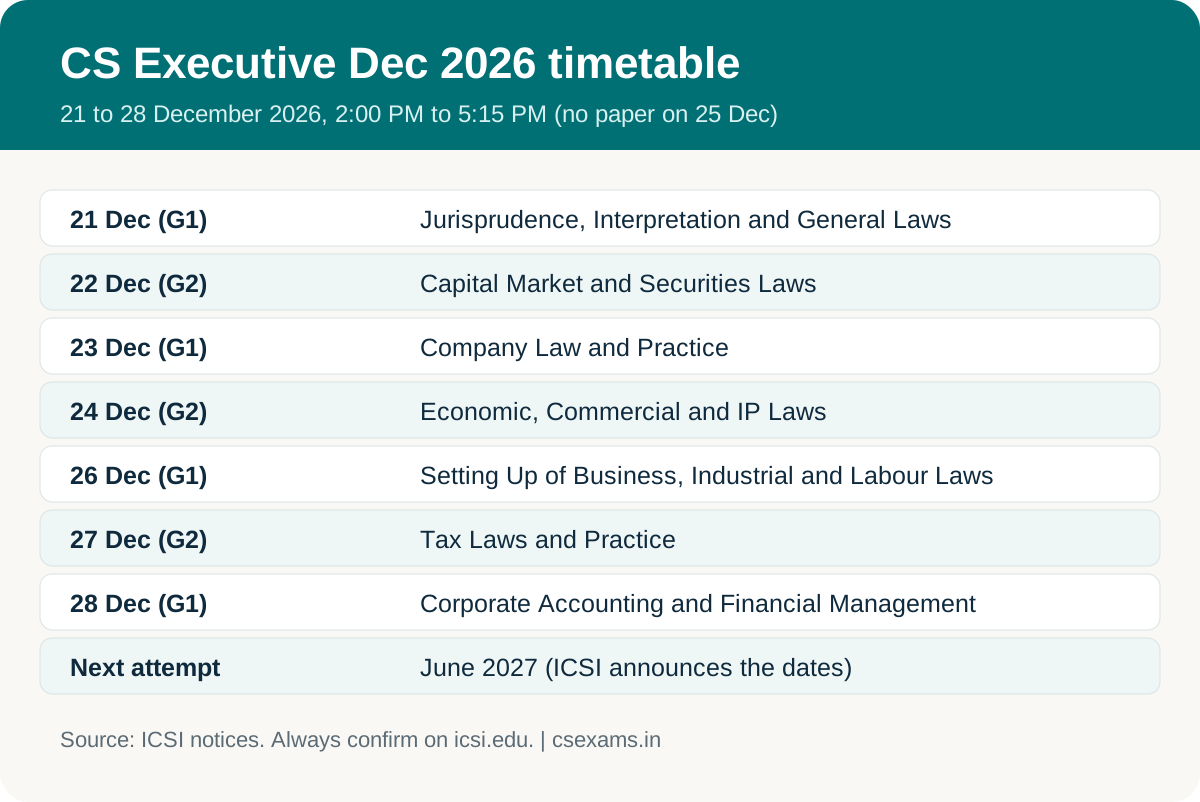
| What | Date |
|---|---|
| CS Executive Dec 2026 exams | 21 to 28 December 2026 |
| Admit card | Expected in the second week of December 2026 on icsi.edu, based on past years (the Dec 2025 cards came on 12 December 2025) |
| Dec 2026 result | Expected around 25 February 2027, based on past years (the Dec 2025 result came on 25 February 2026) |
| Next attempt | June 2027 |
Write full papers under time before the exam: our CS Executive test series has papers on the ICSI pattern, checked by Company Secretaries. See plans and prices.
Always confirm dates on the official ICSI website, icsi.edu.
This paper is less about understanding and more about recall. The concepts are not hard. What hurts students is the number of regulations, thresholds and timelines. Below is how the paper is built, where to start, and a 30-day plan that keeps the facts fresh.
CS Executive Capital Market and Securities Laws: key facts
These details are taken from the ICSI Syllabus 2022 document, the official December 2026 time table and the ICSI study material list for this session.
| Point | Detail for December 2026 |
|---|---|
| Paper | Capital Market and Securities Laws, Group 2 |
| Date and time | Tuesday, 22 December 2026, 2:00 PM to 5:15 PM (15 minutes reading time) |
| Part I | Capital Market: 40 marks |
| Part II | Securities Laws: 60 marks |
| Study material | Updated till 30 November 2025, plus the December 2026 supplement |
| Passing rule | 40 in the paper and 50 percent aggregate in the group |
Check the full schedule on the ICSI December 2026 time table.
What Part I Capital Market covers
Part I is 40 marks. It starts with the basics of the capital market and the secondary market in India, then moves to the Securities Contracts (Regulation) Act, 1956, SEBI, depositories and depository participants, securities market intermediaries, and the International Financial Services Centres Authority.
Part I questions are often about structure and roles: what a depository does, how an intermediary is registered, what powers SEBI has. These are easier to score on if you write in clear points. Students who write one long paragraph on SEBI's powers lose marks simply because the examiner cannot find the points quickly.
What Part II Securities Laws covers
Part II carries 60 marks and is the heavy part. It covers issue of securities, non-convertible securities, listing obligations and disclosure requirements, acquisition of shares and takeovers, prohibition of insider trading, fraudulent and unfair trade practices, delisting and buyback, mutual funds and collective investment schemes.
These chapters are built on SEBI regulations that are full of numbers: percentage thresholds, days for disclosure, eligibility conditions. That is exactly where marks are won or lost. A question on takeovers or insider trading usually gives a situation and asks what the company or person must do. If you know the trigger and the timeline, the answer writes itself.
The most common Part II mistake
Most students lose marks by mixing up timelines between regulations. The fix is not more reading. It is a separate one-page table per regulation, written in your own hand, which you test yourself on every few days.
Study material, supplement and SEBI changes
SEBI changes its regulations often, and that worries students more than it should. For December 2026, ICSI lists the Capital Market and Securities Laws study material updated till 30 November 2025, and it advises students to read the supplements it has posted for this session along with the material. Those two documents together are what you prepare from.
So do not try to follow every SEBI circular in the news. Read the supplement once now, note which chapters it touches, and write each change into your own notes or regulation tables. If a change appears in the supplement, treat the supplement version as the one to learn. If you see a change discussed online that is not in either document, keep it aside until after the exam.
One practical tip: when you update a table from the supplement, mark that row with a small star. In the last week, quickly revise all the starred rows, because examiners like to test recent changes and students often remember the old figure under pressure.
A 30-day revision plan for CMSL
This plan assumes you have read the syllabus once and are preparing the other Group 2 papers in parallel. It gives this paper about two hours a day.
| Days | Focus | Output |
|---|---|---|
| 1 to 5 | Part I: basics, secondary market, SCRA, SEBI | Point-wise notes on powers and functions |
| 6 to 8 | Depositories, intermediaries, IFSCA | One page per topic |
| 9 to 13 | Issue of securities and non-convertible securities | Eligibility and timeline tables |
| 14 to 17 | Listing obligations and takeovers | Trigger and disclosure tables |
| 18 to 21 | Insider trading, unfair trade practices, delisting and buyback | Case-style practice answers |
| 22 to 24 | Mutual funds and collective investment schemes, supplement | Short notes and supplement margin notes |
| 25 to 28 | Two full timed papers and checking | Mistake list |
| 29 and 30 | Recall tables and mistake list only | No new reading |
For how this fits with your other papers, read our CS Executive Dec 2026 last month revision plan. If you want to see which chapters carry more weight in past papers, our CS Executive chapter-wise weightage post covers it.
A simple method to remember regulations
Reading SEBI regulations again and again feels productive, but most of it does not stay. Active recall works better. Here is a method many of our students use in the last month.
- For each regulation, make a table with three columns: the event, the threshold or condition, and the timeline.
- Cover the last two columns and try to fill them from memory.
- Mark the rows you got wrong in red. Those rows are your revision list for the next session.
- Repeat every three or four days until the red rows disappear.
This takes 20 minutes per regulation once your tables are ready. It is the single most useful habit for this paper, because it trains exactly what the exam tests.
If you only have time for one thing each evening, do a five-minute recall test on one regulation table before you sleep.
Writing answers in the exam
For situation questions, use a clear structure. State the regulation and the provision, apply it to the facts, and give a conclusion on what must be done and by when. For theory questions in Part I, write in short points with headings. Keep answers to the marks they carry, because this paper has many questions and running out of time is common.
Use the reading time to pick your questions and write the regulation name next to each one on the question paper. That small step stops you from mixing up two regulations once you start writing fast.
Practise with checked papers
You will only know if your answers are complete when someone else checks them. Our CS Executive test series includes full Capital Market and Securities Laws papers checked by company secretaries, who point out missed provisions, wrong timelines and presentation issues. Two checked papers before 22 December will tell you a lot about where your marks are going. You can compare the options on our plans page.
Finish your main revision of this paper by about 18 December. That leaves the last few days for quick recall, and it keeps Company Law on 23 December from being pushed to a single night. On the evening of 21 December, after Jurisprudence, spend your time only on the recall tables and the starred supplement rows, then sleep early.
Frequently asked questions
When is the CS Executive Capital Market and Securities Laws paper in Dec 2026?
It is on Tuesday, 22 December 2026, from 2:00 PM to 5:15 PM, with 15 minutes of reading time at the start. It is the first Group 2 paper.
How are marks split in CS Executive Capital Market and Securities Laws?
Under Syllabus 2022, Part I Capital Market carries 40 marks and Part II Securities Laws carries 60 marks.
Which study material applies to CS Executive CMSL for December 2026?
ICSI lists the study material updated till 30 November 2025 for this paper. Read it with the December 2026 supplement posted on the ICSI academic portal.
How do I remember SEBI regulation timelines for CS Executive?
Make one sheet per regulation with its key thresholds and timelines in a table, and test yourself on it every few days. Writing them out is far better than rereading.
Is CMSL a tough paper in CS Executive?
Students find it heavy because of the number of regulations, but questions are fairly direct. With organised notes and regular recall practice it is a manageable paper.
Does CS Executive CMSL include IFSCA?
Yes. The Syllabus 2022 Part I list includes the International Financial Services Centres Authority along with SEBI, depositories and market intermediaries.
Practise what you just read