In CS Executive Courses, one of the most important subjects is company incorporation. This topic not only explains the law but also shows how a business is formally made under the Companies Act. For students, it is necessary to know the incorporation processes, as the company's secretaries are often responsible for guiding the promoters in this process.
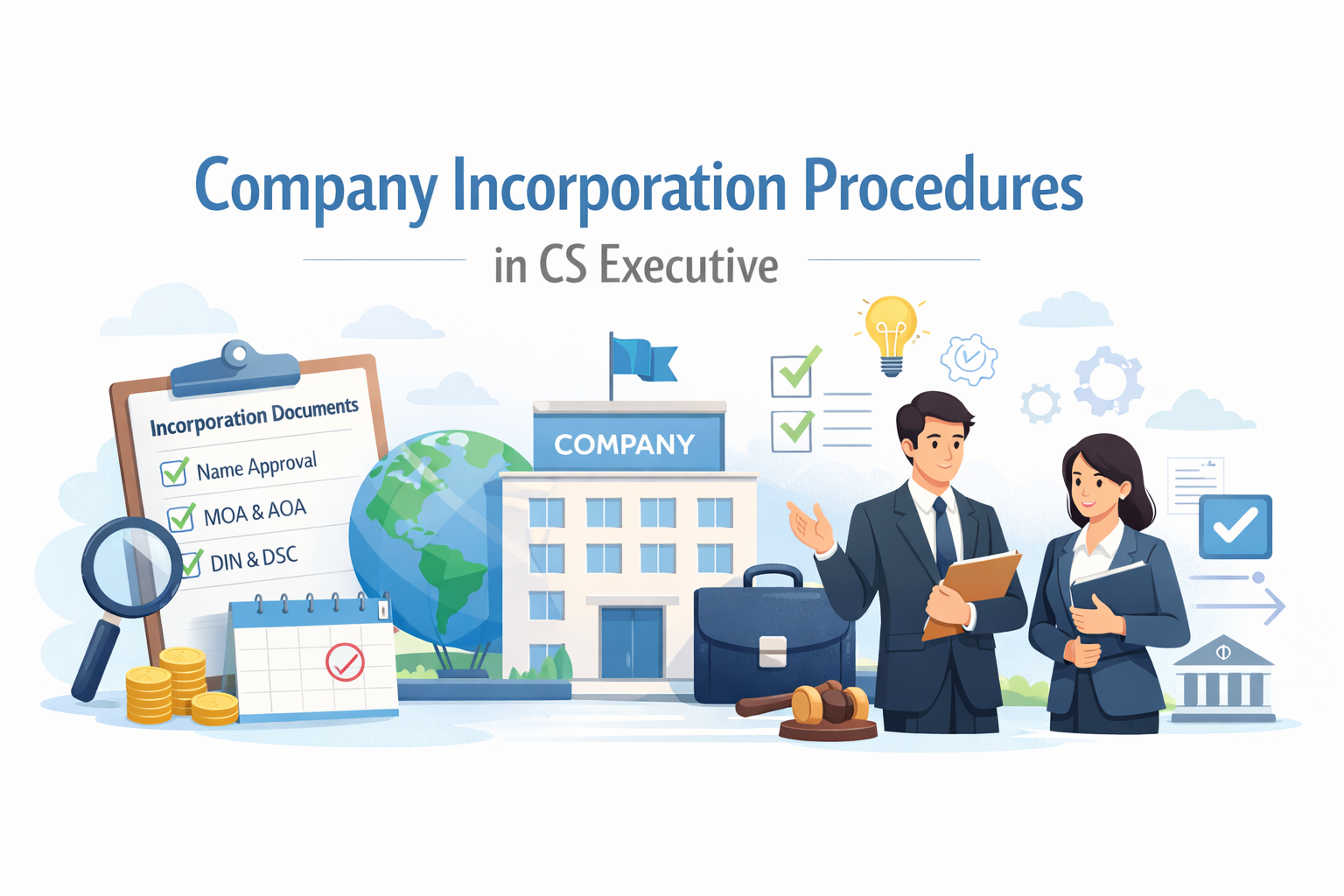
In the Executive Examination level, the company's inclusion in the CS Executive subject is a very important subject. Understanding how a company is formed under the Companies Act, 2013, is required for each student who is chasing the CS course. Below, we have explained important documents such as the incorporation stages, the MOA, the AOA CS, and the new Spice+ Forms.
In this guide on company incorporation processes in CS Executive, we will discuss the entire process step-by-step. After pre-incorporation requirements, subsequent compliance will be clearly explained and in simple terms. Its purpose is to understand and make it useful for your studies as well as future practice.
Company Incorporation in CS Executive
In the CS Executive, the company incorporation refers to the process of legally forming a company under the Companies Act, 2013, which is studied in the CS Executive Course. This process involves legal structure, necessary approval, presenting the correct documents, and understanding the registration stages.
Students who are preparing for the exam should clearly understand how companies in India are registered using the traditional form-wise approach or the integrated Spice+ Form. Understanding these procedures helps students to create a strong foundation in corporate law.
Types of Companies Under the Incorporation
According to the Companies Act, 2013, companies can be divided into different types, which are important to understand company incorporation for a CS executive:
- Public Company: At least 7 customers and 3 directors are required.
- Private Company: At least 2 customers and 2 directors are required
- One-person company (OPC): only 1 person is required as both customer and director
- Small company: Private companies come under the category, but with simple rules.
- Section 8 Company: Works for charitable or non-profit purposes.
The CS executive includes another classification in the company incorporation:
- Company Limited by Shares
- Company limited by guarantee
- Unlimited company
Pre-Incorporation Requirements
Before filing the incorporation form, some details and documents should be arranged. This phase is called the pre-pre-recession phase.
| Requirement | Details Needed |
| Proposed Name of the Company | At least two unique names following MCA naming rules |
| Registered Office Address | Proof of office, such as an electricity bill, rental agreement, or ownership deed |
| Directors’ Details | Identity proof, address proof, and DIN (Director Identification Number) |
| Digital Signature Certificate | Needed for e-filing forms on the MCA portal |
| Draft MOA & AOA | Memorandum and Articles of Association in electronic form |
Important Documents of Company Incorporation in CS Executive
When starting a company, two major documents are required, known as the MOA and AOA CS:
1. Memorandum of Association (MOA)
- The MOA is like the company's rule book, outlining what it can and cannot do.
- This includes important segments such as
- Name segment
- Registered office section
- Commodity block
- Liability section
- Capital segment
- Customer segment
- Nominee section (only for OPC)
2. Articles of Association (AOA)
- AOA is the internal rule book for the company's daily operations.
- It defines the powers and duties of the directors and the manner in which meetings should be held.
- In the company's incorporation in CS Executive, students learn that the AOA should follow the MOA and cannot go beyond its scope.
Two Important Methods of Incorporation
When a business decides to include it, there are usually two common approaches that it can follow. Each method has its own process and legal implications.
A) Stagewiz Form Filling
Step 1: Get Digital Signature Certificate (DSC): The first director(s) should receive a DSC. It is used to sign online documents.
Step 2: Apply for Director Identification Number (DIN): A DIN is like an ID card for a director. It should be applied using the prescribed forms.
Step 3: Name approval: Using the Spice+ Form, the proposed name of the company should be approved by the ROC.
Step 4: Draft MOA and AOA: As previously discussed, the MOA and AOA CS should be prepared and signed.
Step 5: Filing Corporation Form: These forms include the company name, office address, director, and more. In terms of the traditional route, different forms such as INC-1, INC-7, INC-22, and Dir-12 are used.
Step 6: Certificate of Correction: After reviewing all the details, the ROC issues a certificate of incorporation. This document proves that the company is now registered.
Step 7: CIN allocation: Once included, the company receives a corporate identity number (CIN), which is its unique ID.
B) Integrated Form-Spice+ (First INC-29)
Spice+ is an online form that is used for quick company registration. It covers several processes in the same stage.
- The Spice+ Form replaces many old forms, such as Dir-3, INC-2/7, Dir-12, and INC-22.
- Only one name can be proposed.
- Three directors can apply for DIN in the same form.
- The MOA and AOA are to be attached digitally.
Documents Attached to the Application
While filing the incorporation form, several documents are connected to support the information given. Some of these include:
- Proof of identification and residence for all directors and customers
- Evidence of registered office (utility bill, rent agreement, or ownership proof)
- NOC from property owner (if rented campus)
- Passport-shaped photos directors
- Digital signatures of customers and professionals certifying forms
Each document should be correct and updated, as even a small mistake may lead to rejection of the resume.
Fees & Stamp Duty
Correction involves payment of government fees and stamp duty. The amount depends on the authorized share capital and the state in which the company is registered.
ROC filing fee—based on capital slab
Stamp Duty—The state varies from the state payable on the MOA, and the AOA varies from the state.
Additional Fee - Digital Signature Cost and Professional Fee. For CS executive students, it is important to learn how to calculate these costs as part of practical training.
Certificate of Incorporation
Once all the documents and fees are deposited, the registrar reviews the application. If everything is in order, the company is issued a certificate of incorporation. This document serves as proof that the company is legally formed and can commence its operations.
The certificate also has a corporate identity number (CIN), a unique number given to each corporation. In addition, PAN and Tan can also be allocated during the procedure.
Mistakes are avoided in the incorporation
Many applications face delays due to small errors. There are some common mistakes to avoid:
- Choosing a name similar to existing companies
- Presenting old documents as proof
- Drawing of MOA or AOA
- Signature missing required forms
- ROC is not answering questions quickly
Paying the right preparation and attention to help avoid these issues.
Why Choose CS Exam Test Series for CS Preparation
When it comes to preparing for the hard CS exams, choosing the right test series can make all the difference. csexams.in has emerged as a trusted and result-oriented platform for CSEET, Executive, and Professional-level aspirants. Here's why it should be your first choice:
- Trusted by Thousands of CS Aspirants: The CS Exam has built a strong reputation among CS students for its consistent quality and excellent student feedback.
- ICSI Pattern-Based Question Papers: All tests are strictly based on the latest ICSI exam pattern and syllabus, ensuring real exam-like practice.
- Timely Evaluation with Expert Feedback: Get your answers evaluated within 48–72 hours along with detailed feedback, a marking scheme, and improvement tips.
- Personalized Mentorship & Study Planner: Get personalized mentorship, performance tracking, and a daily study plan customized to your syllabus completion pace.