In this article (14)
- CSEET Business Communication paper pattern at a glance
- The four syllabus units and what they mean on paper
- How the ICSI sample paper is set, question by question
- Choosing your five questions in the exam hall
- Drafting formats you must be able to write without thinking
- A two month plan for Paper 1
- Common mistakes in the Business Communication paper
- Frequently asked questions
- Is CSEET Business Communication subjective or MCQ now?
- When is the CSEET Business Communication paper in February 2027?
- How many questions do I have to answer in CSEET Business Communication?
- What are the passing marks for CSEET?
- Which drafting formats come in CSEET Business Communication?
- Is there reading time in the CSEET Business Communication paper?
The CSEET Business Communication paper is no longer a set of MCQs on a screen. Since the June 2026 session it is a 3 hour written paper of 100 marks, and in the February 2027 CSEET it is the first paper, on Monday 1 February. If you have been preparing from old online quizzes, this is the paper where your method needs to change the most.
Latest update (18 Nov 2026): the next CSEET is on 1 to 4 February 2027 on the new ICSI pattern (three written papers and one OMR paper). Registration for the June 2027 CSEET is open till 28 February 2027.
| CSEET 2027 | Details |
|---|---|
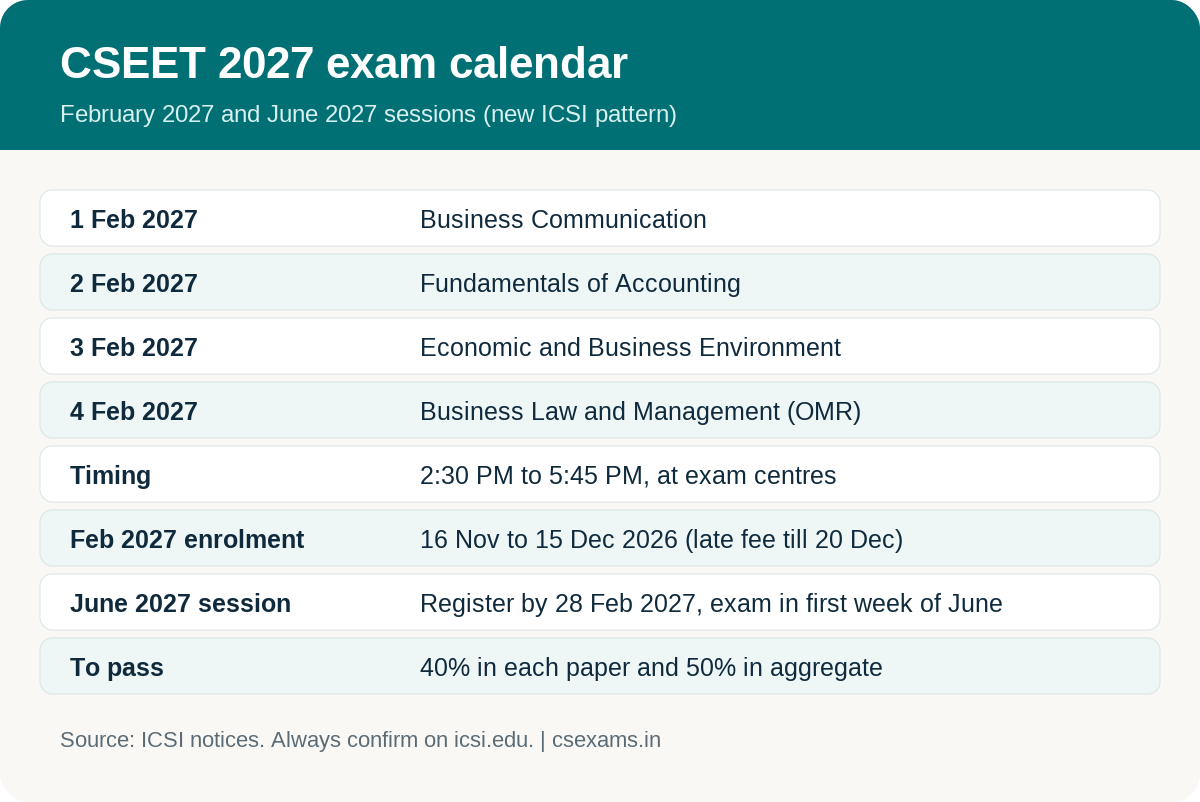
| CSEET Feb 2027 exam | 1, 2, 3 and 4 February 2027, 2:30 PM to 5:45 PM, at exam centres |
| Papers | Business Communication, Fundamentals of Accounting, Economic and Business Environment, Business Law and Management (OMR) |
| Feb 2027 enrolment | 16 Nov to 15 Dec 2026 (late fee 16 to 20 Dec 2026) |
| Admit card | Expected in the third week of January 2027 on icsi.edu |
| CSEET June 2027 | Registration till 28 Feb 2027, enrolment 16 Mar to 15 Apr 2027, exam in the first week of June 2027 |
| To pass | 40% in each paper and 50% in aggregate |
Practise on the new pattern with our CSEET test series for February 2027, with written answers checked by Company Secretaries.
Always confirm dates on the official ICSI website, icsi.edu.
This guide explains the CSEET Business Communication paper pattern as ICSI has set it in its sample question paper, what each question is really testing, and a practical way to prepare in the time left before February.
CSEET Business Communication paper pattern at a glance
ICSI restructured the CSEET from the June 2026 session. The test is now held at exam centres over four days, and three of the four papers are written. Business Communication is Paper 1.
| Point | What ICSI has set |
|---|---|
| Paper | Paper 1: Business Communication |
| Date in the February 2027 session | Monday, 1 February 2027 (day 1) |
| Marks | 100 |
| Type | Subjective (written answers) |
| Time | 3 hours, plus 15 minutes to read the question paper |
| Passing rule for the CSEET | At least 40% in each paper and 50% aggregate across all four papers, in one sitting |
| Carry forward of marks | Not allowed: no paper-wise exemption at the CSEET |
The aggregate rule is the part students forget. A comfortable 65 in Business Communication gives you room in Fundamentals of Accounting or Economic and Business Environment. That makes this paper a scoring opportunity, not just a qualifying hurdle. For the full four day structure, read our CSEET exam pattern page.
The four syllabus units and what they mean on paper
The restructured syllabus says the paper tests "essentials of English Grammar and critical aspects of Business Communication" at the basic knowledge level. It has four units. ICSI does not give a percentage weightage for each unit, so the sample paper is the best guide to how marks are spread.
- Essentials of Good English: parts of speech, tenses, voice, articles, punctuation, synonyms and antonyms, idioms and proverbs, abbreviations, common errors, sentence correction and rearrangement, comprehension and summarising.
- Communication: principles of business communication, written, oral and visual channels, communication networks, digital media such as email and video conferencing, listening, barriers, etiquette, public relations, advertising and legal issues like data privacy and defamation.
- Business Correspondence: business letters, positive, negative and persuasive messages, office orders, circulars, memoranda, MIS reports, email writing, and meeting documents such as notices, agendas, minutes and action taken reports.
- Common Business Terminologies: financial and non-financial terms as used in laws, rules and regulations.
If you want a topic by topic reading list, our post on important Business Communication topics for CSEET covers that. The rest of this guide is about the paper itself.
How the ICSI sample paper is set, question by question
ICSI has published a sample question paper for Paper 1. Its shape tells you more than any guess. Question 1 is compulsory and carries 20 marks. You then answer any five of the remaining seven questions, each worth 16 marks, for the other 80.
| Question | Marks | What it tested in the sample paper |
|---|---|---|
| Q1 (compulsory) | 20 | Short case situations and theory: types of communication, listening skills, public relations |
| Q2 | 16 | A passage with ten one mark MCQs on comprehension, grammar and prepositions, plus a descriptive answer on virtual meetings |
| Q3 | 16 | Idioms, proverbs, spellings, adjectives, conjunctions and abbreviations, plus short theory on barriers and agendas |
| Q4 | 16 | A formal letter to a bank, essentials of a business letter, an office memorandum |
| Q5 | 16 | Theory on social media, courtesy at the workplace, government email policy |
| Q6 | 16 | Sentence rearrangement, redundancy, voice change, word choice, matching terms with meanings, elements of MIS |
| Q7 | 16 | Drafting a notice and a business report, features of email |
| Q8 | 16 | Minutes of a board meeting, an email asking for a quotation, communication networks |
Two things stand out. First, drafting appears in at least three of the optional questions: letter, memo, notice, report, minutes and email. Second, the grammar and vocabulary items are still there, but now as short parts inside a bigger question. A sample paper is not a promise of the real one, yet it is the clearest signal ICSI has given.
Choosing your five questions in the exam hall
The choice of five out of seven is where marks are won or lost. Use the 15 minutes of reading time to mark each optional question as strong, possible or skip. Most students who lose time here do so because they start writing the first question that looks familiar and then get stuck on its last part.
- Pick questions where you can write every part. A question with one weak 4 mark part is still fine if the other 12 marks are safe.
- Prefer drafting heavy questions if you have practised formats. A clean notice or set of minutes scores steadily because the examiner can see the structure at once.
- Do grammar heavy questions early, while you are fresh. Small errors creep in when you rush them at the end.
- Give roughly 30 to 33 minutes to each 16 mark question and about 35 minutes to Question 1. Keep 10 minutes to read through.
Drafting formats you must be able to write without thinking
Drafting is learned by writing, not by reading model answers. Each format below should come out of your pen in the right order on the first try.
- Business letter: sender's address, date, inside address, subject line, salutation, body in short paragraphs, complimentary close, signature block.
- Office memorandum: heading, reference number, date, to, from, subject, message, initials. No salutation.
- Notice of a meeting: company name, type of meeting, date, time, venue, agenda items, by order of the board, place and date, signature of the Company Secretary.
- Minutes: serial number of the meeting, date, time and place, members present, chairperson, quorum, items discussed with resolutions, signature line for the chairperson.
- Business report: title, to and from, date, terms of reference, findings, recommendations, signature.
- Email: clear subject line, greeting, purpose in the first line, short body, call to action, sign off with name and designation.
A useful habit: whenever a question gives you a situation, underline the names, dates and amounts it mentions and make sure every one of them appears in your draft. Examiners often check for exactly those details.
A two month plan for Paper 1
From late November you have about nine weeks to 1 February. Business Communication needs less time than Accounting, but it needs regular writing. Around 45 minutes a day is enough if you keep it steady. Fit it into your overall CSEET February 2027 preparation plan.
| Weeks | Focus | Daily output |
|---|---|---|
| 1 to 2 | Grammar, vocabulary, common errors from the ICSI study material | One exercise set and ten idioms or terms |
| 3 to 4 | Communication theory: channels, networks, barriers, listening, etiquette | Two short theory answers of 4 to 6 marks |
| 5 to 6 | All drafting formats, two per day | One letter or memo and one notice, minutes or report |
| 7 | Common business terminologies and comprehension passages | One passage and twenty terms |
| 8 to 9 | Full papers under exam timing | Two to three complete papers, then fix the mistake list |
Full papers in the last two weeks matter more than any extra reading. They show you whether you can finish five questions and Question 1 in three hours with handwriting that stays readable.
Common mistakes in the Business Communication paper
- Writing theory answers as long paragraphs. Use short points with a one line explanation each, as the marks are usually split by point.
- Missing the subject line or date in a letter or email. These are easy marks and often the first thing an examiner looks for.
- Answering all seven optional questions halfway. Only five are counted, and half answers rarely add up to full ones.
- Ignoring the reading time. Fifteen minutes of planning saves far more than fifteen minutes later.
- Practising only MCQs from old CSEET sets. The written format needs written practice.
If you want your drafts and theory answers checked against ICSI's pattern, our CSEET test series has full written papers marked by Company Secretaries, and you can compare options on the plans page. For the official sample paper and syllabus, see the ICSI announcement on the restructured CSEET.
Frequently asked questions
Is CSEET Business Communication subjective or MCQ now?
From the June 2026 session it is a subjective written paper of 100 marks and 3 hours. Only Business Laws and Management is an OMR paper in the restructured CSEET.
When is the CSEET Business Communication paper in February 2027?
It is the first paper of the February 2027 session, on Monday 1 February 2027.
How many questions do I have to answer in CSEET Business Communication?
In ICSI's sample paper, Question 1 is compulsory for 20 marks and you answer any five of the other seven questions, each worth 16 marks.
What are the passing marks for CSEET?
You need at least 40% in each of the four papers and 50% in aggregate, all in one sitting. Marks cannot be carried forward to a later session.
Which drafting formats come in CSEET Business Communication?
The syllabus and sample paper cover business letters, office memoranda, circulars, notices, agendas, minutes, reports and emails.
Is there reading time in the CSEET Business Communication paper?
Yes, each paper of the restructured CSEET gives 15 minutes to read the question paper before the 3 hours of writing time.
Practise what you just read